Not another “Student dies after exam failure” headline – Please
_vb_28.jpeg)
A heart-breaking incident has come to light from Bengaluru, where a 14-year-old boy studying in 7th grade took his own life after writing a painful suicide note. The words he left behind were so raw, so piercing, they could break even the toughest of hearts. His parents, respected figures in society and artists by profession, are now left shattered, as are all of us. Despite such a background, how did this tragedy happen? Who should be held responsible? These questions hang heavy in the air, with no easy answers.
Let’s face it, something is seriously going wrong around us. And we aren’t talking about it enough.
In recent years, suicides, especially among children and young people have been increasing at an alarming rate. Many experts point to the growing economic crisis in the country as a major contributing factor. Add to that rising unemployment, financial insecurity, work pressure, and overuse of mobile phones all of which are making people, particularly the youth, feel trapped and hopeless. Depression, which is still largely misunderstood and untreated, is slowly suffocating an entire generation.
But here’s the real question: why are tender children, who haven’t even begun to experience life, deciding to end theirs?
What kind of pressure is weighing on their little hearts? If we, as a society, continue to ignore these questions, then we must question our humanity itself.
According to the Government of India’s data, more than 35 children die by suicide every single day. In 2020 alone, 12,521 children died by suicide. In 2021, the number rose beyond 13,000. And in most of these cases, the cause was said to be exam failure. Every year, as SSLC and PUC exams approach, students begin to feel intense anxiety and stress. The expectations on them from schools, parents, and society become too much to bear. We’ve seen these headlines again and again: Student dies by suicide after failing exam. And each time, the system quietly closes the file and moves on. But who is really at fault?
Why should a failed exam cost a child their life? How much responsibility lies with the school system, the parents, and the society that constantly pressures them? Why is there no serious discussion on this?
If a child dies because of the pressure of exams, the school management and the parents must be held accountable. It’s time society changed its attitude towards students, both those who succeed and those who struggle. A failed student is not a failed human being. They don’t deserve to be ignored, judged, or humiliated. They need support, not shame. They need hope, not hopelessness.
Let’s not forget, our current education system is almost entirely exam-centric. Add to that the attitude of some parents who treat marks as a matter of life and death. That combination can be fatal. Children are being taught that their worth is tied only to numbers on a mark sheet. This is not education. This is pressure-cooking young minds.
Then there’s the issue of mobile phones. In many homes, toddlers are being handed phones to keep them busy. This habit grows and takes over their minds. Children today are spending hours online, exposed to violent content, self-harm videos, or dark thoughts that they cannot process. Without proper supervision or awareness, their emotional well-being is left to the mercy of the internet. Some even fall into the trap of cyberbullying, online blackmail, or threats. Out of fear, many children don’t tell their parents. They try to handle it alone and sometimes, that burden is too heavy.
Easy access to narcotic substances is also becoming a concern, especially among school and college students. It may begin out of curiosity or peer pressure but can quickly spiral into dangerous territory.
Earlier, family time used to be a space for emotional connection. Today, in many households, both parents are busy with jobs, and the child is left alone. Even in nuclear families, friction and fights between parents leave emotional wounds on children. Parents may not realise it, but children absorb everything, the tension, the arguments, the lack of love.
So, let’s be very clear. Saying “what stress do kids even have?” is not only ignorant, it is dangerous. Children do feel stress. It may not look like adult stress, but it is real. Parents need to spend time with their children. Not just to instruct or discipline them, but to listen, to understand, to connect. What children need more than anything else is affection, patience, and a sense of safety.
They must know that even if they make mistakes, they can come to their parents. That they won’t be scolded, but heard. That their emotions won’t be dismissed as silly. What may seem small or trivial to an adult could feel like a mountain to a child.
If a child brings up issues of bullying in school or misbehaviour by teachers, take them seriously. Parents should make it a point to stay in touch with teachers, attend school meetings, and monitor the environment their child is in. Every child has something special within them. It’s the duty of the parents to help them find it, not force their own dreams on them. A parent must be the child’s biggest support, not their biggest fear.
A child’s mind is like glass, that is fragile, clear, and beautiful. If stones are being thrown from all sides, parents must become the wall that shields it. Not the stones that break it.
There is no single solution to prevent child suicide, but one thing is certain that the role of parents, schools, and society cannot be ignored. Children need more than marks and medals. They need to be heard, understood, and loved without conditions. Parents must be present, schools must be sensitive, and society must stop glorifying success at the cost of a child’s peace of mind. We need to talk, listen, and care, not after tragedy strikes, but before. Because we cannot afford to wake up one more morning to see yet another cold, lifeless line in the news “Student dies after exam failure.” Not another headline like that - please.
Let the Truth be known. If you read VB and like VB, please be a VB Supporter and Help us deliver the Truth to one and all.
Lt Gen NS Raja Subramani to be India's next Chief of Defence Staff
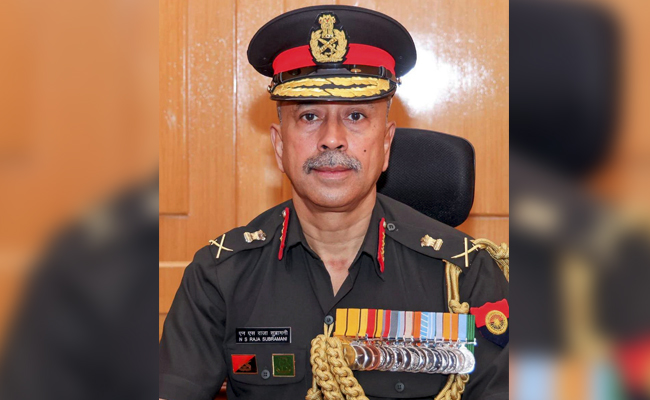
New Delhi (PTI): Lt Gen NS Raja Subramani will be India's new Chief of Defence Staff (CDS) and his key task is set to be to implement the ambitious theaterisation plan that seeks to ensure tri-services synergy.
He will succeed Gen Anil Chauhan whose tenure will come to an end on May 30.
Gen Chauhan, a former Eastern Army Commander, took charge as the country's senior-most military commander in September 2022, over nine months after the first CDS, General Bipin Rawat, died in a helicopter crash in Tamil Nadu.
The government has appointed Lt Gen NS Raja Subramani (Retd) as the Chief of Defence Staff, who will also function as the secretary of the Department of Military Affairs, the defence ministry said on Saturday.
Lt Gen Subramani is currently serving as the military adviser to the National Security Council Secretariat.
Prior to that, he was the Vice Chief of the Army Staff from July 1, 2024 to July 31, 2025, and was General Officer Commanding-in-Chief of the Central Command from March 2023 till June 2024.
As Chief of Defence Staff, Lt Gen Subramani's primary task will be to implement the theaterisation model to bring in tri-services synergy by rolling out integrated military commands.
The officer is a graduate of the National Defence Academy and the Indian Military Academy. He was commissioned into the eighth battalion of the Garhwal Rifles on December 14, 1985.
Lt Gen Subramani is an alumnus of Joint Services Command Staff College, Bracknell (UK), and the National Defence College, New Delhi. He holds a Master of Arts degree from King's College London and an MPhil in defence studies from Madras University.
In his illustrious career spanning over 40 years, Lt Gen Subramani has served across a wide spectrum of conflict and terrain profiles and tenanted a host of Command, Staff and Instructional appointments.
He commanded the 16 Garhwal Rifles in Counter-Insurgency operations in Assam as part of Operation Rhino, the 168 Infantry Brigade in Jammu and Kashmir, and the 17 Mountain Division in the Central Sector, all during a challenging operational environment.
He also has the distinction of commanding two Corps, including the Indian Army's premier strike Corps on the Western Front.