Political interference compromising credibility of higher offices
Recent developments have cast doubts on the integrity of higher offices. The government, in its need to make things work according to its whims, has been blatantly interfering with the functioning of the various offices thus leading to erosion of their reputation. This discussion started when Modi govt made use of Army for political purposes. This trend is entirely new to India that a government would shield itself behind Army and prompt Army officers to speak good about the ruling dispensation.
Eventually, things reached a stage where the keepers of law, justices sitting in supreme court, had to register their apprehensions against the CJI. If the legal system loses its objectivity, how far behind are other agencies? Who would protect democracy if the very pillar of democracy collapses? Supreme court didn’t manage its neutral image well even when the Vice President rejected impeachment charges. Petitioners had argued that since this case was about questioning the neutrality of CJI, he should not be allowed to choose members of the bench to hear this matter. The petition was withdrawn since the most basic tenet of law was broken by the CJI.
This has raised many doubts about the functioning of the Supreme Court that has to uphold democracy and has compromised the very foundation of this country’s most important pillar of functioning. This has not just cast aspersions on the functioning of highest office of legal system in the country, but the parliament has also failed in bringing most pertinent issues to discussion and frame new policies to safeguard the sovereignty of the country.
For instance, Lok Sabha worked for only 33.6 hours among 28 days during budget session, and could pass only 2 bills in the 14 minutes it could find to pass. The 2018-19 budget was passed without any discussion. Speaker denied permission for the opposition parties to show no trust vote against the BJP. PM Modi has to ensure the discussions happen among his colleagues. But on the contrary, he and his cabinet members had staged a day-long dharna opposing the non-coperation of opposition parties.
Ironically enough, this was some gesture to overcome criticism against his authoritarian behaviour. Now, the government is literally running without a finance minister since some time. The thinkers within BJP are ruing the state it has reached within the government. Though Reserve Bank would ideally form economic policies, it gave its complete concurrence to central government to demonetize currency notes in the recent past.
About 99% of the currency was returned to the banks. But about 100 people had lost lives in the meantime. The country still continues to suffer the result of demo on the country’s economy. The Election Commission has to work neutrally without any black spots on its name if democracy has to work to the best of its abilities. But in the recent past, whether it is postponing Gujarat elections or disqualifying AAP MLAs without hearing their case, EC has been proving it is after all a caged parrot who sings the tune of its owner. The saving grace was Delhi high court which heard the case and cancelled the earlier order of disqualification.
Deemed as independent, many agencies have been compromised with as far as their functioning goes. For instance, since the Chennai High Court couldn’t decide on the legality or the lack of it, of disqualification of 18 MLAs, it seemed like the government was running its show illegally. Now Chennai High court gave a mixed verdict. Hence, the whole matter has now reached a quagmire. In a democratic set up, when all else fails, one can always rely on judicial system to serve justice. But with even judicial system being compromised on, we surely are living in those dark days of undeclared emergency.
Let the Truth be known. If you read VB and like VB, please be a VB Supporter and Help us deliver the Truth to one and all.
KSRTC introduces gender ticketing in buses across Kerala
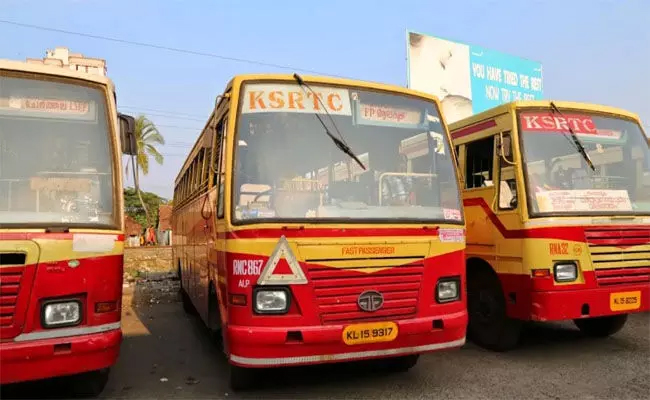
Thiruvananthapuram (PTI): The KSRCTC on Saturday began implementing gender ticketing in buses operating across the state.
According to a Kerala State Road Transport Corporation (KSRTC) circular issued on Friday, the gender ticketing system is intended to record whether a passenger is a woman, a man or a child in tickets issued on KSRTC buses from Saturday.
To facilitate the system, Electronic Ticketing Machines (ETMs) have been updated.
The circular stated that conductors in all KSRTC depots should record the gender category of passengers while issuing tickets through the ETMs.
Options for women, men, and children have been included in the ETMs to identify passenger categories when issuing tickets.
The printed tickets generated by the ETMs will also indicate the passenger's category, officials said.
The UDF had promised free KSRTC travel for women across the state during the Assembly election campaign.
UDF, which won 102 of 140 seats, would soon form the government after the Congress party finalises the discussion on the next Chief Minister.
The introduction of gender ticketing is being viewed as an effort to estimate the number of women travelling daily on KSRTC buses before implementing the poll promise.
Some conductors have reportedly raised concerns over the additional time required to record passenger details, especially during rush hours.