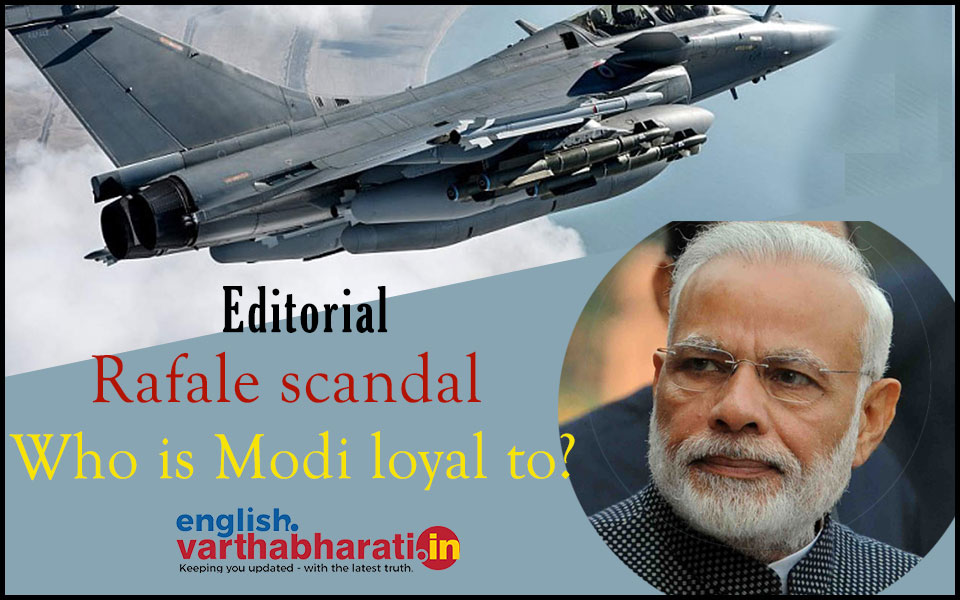
Rafale scandal: Who is Modi loyal to?
Modi and his men seem to think that it is a huge success and a ‘clean chit’ given to them that an investigation of an alleged scam has been evaded at the outset. Supreme Court has dismissed the petition to probe into Rafale scam under the supervision of court.
Which means, the court has said it would not interfere with the matter and has hence specified its limitations in its jurisdiction. The court’s statement does not come after any investigation carried out by the Supreme Court. And the Team Modi is using it to pull wool over people’s eyes as it always does.
They are using this statement by the Court to defend themselves. They have been telling people that the court has absolved them of all corruption charges and that the court called it a clean deal, or something to that effect.
Many leaders including those from within the BJP and opposition parties have said Rafale Scam is many times bigger than the Bofors scandal. Through this scam, the government tried to axe the chances of HAL which has been bolstering and providing for the nation’s defence needs, and attempted to promote a non-entity in this sector such as Reliance.
This deal was clearly to offer advantage to Ambani family and his business, even at the cost of compromising on national security. These are the charges Modi is facing right now. His statement of palming off the blame of introducing Ambani into the deal was by Dassault Aviation has fallen flat with former President of France Hollande who said India specified the defence partner and they just went with the choice.
Even after all this, Narendra Modi government did not allow an investigation to take place. Bofors is nothing when compared to this Rafale deal which amounts to Rs one lakh crore.
Opposition parties are levelling serious charges that Modi has thrown all caution, policies and legal frameworks to wind to accommodate the interest of his corporate friends and beneficiaries. The Modi government has been issuing conflicting statements about this issue and misguiding the Parliament.
At some point, this government had said the deal was finalized by the UPA government when it was in power. The last UPA government had planned to buy 126 jets to bolster the Airforce from French company Dassault. Congress government which had faced a lot of embarrassment in case of Bofors, had taken enough care to ensure such mistakes do not repeat themselves over here.
Hence it had formed committees of experts to ratify the deals and specific issues. The committees had to submit their recommendations before the deal was finalized. Hence, the scrutiny was close at every stage.
This is how UPA planned to take the Rafale decision before buying 126 fighter jets. But everything turned topsy turvy with Modi government. The agreement that was reached during UPA was to buy jets at a cost of Rs 670 cr per unit, after long discussions that were held in 2012.
According to that, 18 jets would be bought from France and the rest of 108 jets would be assembled at Hindustan Aeronautics Limited. And in the meantime when the governments changed, the CEO of Dassault Company came down to India to hold discussions in 2015. He declared the talks were finalized and the agreement was closed to start the work.
But in order to offer profits to a corporate capitalist, PM Modi ignored the defence ministry and finalized the deal with his own specific terms and conditions. HAL was kept out and Reliance, a novice in defence sector, was the new shining partner in this deal.
Modi is credited with meddling with CBI since the office began to show interest in investigating the Rafale deal. The tiff between Alok Verma and Asthana was just a pretext this government needed. Asthana was the central government’s mole in CBI who informed the centre that Verma was interested in probing this deal. Latter was sent on compulsory leave. The centre has been successful in ensuring even the SC sings its tunes. But the SC statement is filled with contradictions.
The verdict says “The price fixing details of jets have been discussed with CAG and the PAC has scrutinized it. Only part of this scrutiny has been published in Parliament and public websites”. But the PAC has already said CAG report has not reached it yet.
Hence, the question arises about whether the SC was misguided and misinformed on the whole thing? Whatever that be, if Modi is honest in his intentions, why should be fear an investigation? Can he not come out unblemished and innocent from all this? It is his duty to regain the trust and faith of the nation. If the SC cannot probe this, this should be handed over to JPC. Since this is the question of country’s safety and security, Modi has to prove whether he is loyal to Reliance or to the country.
Let the Truth be known. If you read VB and like VB, please be a VB Supporter and Help us deliver the Truth to one and all.
BJP, TMC hail SC directions on counting of votes for West Bengal polls
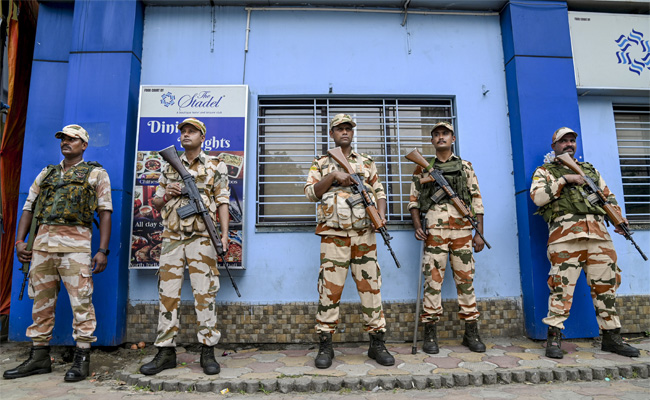
Kolkata (PTI): The BJP and TMC on Saturday both hailed the SC directions on the Election Commission's circular over the deployment of central government personnel for vote counting in West Bengal.
The apex court on Saturday said no further order was necessary on the TMC's plea challenging the Calcutta High Court's dismissal of its petition against the April 13 circular.
In a social media post, BJP leader Amit Malviya said, "In yet another legal setback, the Supreme Court has refused to intervene. The Trinamool Congress had approached the court challenging the exclusion of state government employees from vote-counting supervisor duties, and had sought an urgent hearing."
"The refusal to entertain this plea underscores a clear message -- attempts to influence or cast doubt over the integrity of the counting process will not find easy validation. Another day, another judicial rebuff for Mamata Banerjee," he added.
The TMC, however, claimed that the SC directions vindicated its stand.
"The issue raised before the Hon'ble Supreme Court pertained to the implementation of the said communication in a manner whereby only Central Government/Central PSU employees were being appointed as Counting Supervisors and Counting Assistants for counting of votes," the party said in a statement.
The TMC said it was highlighted that such an interpretation and implementation of the communication would be contrary to the framework of a fair and balanced counting process.
"After hearing the parties, the Hon'ble Supreme Court directed that Clause 1 of the communication dated 13.04.2026, relating to the appointment of Counting Supervisors and Counting Assistants, must be read along with the salient feature contained in the second page of the said communication, which provides for random selection of both State Government and Central Government employees," it said.
"The Hon'ble Supreme Court has further recorded the undertaking of Mr Dama Seshadri Naidu, learned Senior Advocate appearing for the Election Commission of India that the said communication shall be followed in its letter and spirit," it added.
The TMC said that in view of the directions, it is expected that the counting of votes shall be conducted in a fair, transparent, and balanced manner.
A special bench of Justices P S Narasimha and Joymalya Bagchi said the EC can choose the counting personnel, and its April 13 circular, which provides for deployment of state government employees as well, cannot be said to be incorrect.
The poll body said the apprehensions of TMC of any wrongdoing are misplaced, as the circular very clearly states that there will be a mix of central and state government employees.
The EC assured the court that the circular would be implemented in letter and spirit, and there would be state government employees also during the counting of votes on May 4.
Polling for the 294-member West Bengal assembly was held in two phases -- April 23 and April 29. The counting of votes will be taken up on May 4.
On April 30, the Calcutta High Court dismissed the TMC's petition against the Election Commission circular, saying there was no illegality in the poll panel's decision to appoint counting supervisors and assistants from Central government and Public Sector Undertaking (PSU) employees, instead of the state government staff.