Self-inflicted issues rocking coalition govt
The current congress is a fine example of attempts for early harvest without even giving the crop time to grow. The govt is a coalition of JD(S) and Congress. It came into existence under duress and as a result of anxiety that BJP and JD(S) may come together to claim their right over forming the govt. All this hurried coming together is showing its impact now. There were two main reasons for this hurried coming together. One was to keep BJP away from the seat of power. Second was to keep former CM Siddaramaiah away from the power centres of Congress. The latter reason was a lot more important to leaders within the congress since the party had become synonymous with his identity. The preparation for this had started even before the elections were announced. The failure of Siddaramaiah was more of a result of Congress conspiracy than the attempts made by leaders within the BJP.
HD Kumaraswamy, the declared antagonist of Siddaramaiah, was made CM for the same reason without even negotiating on any terms and conditions. Politically, giving up the chair of CM to JD(S) and make HDK the CM, with mere 37 seats, was not a well-calculated decision. Even worse is to believe that HDK will remain CM for all five years of his term since Congress is not too clear about this within the party lines. Amid all this, the dissidence has started within Congress with Jarkiholi brothers being unhappy with the treatment they were meted out since the formation of the govt. While Congress is writhing over this, BJP has used this opportunity to start on operation Kamala. They are just looking for a tender spot to start the surgery of destruction.
BJP has not forgotten the humiliation it had to undergo around the time of forming the government. Hence it is keeping a close watch on the developments within coalition partners. If there is a crack in the relationship of Cong and JD(S), the possibilities of JD(S) and BJP coalition government before the next Lok Sabha elections. Hence, the possibilities of coalition cannot be ruled out for sure. BJP has to secure all its forts in states to ensure Modi returns to the seat of PM in 2019. Hence, the party is willing to purchase MLAs at any cost. The party is waiting for such a weak moment to surface sooner than later.
With all these realities around, JD(S) and Congress have to reach a workable equation to ensure things work to people’s benefit. Kumaraswamy cannot always hold Congress to ransom over having BJP as a choice. This cannot work for a long time. JD(S) has already paid a heavy price for having done this musical chair for politics in the past. Devegowda and his sons have repeatedly regretted and cried in public, apologising over having practiced politics like this.
The recent complications within Congress have prompted BJP to believe it can make a headway into the situation. The Belgaum politics has had a direct impact on the government. On the outset, though the coalition looks like a result of being a convenient arrangement to avoid communal forces from clinching power. But the whole government set up stands on money and muscle power. Siddaramaiah is in the equation only for name sake. The whole responsibility of coalition equation rested on the shoulders of D K Shivakumar.MLAs were held together with money power. Or else, many would have jumped over to the BJP side owing to money itself.
The same moneyed politicians are responsible for the complications that have cropped up within Cong. Jarkiholi brothers have been at logger heads with the govt from the beginning. It was the responsibility of coalition partners to take them into confidence. Satish Jarkiholi has been working not only though his strong economic background but also owing to his social commitment as well. He comes from grassroots and from a marginalized caste. Congress shouldn’t have ignored his cautions. The party felt he wouldn’t jump the fence for whatever reasons and hence the issue grew out of control. Though a coalition partnership forces everyone to camouflage their small grudges, people often show it at a time when the moment is apt for the show.
Siddaramaiah does not have the numbers to show his mite, neither the money nor the backing of other factors. He can never stage dissidence. But he is using the situation as per his convenience. The disgruntled MLAs have put Siddaramaiah before them to show their dissidence. This is a momentary show. No sooner are their demands met, they’ll soon stop their show and move on with other things. They’ll then side with DKS. But Siddaramaiah cannot be held directly responsible for the dissidence that has arisen out in Congress. DK Shivakumar needs to make his moves like a statesman, and not with the confidence that money or muscle power can bring. It is his need too, that the government remains in power. He has to engage in talks with the dissenting MLAs, setting aside his personal glory. JD(S) also needs to understand the responsibility and the stakes it has in ensuring govt remains in power with its partner, to create a level of confidence among people. This may give at least two years of life for coalition govt. Just about enough to save its reputation.
Let the Truth be known. If you read VB and like VB, please be a VB Supporter and Help us deliver the Truth to one and all.
KMES Institutions shine in SSLC result, continue four-decade legacy of education in rural Karkala
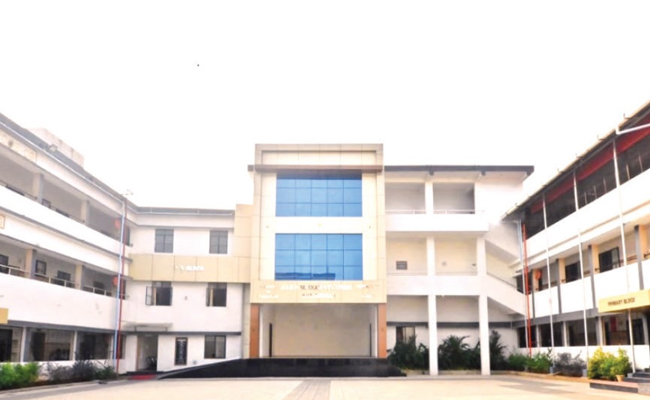
Karkala: KMES Institutions of Education at Kukkundooru in Karkala taluk has recorded outstanding results in the 2025-26 SSLC and PUC examinations, continuing a four-decade educational journey that began with just 22 kindergarten students and no building of its own.
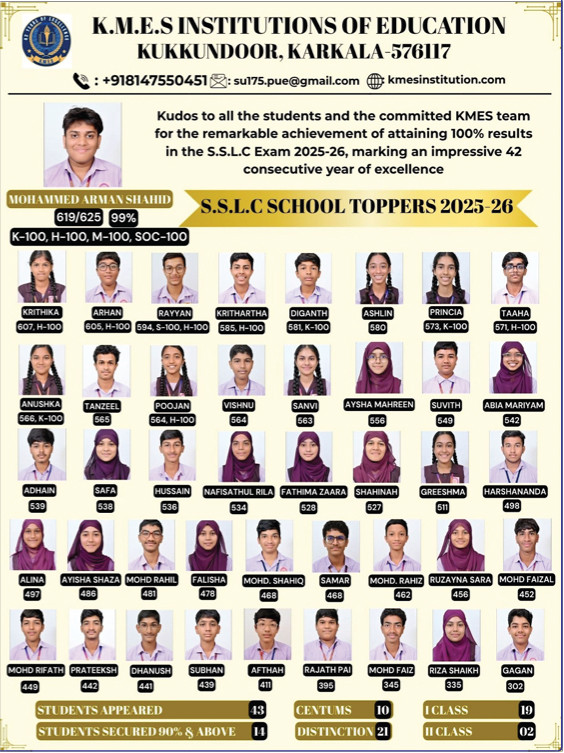
The institution secured a 100 per cent result in the SSLC examinations, with all 43 students passing the examination this year.
Muhammad Arman Shahid emerged as the school topper by scoring 619 marks out of 625, securing 99 per cent and also ranking sixth at the state level. He scored full marks in Kannada, Hindi, Mathematics and Social Science.
Krithika V. Nayak secured the second position in the school with 607 marks and 97.12 per cent, while Arhan stood third with 605 marks and 96.8 per cent.
Out of the 43 students, 21 passed with distinction, 19 secured first class, two students obtained second class and one student passed in third class. Fourteen students scored above 90 per cent.
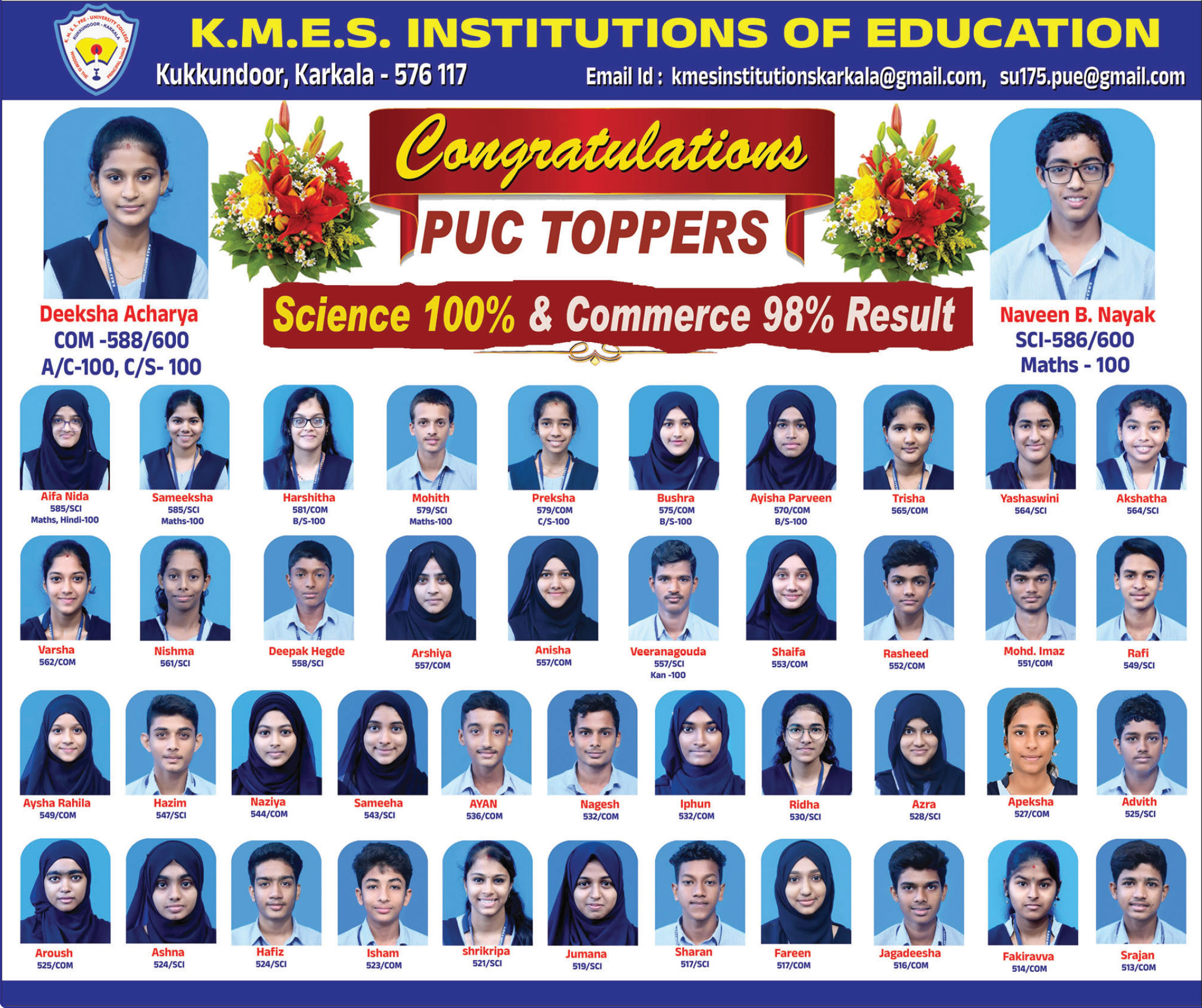
The institution also performed strongly in the PUC examinations. The Science stream recorded a 100 per cent result, with all 44 students passing, while Commerce secured a 98 per cent pass percentage.
Twelve students scored full marks in different subjects, including Mathematics.
In Commerce, Deeksha Acharya topped the college with 588 marks, while Harshitha H. Kini secured the second position with 581 marks.
In Science, Naveen B. Nayak emerged as topper with 586 marks, followed closely by Sameeksha Moily and Aifa Nidha, who both secured 585 marks.
Speaking about the achievement, High School head teacher Shrimati Patkar said the institution has always focused on supporting academically weak students through affordable education and free special classes.
“Our ambition is to provide quality education even to students who struggle in studies. The fees are very low, and free coaching classes are conducted. I have worked here for 28 years and have always found the atmosphere supportive of education,” she said.
Primary School head teacher Lolita Zeena D’Silva appreciated the dedication of the teaching staff and said the school encourages students not only to achieve high marks but also to become role models.
PU College Principal Balakrishna Rao said the institution focuses on value-based education and overall personality development.
“The aim is to help students succeed not only academically but also in cultural activities, sports and leadership. We encourage qualities such as patience, tolerance and discipline,” he said.
Rao also credited the institution’s growth to the support of founders K.S. Mohammed Masood and K.S. Nissar Ahmed, along with President K.S. Imtiaz Ahmed.
Speaking on the occasion, Imtiaz Ahmed said the institution was built on the dream of making quality education accessible to financially backward families in rural areas.
He said the guidance and encouragement of his elder brothers, Mohammed Masood and Nissar Ahmed, along with the contribution of teachers, students and parents, helped transform the institution into a model educational centre.
The KMES Institutions trace their roots back to 1984, when they were founded by senior social activists Haji P.M. Khan, K.S. Nazeer Ahmed and Haji A.S. Rashid Haider.
The institution initially functioned from the Government Urdu School premises as it did not have a building of its own. Classes began with only 22 students in lower kindergarten and two teachers.
Later, under the leadership of K.S. Mohammed Masood and with continuous financial and moral support from non-resident businessman K.S. Nissar Ahmed, the institution gradually expanded.
In 1993, the school shifted to its own building and began conducting classes from LKG to Class 5.
As student admissions increased, Nissar Ahmed personally funded the construction of three additional classrooms to address infrastructure shortages.
The institution’s new school building was completed in 1997, while the PU College building was constructed in 2001.
From humble beginnings in a borrowed building to producing state-level rank holders and consistent academic results, the KMES Institutions have grown into one of the prominent educational centres in the Karkala region.