Supreme Court shouldn't fail people's trust

Supreme Court is the lone pillar that can uphold the democracy under all circumstances because it can always insist on measures that can rectify to set the country on the track of democracy when legislative or executive goes on a different track.
The court has to caution the government when when it does not work to uphold the democratic values. After Narendra Modi's NDA government came into power, people are forced to place all their hopes on Supreme Court decisions to uphold their interest.
Misuse of Election Commission, interference in CBI and Army, series of fake encounters in Gujarat, reservation etc, there are way too many issues that are awaiting a final sentence by SC to reach conclusion while upholding democracy.
These are the issues that will decide the future of the country. Apart from all those that cases, just as the government's decisions are coming under scanner, the cases that are reaching the doorstep of Supreme Court are increasing rapidly. Now under such circumstances, if there is a situation where the supreme court's credibility becomes questionable, who would save the democracy of the nation?
This question is not being raised by general public, but by persons who held the most responsible position in the Supreme Court, a justice has such concerns now.
Former justice Joseph Kurien has made these observations and this seems to be a case of the fence eating the crop.
In a recent statement to the media, Kurien has said Justice Deepak Misra was influenced by external elements in the recent times and that was detrimental to the Supreme Court since the highest legal institution seemed to have lost track with respect to some very significant cases. One cannot dismiss those words as the rant of a retired person. He had revealed these facts with his colleagues even when he was serving in the court.
This was made evident in a press conference some of the justices held on earlier occasion. This wasn't a personal grouse one held against another colleague. Few of Dipak Misra's colleagues had voiced their concern to the chief justice himself when he held the office. Their main complaint was that Misra was handing over very significant cases to some junior judges without any experience in handling them.
When Misra didn't heed to their words, they were forced to call a press conference. It was for the first time in the history of Supreme Court and the country that such a press conference was held ever.
Politically too, this press meet had created some ripples and Misra seemed to have rectified his stand after that only to some extent, as per Kurien.
Kurien has made another explosive statement now.
His allegation is that Misra was being influenced by external forces.
But he is hesitant to reveal the sources of those ‘forces’. However, guessing what those forces' could be, is anybody's guess.
While people trusted Supreme Court could control the unhindered run of politicians, justice Deepak Misra kneeled before the very legislative.
A weakened judiciary is the reason behind unhindered and unhesitant execution of dictatorial conduct and implementation is unconstitutional measures by Narendra Modi government.
If some of the judges hadn't spoken against this, the future would have been even more scary. If a person who occupies the highest post in judiciary becomes subservient to the ruling dispensation?
And how does one have faith that they'd be served with justice when the Prime Minister works to his convenient and not by the book.
If the other judges had kept silent, future would have been darker than we'd like to assume. At the same time anti constitutional forces are getting bolder with time in India. At a time like this, Kurien's allegations have shows a new reality that doesn't look very bright.
At the same time if Supreme Court also gives anti-constitutional viewpoint through it's judgements, there might be judgements that would even be against the very constitution we believe in.
Manusmriti might take the place of constitution in the coming days using the judiciary route. A sword of fake encounter is hanging on the neck of PM's Man Friday. But for him to be punished, the judiciary needs to retain its independence. If not, people on the guise of policeman may commit murders and Judiciary may be forced to offer their respects to him. Ram Janma Bhoomi and Babri Masjid are the big bones of contention to the country. No one can serve justice to this case except for supreme Court.
At the same time, allegations on the court by a former justice are not very bright. Anybody who cares for democracy needs to come together now to create awareness among people about Misra's leniency towards some particular ideology which is against the spirit of law and constitution. Through this, we also need to uphold the values of democracy.
Let the Truth be known. If you read VB and like VB, please be a VB Supporter and Help us deliver the Truth to one and all.
Nine dead as fire breaks out in residential building in east Delhi
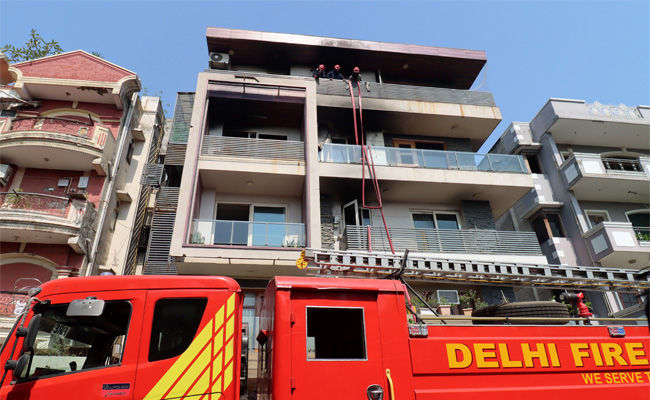
New Delhi (PTI): A fire broke out in a residential building in east Delhi's Vivek Vihar early Sunday, leaving nine people belonging to two families dead, including a toddler, officials said.
The incident was reported around 3.48 am at a four-storey building in Vivek Vihar Phase-I, following which police, fire and disaster management teams rushed to the spot.
According to the police, the blaze engulfed flats on the second, third and fourth floors of the building, prompting a large-scale rescue operation.The cause of the fire is yet to be ascertained.
The Delhi Fire Service (DFS) said nine charred bodies were recovered from different floors.
ALSO READ: Tribals, Scheduled Castes preserved India's identity and soul despite foreign invasions: Bhagwat
"One body was recovered from the first floor, five from the second floor and three from the staircase which was found locked," the DFS officer said.
Those found dead on the second floor have been identified as Arvind Jain (60), his wife Anita Jain (58), son Nishant Jain (35), daughter-in-law Anchal Jain (33) and grandchild Akash Jain.
On the third floor, three members of a family were found dead. They were identified as Nitin Jain (50), wife Shailey Jain (48) and son Samyak Jain (25).
On the first floor a woman identified as Shikha Jain (45) was found dead while her husband Naveen Jain (48) sustained injuries.
A senior police officer said, "Around 10 to 15 people were rescued from the premises during the firefighting operation. Two of them, who sustained minor injuries, were shifted to the Guru Teg Bahadur Hospital."
A total of 12 fire tenders were pressed into service to douse the flames, while teams from the Delhi Disaster Management Authority (DDMA), traffic police and local police assisted in the rescue and evacuation efforts.
Police said the fire was brought under control after several hours. Efforts are underway to determine the cause of the fire, police said.
Further investigation and proceedings are underway.