The tongue that showed non-cooperation to the Cooperation Minister
VB Editorial | August 14, 2025 |
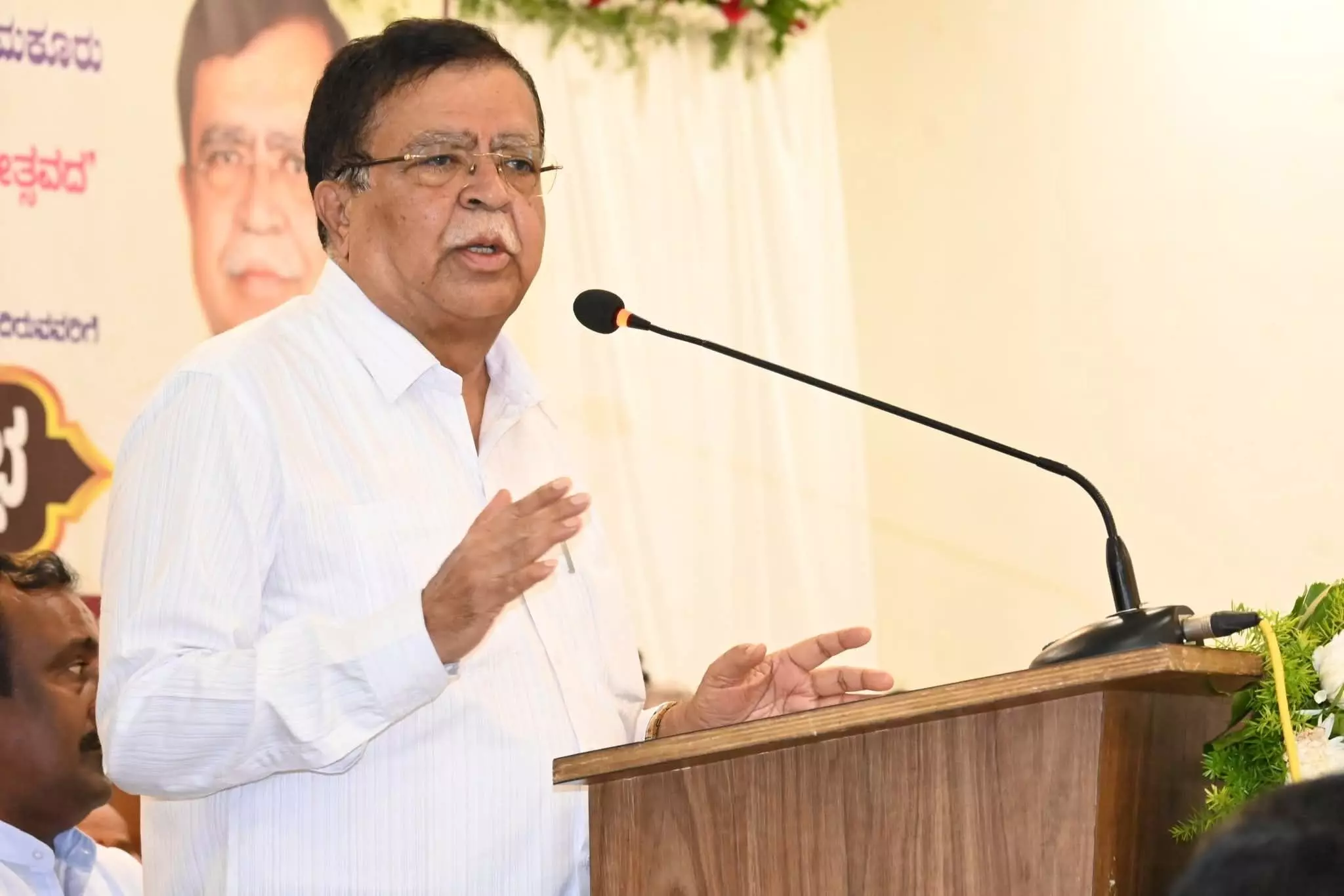
There is a saying: “An old root and a new sprout make a beautiful tree.” In politics, senior leaders are expected to be those roots, deep, steady, and guiding the party through storms. Their long experience should strengthen the organisation, not weaken it. But in the Congress today, that very idea seems to have turned upside down. Instead of standing as pillars of strength, many seniors have turned into burdens, creating more embarrassment than support.
Take the case of S. M. Krishna. Once a towering figure who served as Chief Minister, Union Minister, and Governor, he left the Congress in his final years claiming neglect, only to end his career making bitter statements against the very party that gave him everything. Even after joining the BJP, he found no real honour. The same story played out with leaders like Pranab Mukherjee and Ghulam Nabi Azad, who used the Congress like a banana leaf, useful only until it was discarded. Now, Shashi Tharoor too seems to be leaning towards that path.
In contrast, Rahul Gandhi, despite facing ridicule and setbacks, has remained committed to the party’s ideology. With the Bharat Jodo Yatra and relentless campaigns, he has tried to inject new life into the organisation. While some seniors pull the party backwards, Rahul struggles to push it forward.
It is largely due to Rahul’s persistence that “vote theft” has become a subject of national debate. From Madhya Pradesh to Maharashtra, from Karnataka to Bihar, he has highlighted the manipulation of electoral rolls and the complicity of the Election Commission. In Bihar especially, the scale of irregularities has alarmed the nation, with even the Supreme Court expressing concern. At such a crucial time, when democracy itself seems at risk, Congress leaders across states should be rallying behind him. Instead, Karnataka’s Cooperation Minister, Rajanna, chose to display his non-cooperation.
His loose remarks, questioning Rahul’s allegations, handed the BJP an unexpected weapon. The irony is sharp: at a moment when the opposition should have spoken in one voice, a minister from within broke ranks and weakened his own party. Rajanna’s statement has not only embarrassed Congress but also placed his own ministerial post on the chopping block.
Even if his intention was not to target the high command, Rajanna cannot claim ignorance of how his words would be twisted. When the very institution of the Election Commission is accused of undermining democracy, it was his duty as a minister to lend his voice to the struggle, not fuel the fire of dissent. Instead, he dug a pit for himself — and now finds BJP leaders stretching a false hand of sympathy to pull him out.
The opposition has predictably seized on his statement. Both Houses have witnessed heated arguments over whether Rajanna should be sacked, with BJP leaders crying hoarse that he has been made a scapegoat. Their hypocrisy is glaring. This is the same BJP that mercilessly silences its own leaders, MLAs, journalists, activists, and even police officers when they dare to speak the truth. Their newfound compassion for Rajanna is nothing more than political theatre.
At the same time, the episode raises questions about Congress’s internal democracy. Some argue that Rajanna’s freedom of speech should be respected. But freedom of speech inside a party cannot extend to giving ammunition to political opponents when the battle is over saving democracy itself. This is not the first time Rajanna has made remarks that hint at sympathy for the BJP. In the past, the party tolerated him. This time, however, his words struck directly at the high command, and at Rahul Gandhi’s fight against electoral fraud.
Rajanna’s rhetorical question, “What was the state government doing when irregularities were happening?”, might have been aimed at Karnataka Congress leaders. But its impact went far beyond, undermining the larger national struggle. Anyone with political maturity would know that the Centre can engineer manipulation through the Election Commission regardless of which party runs a state government. Bihar is proof enough.
Internal debates within a party are natural. But there is a time and place for everything. Rajanna chose the wrong time, wrong place, and wrong words. Whether his motive was carelessness or deliberate sabotage, the outcome is the same: he has damaged both himself and his party.
It is indeed unfortunate that another minister from the Valmiki community has had to step down. But in this case, Rajanna has no one else to blame. His fall came not from his opponents, not from the BJP, not even from the Congress high command, but from his own tongue.
Let the Truth be known. If you read VB and like VB, please be a VB Supporter and Help us deliver the Truth to one and all.
Real Madrid fines Valverde and Tchouaméni half a million euros each for altercation

Barcelona (AP): Real Madrid slapped players Federico Valverde and Aurélien Tchouaméni with half-a-million-euro ($588,000) fines on Friday for their altercation during practice.
The massive fines came a day after the midfielders tussled when the team trained. Valverde said in a post on social media on Thursday that no punches were thrown. But Valverde knocked his head on a table and he suffered a small cut that required a brief hospital visit.
On social media, Valverde initially called it a “meaningless fight” with a teammate and said “everything has been blown out of proportion."
His employers, however, considered it a significant enough breach of team discipline to nail both Valverde and Tchouaméni with fines that bite even the bank account of a top soccer player. The half-a-million euro penalties reflect the reputational damage the club was enduring in a chaotic end to a disappointing season.
In a statement, the 15-time European champion said its disciplinary action was concluded after both players expressed to the club “their complete remorse for what happened and apologized to one another.”
Madrid added they also apologized to their teammates, the coaching staff and club supporters, as well as showing their willingness to accept whatever disciplinary action the club deemed “opportune.”
Tchouaméni was back training with Madrid on Friday, two days before they play at Barcelona in a clasico. Madrid has to win otherwise Barcelona will be crowned La Liga champion.
After being notified of the fine, he posted a public apology to the club and its fans on social media.
“What happened this week in training is unacceptable,” Tchouaméni wrote. "I say this while thinking about the example we are expected to set for young people, whether in football or at school.
“Above all, I am sorry for the image we projected of the club.”
Valverde was not at practice due to the head knock.
Both players are set to play in the World Cup next month, with Tchouaméni playing for France and Valverde for Uruguay.
Chaotic end to a poor season
===================
The run-in between the players, who for seasons have played side by side in Madrid's midfield, came after they argued this week in previous training sessions. But tempers boiled over on Thursday. Spanish media was rife with reports that the players previously disagreed over the club's decision to let coach Xabi Alonso go after just months on the job.
It was not the only altercation involving Madrid players during training this week. Álvaro Carreras confirmed he was in a “minor” incident with a teammate. Spanish media said he and fellow defender Antonio Rüdiger got into a scuffle.
Álvaro Arbeloa, the coach who was promoted from Madrid's reserve team when Alonso was fired in January, will face tough questions on what went wrong inside the changing room when he gives a press conference on Saturday ahead of the clasico at Camp Nou.
Madrid is facing a second consecutive campaign without a major trophy amid rumors in the Spanish media that club president Florentino Pérez is considering bringing back Jose Mourinho to straighten out his underperforming team.