Today’s Farmers are Tomorrow’s Migrant Labourers!
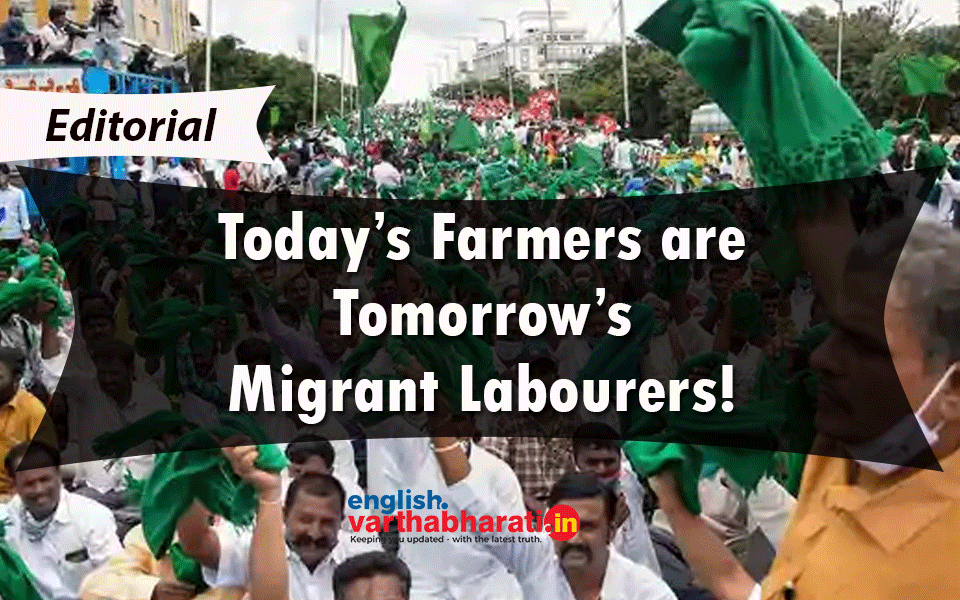
The images of hundreds of labourers all across the country walking from cities back to their villages in blistering heat without food and water and having lost their livelihoods in the aftermath of the nation-wide lockdown declared by the Modi government is still haunting the nation. The pathetic life of labourers in the unorganized sector in India was thus unraveled. The health scare created by Covid-19 soon turned into a humanitarian crisis. The lockdown also witnessed a tragedy of enormous proportions when 16 labourers relaxing on railway tracks on their way back to their villages died when a train ran over them. Now, when a series of anti-farmer laws are being implemented, we need to remember the trials and tribulations of these migrant labourers.
In India, farmers suffer losses and migrate to cities and towns to work as laborers. The final outcome of the recent agricultural laws that are being hurriedly implemented will be that of farmers handing over all their lands to corporates and becoming daily wage laborers or farmers selling their lands to the rich, losing their money, migrating to cities, and becoming ‘anonymous laborers’ without an identity of their own and becoming a part of the mass. True, these laborers don’t have a country or government to call their own or fall back on because the government has already declared that there is no need to keep a count of their lives or deaths.
Last week, responding to a question on migrant laborers in the Lok Sabha, Labour and Employment Minister Santosh Kumar Gangwar stated that the government does not have any data on the number of migrant laborers who either died or were wounded when they were returning to their villages during the lockdown. This stand of the government reiterates the fact that the government is not interested in taking any responsibility for the plight of migrant laborers.
According to a report by a Non-Governmental Organization (NGO), as many as 971 laborers died en route their hometowns in the first two months of the imposition of lockdown. This report confirms that these deaths did not occur due to the Coronavirus. Of these deaths, 96 deaths occurred in Shramik trains, 209 people died in accidents, and 216 died due to economic distress.
The distress that these migrant laborers experienced post-lockdown was the most dreadful. The Labour Ministry issued a statement in Parliament that more than 1.04 crore migrant laborers returned to their respective home states. This despite the fact that data is not available for states including Karnataka, Chhattisgarh, Orissa, and others.
According to other estimates, the number of laborers who returned to their villages has crossed two to three crore. Most importantly, nobody seems to have any information about the fate of these laborers who returned to their villages from the cities. How did these villages accept these migrant laborers? There are no answers to questions about whether these villages have been liberal enough to accept these laborers who first faced neglect due to their caste and class and now after the outbreak of the Coronavirus. Migrant laborers are neither accepted by cities where they work nor do they belong to villages. Due to this, they are deprived of government benefits both in their villages and the cities.
The government does not seem to have data on the migrant laborers in the country either. In the last week of May, the Central Government stated that about four crore migrant laborers are engaged in different occupations in various parts of the country, of whom more than 75 lakh have reached their villages and towns through trains and buses. The Economic Survey-2017 estimated that the country has about six crore inter-state migrant laborers and eight crore inter-district migrant laborers.
Even as the migrant laborers working in other states or those who have returned to their homes are in a quandary, the Centre is trying to implement ‘labor reform laws’ that are actually snatching the rights of migrant laborers belonging to the unorganized sector. At the same time, anti-farmer laws are also being introduced. All these are bound to increase the number of daily-wage laborers and migrant laborers. In addition, it will uproot the existence of small and marginal farmers in rural areas.
If the state of these laborers, who form the backbone of all developmental and construction projects in urban areas, is not improved, Modi’s Atmanirbharatha will remain a mere slogan. If the legislation that is trying to morph farmers as laborers, suffocating them, and pushing them towards daily wage labor are not withdrawn, nothing can prevent their alienation in the country.
Let the Truth be known. If you read VB and like VB, please be a VB Supporter and Help us deliver the Truth to one and all.
Lt Gen NS Raja Subramani to be India's next Chief of Defence Staff
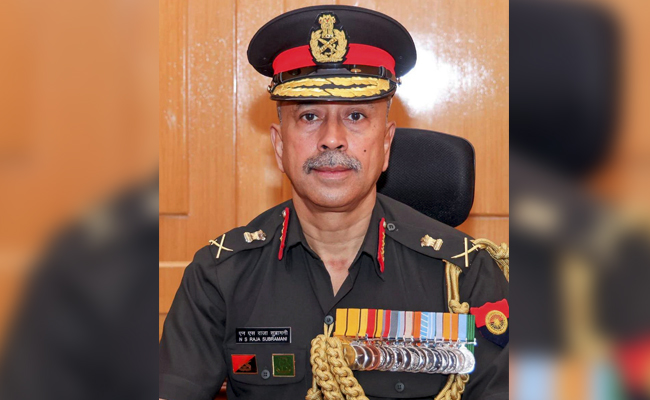
New Delhi (PTI): Lt Gen NS Raja Subramani will be India's new Chief of Defence Staff (CDS) and his key task is set to be to implement the ambitious theaterisation plan that seeks to ensure tri-services synergy.
He will succeed Gen Anil Chauhan whose tenure will come to an end on May 30.
Gen Chauhan, a former Eastern Army Commander, took charge as the country's senior-most military commander in September 2022, over nine months after the first CDS, General Bipin Rawat, died in a helicopter crash in Tamil Nadu.
The government has appointed Lt Gen NS Raja Subramani (Retd) as the Chief of Defence Staff, who will also function as the secretary of the Department of Military Affairs, the defence ministry said on Saturday.
Lt Gen Subramani is currently serving as the military adviser to the National Security Council Secretariat.
Prior to that, he was the Vice Chief of the Army Staff from July 1, 2024 to July 31, 2025, and was General Officer Commanding-in-Chief of the Central Command from March 2023 till June 2024.
As Chief of Defence Staff, Lt Gen Subramani's primary task will be to implement the theaterisation model to bring in tri-services synergy by rolling out integrated military commands.
The officer is a graduate of the National Defence Academy and the Indian Military Academy. He was commissioned into the eighth battalion of the Garhwal Rifles on December 14, 1985.
Lt Gen Subramani is an alumnus of Joint Services Command Staff College, Bracknell (UK), and the National Defence College, New Delhi. He holds a Master of Arts degree from King's College London and an MPhil in defence studies from Madras University.
In his illustrious career spanning over 40 years, Lt Gen Subramani has served across a wide spectrum of conflict and terrain profiles and tenanted a host of Command, Staff and Instructional appointments.
He commanded the 16 Garhwal Rifles in Counter-Insurgency operations in Assam as part of Operation Rhino, the 168 Infantry Brigade in Jammu and Kashmir, and the 17 Mountain Division in the Central Sector, all during a challenging operational environment.
He also has the distinction of commanding two Corps, including the Indian Army's premier strike Corps on the Western Front.