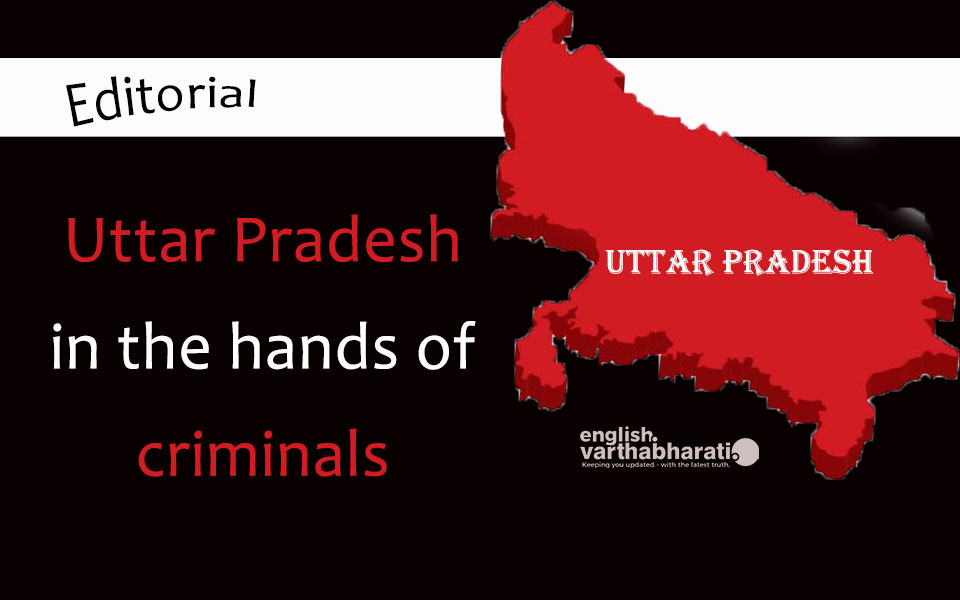
Uttar Pradesh in the hands of criminals
There was a time, when states like Uttar Pradesh and Bihar were known a ‘jungle raj’. Robberies and dacoities were common on streets, on trains and any space used by general public.
People would fear going out in the night. Even the police department had a notorious reputation those days since common public who went to stations seeking justice or to lodge a complaint, would never be unsure if they’d return alive. Police officers were under the control of zamindars. Citizens had to fear the criminals on one hand and the police, on the other. In the recent days, looks like this situation has returned and this time around, it has gone from frying pan to the fire.
At a time when general public would be scared of anti social elements; now, even the Bihari police have to fear the criminals. The police who watched the lynching of Akhlaq on the pretext of him having stored beef (which turned out to be a false allegation later) are now the target of criminals. This is somewhat like the story of a tiger who tasted human blood. Those who love the smell of blood won’t decipher between the blood of commoners or that of the police.
As a proof of the fact that Sanghi goondas have completely taken over the law and order system in Uttar Pradesh, another police officer has been murdered. Even when the lynching of one police officer at Bulandshahr is still fresh on people’s mind and the investigation is yet to progress, another police constable has been done to death in an incident of targeted stone pelting.
The constable was on his way home from duty, when death came calling. As usual, the UP CM has hardly spoken about this. This is an open challenge that the goondas have posed to the police department in UP.
Irony is, if they were mere rowdies, they would have been killed in staged encounter by now. The police who could mercilessly shoot and kill the Dalits like stray canines, when they staged protests, killing rowdies is no big deal really.
But they are helpless in UP. Because the ones who killed the cops are not mere rowdies, but political activists in the guise of keepers of culture. And they even have the silent concurrence of the CM of this state. To act against them is to act against the CM or the entire political system itself.
Which is why, saving their own life is a big deal for the police there beyond catching the culprits. This is contributing a lot to the increasing criminal activities in UP. The police are forced to share a very cordial relationship with the criminals owing to the political support the latter possess.
They can move the police to any place if the latter do not dance to their tunes. If that’s not possible, the conventional mode of punishing such as murder, is an easier option for the goondas who are given clean chit by someone as big as the CM Yogi Adityanath.
His statement will not condemn the killing, but merely call it an ‘accident’ and hand it over to the investigating agencies to delay things further. This has given the culprits major boost to continue on killing spree after the Bulandshahr incident.
This indirectly encouraged the next murder both these incidents are warnings issued by the Sangh Parivar to the police department in UP. A report says such blatant ‘cautions’ have increased after the recent killings to indicate ‘this would be the fate of everyone who’d defy us’.
Sangh goondas are getting a major impetus with this and this is working very badly on the morale of the law implementing agencies. How would the police ever perform their job if they are threatened for simply imparting their duties? That the goondas enjoy political support is another matter altogether.
With these murders, the criminals are on the way to totally take control of the law and order situation in UP. None of the oral instructions seem to be working at all. Recently, retired officers had written to CM Adityanath and had implored him to uphold the duty of public office, by ensuring that the situation is free from threat for the officers to perform their duties.
But considering the political background of Adityanath, these things do not seem to materialize in UP yet. Because the CM himself assumed power by way of hate speech and mob leading mentality. How can he instruct the officers to act against his own men? The President needs to intervene for UP to come under control. Either the CM has to resign, or the government needs to be dismissed and the President rule needs to be imposed.
Let the Truth be known. If you read VB and like VB, please be a VB Supporter and Help us deliver the Truth to one and all.
AIITA welcomes Karnataka’s ban on obscene songs in school events
Bhatkal: The Karnataka unit of the All India Ideal Teachers Association (AIITA) has welcomed the Karnataka government’s decision to strictly ban school children from dancing to obscene songs during educational and cultural programmes in government, aided, and private schools across the state.
AIITA Karnataka State President M. R. Manvi congratulated the government for taking what he termed an important step to preserve the sanctity of education.
“Such decisions to safeguard the dignity of school children and uphold the values of education are the need of the hour. This rule should not be limited to government schools alone but must be strictly implemented in all private educational institutions as well,” he said.
He further urged the government to address other concerns within school programmes.
“The government should not only prohibit obscene dances in the name of school anniversaries, but also ensure that plays and dialogues that incite religious hatred are avoided. Schools should be centres of harmony, not platforms for spreading hatred,” he added.
According to a recent circular issued by the Department of School Education and Literacy, obscene dances are adversely affecting the mental health and moral values of students.
In this regard, schools have been advised to use songs that promote nationalism, positive thinking, the greatness of Kannada culture, and value-based traditions instead of inappropriate content during programmes.
The circular also emphasises that students should be dressed in decent attire.
AIITA also backed the department’s warning that disciplinary action would be taken against head teachers if such guidelines are violated. The association has further demanded that district Deputy Directors of Public Instruction strictly monitor the implementation of these rules.