Vacant govt jobs: When will they be filled?

Narendra Modi government came into power assuring generation of two crore jobs. It has been more than four and a half years ever since, and even twenty lakh jobs were not generated in these many years, annually.
In an attempt to cover up for this lack, BJP president Amit Shah has vented ire on illegal immigrants. He says they are usurping the jobs meant for Indian youths. This is sheer illogical reasoning to pull the wool on the eyes of voters.
In the run up to 2019 elections, he has said all the illegal immigrants would be deported, and that the country was home to over 100 crore of them. That means, a hundred crore people would be sent out of the country if BJP comes to power again.
The government had drawn up a list of forty lakh people calling them illegal immigrants in Assam. Many of them were born and had even their many generations of ancestors living there, with them possessing all necessary documents such as Aadhar Card, Passport and bank accounts.
In the list, some members of families were termed illegal while the others were perfect citizens of the country. Hence if Modi comes to power again in 2019, the government may not even have to create jobs since 100 cr people would be pushed out of the country. Forget what happens in the future, why did the Modi government not create two crore jobs as promised prior to polls?
This government couldn’t create even ten lakh jobs annually. None of the promises have been fulfilled. Be it about black money, inflation, looters fleeing the country, mob lynching and in some cases, government encouraged communal clashes to cover for its lack of administration.
As per the recent reports, about 24 lakh jobs are lying vacant in various state governments. More than six lakh vacancies lie in police dept. Railway and Anganwadi vacancies run into few lakhs. Health and armed forces also have thousands of vacancies thus lagging the whole system down.
On the other hand, number of unemployed youths is increasing with every passing day. Even graduates want to be chaprasis if it’s a govt job. The government has turned a blind eye to all this.
The President of the ruling party talks about illegal immigrants to cover for everything that they failed at achieving. Our PM speaks about making India the global leader, and bhakts get delirious at it. The reality, however, is different.
There are hardly any teachers in the schools that prepare tomorrow’s citizens. Though there are lakhs of qualified people, they are not being recruited to fill vacancies. The government has put the whole country’s future in line to serve its ‘corporate’ friends.
Even the law and order situation is going from bad to worse. No recruitments are happening in police department either. The currently serving ones are managing more than their capability to deliver.
Postal department has more than fifty thousand vacancies and the people there are overworked. If someone asks about these numbers, the PM talks about becoming entrepreneurs by making pakodas. Union Minister Nitin Gadkari says govt cannot provide jobs.
Shah says immigrants took away all jobs. Sangh Parivar leaders advise hindu women to have more kids. But they have no answers as to who’d pay for their development and jobs for their livelihood.
At least now the govt has to wake up from its slumber and recruit people for jobs. Lok Sabha elections are coming close. Recruiting people in phases would do good to both the unemployed and government administration. Rajasthan and Chattisgarh polls are drawing close. The government should fill the vacancies at the earliest to better the functioning of the government machinery.
Let the Truth be known. If you read VB and like VB, please be a VB Supporter and Help us deliver the Truth to one and all.
Deputy CM Shivakumar announces property ownership drive in Bengaluru
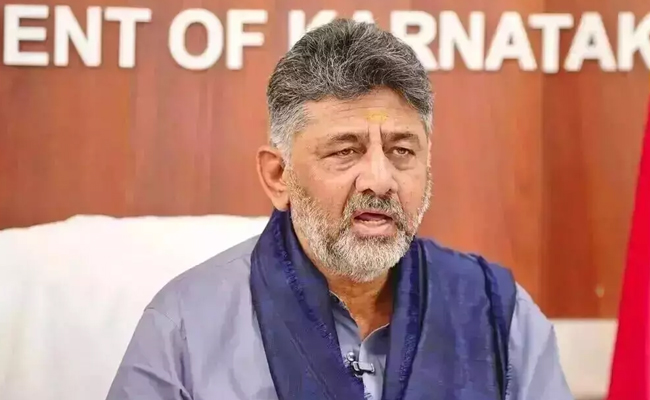
Bengaluru (PTI): Karnataka Deputy Chief Minister D K Shivakumar announced a major property ownership drive here aimed at correcting and regularising property records, saying the government had already rectified 23 lakh Khatas and enabled citizens to download their documents online.
Shivakumar, who also holds the Bengaluru Development portfolio, said the state government had begun converting B-Khatas into A-Khatas and would organise special Khata camps every Saturday across corporation limits from May 16 to help citizens secure their property documents.
A Khata is a legal document in Bengaluru certifying that a property complies with all local by-laws, regulations and has paid property taxes to the civic body.
“We have already corrected 23 lakh khatas and provided an opportunity for people to download them,” he said.
Shivakumar explained that the major campaign has been undertaken in Bengaluru to streamline property documentation.
The Deputy Chief Minister said between five and 10 centres would be set up in every corporation area as part of the “Khata Andolana” programme and urged citizens to participate in large numbers.
“I appeal to people to safeguard their property documents. We have created an opportunity for all citizens,” he said.
Calling it a "people-centric" initiative, Shivakumar said the government was working to ensure citizens received proper ownership documentation for their properties.
Shivakumar further claimed that the initiative had drawn national attention and said the Union government had recognised Karnataka with an award for the programme.
“Your Khata is your right. Obtain your Khata and protect yourself from fraud,” he said, while urging people to take advantage of the scheme.