What’s the contribution of Nehru family?
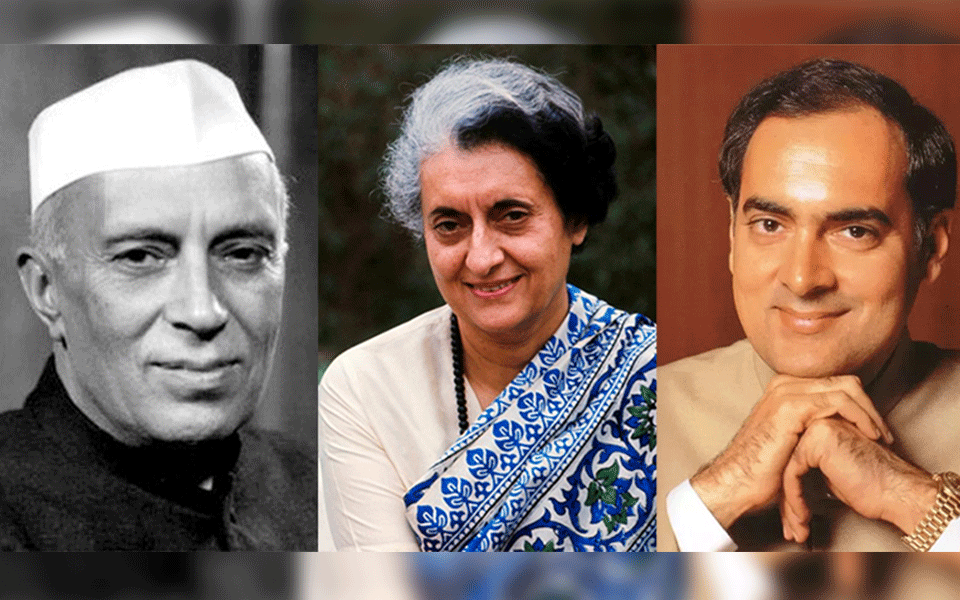
BJP president Amit Shah has put forth a very ignorant question before Indian National Congress President Rahul Gandhi. Shah apparently would like to know ‘what is the contribution of Nehru family to this country’. This question has been answered long ago by senior BJP leader and Union Minister Sushma Swaraj in the United Nations, when she was condemning the terrorism that has been breeding in Pakistan. While listing the achievements of India in the last 70 years in various fields of excellence including science and space, Swaraj had said: “Pakistan didn’t achieve anything except for offering support to rabid terrorism”. This sentence was said before the world leaders. The growth and progress of post-independent India was mainly owing to Nehru, Indira Gandhi and Rajiv. While union minister Sushma Swaraj goes about presenting the accomplishments of India, the fact that a Gujarati leader such as Amit Shah goes about asking ‘what is your family’s contribution’ is not only a testimony to his eroding intelligence, but also the kind of divisive politics this person who is facing charges of fake encounter deaths in Gujarat all through his political career.
This is clearly an insult to the nation. BJP came to power using the pretext of engaging in a war with China and often referring to the days of emergency, and often stating Nehru family did nothing for the country. Now, the current ruling dispensation at the central level is using the Nehru family name to defend and cover for its failed administration. One can make a long list of contributions made by Nehru, Indira and Rajiv. But can we make a similar list about the contributions BJP has made for the progress of the country?
Today, Narendra Modi constantly refers to the accomplishments of ISRO with great pride. ISRO has benefited great deal from the rich vision Nehru had for the nation. And BJP leaders have absolutely no share in this at all. It was during Nehru’s time that the nation that was broken into provinces, was brought together, and thus India became a federal nation. While BJP focuses on creating a rift between communities with communal clashes in the name of temples, Nehru had declared reservoirs and dams are the temples of modern India. Every aspect including IIT and AIIMS mentioned as India’s achievement by Sushma Swaraj before the United Nation, was created during the time of Nehru owing to his far sightedness.
Nehru laid the foundation stone for mega industries. He did not push the nation into the trap of either communism or imperialism but treaded the mid path to take the country on the road to progress by focusing on providing impetus for both agriculture and industries.
We need to realize this. If we cannot compare the India that existed in 1947 to the India that we live in today, then the whole credit goes to visionary leaders such as Nehru and his family members. Nehru did not surrender the country before any international agency. Instead, India came to be known as a non-aligned equal partner and a nation that would lead other countries on par. This direction of leadership continued during Indira Gandhi’s time as well. India had a definite foreign policy during the times of Indira Gandhi and Nehru. This had elevated India’s position in the international arena. Indira Gandhi is not just synonymous with the period of emergency, but also with the love and respect she could receive from the people across classes and creed. She was loved by all. People from even the lowest strata of the society would find strength in her, and they saw her as their mother. She was very familiar in even the most remote villages. She never resorted to doing politics on emotional basis. It was Indira Gandhi who nationalized the banks and made them accessible to the poor. Land tenancy act was another massive and bold decision she made. This decision ensured that even the poorest of the poor who endlessly worked in the lands of the rich and mighty, could possess land property for themselves. She had to earn the wrath of the powerfully rich owing to this. The Billavas in coastal Karnataka who were working as bonded labourers in the fields of rich Bunts, could possess land thanks to this act. The ‘Green Revolution’ and ‘White Revolution’ took place during her tenure. Her entire focus was on eradicating poverty. Hence her political decisions revolved around ‘Garibi Hatao’. She did not fool people in the name of mandir, masjid or Gods. Her strategy earned Bangladesh its independence, She could defeat Pakistan and set Bangladesh free for its own future. Atal Bihari Vajpayee had called her the ‘Durga’ with great appreciation. And the ‘age of computers’ was initiated by Rajiv Gandhi. Today if we see every household possessing a computer and every individual possessing a mobile phone, it is thanks to the vision of Rajiv Gandhi and his close friend Sam Pitroda’s unstinting farsightedness.
Today if Narendra Modi and Sushma Swaraj are boasting of India’s accomplishments n international platforms, all credit goes to the most significant prime ministers of this country. More than this, Indira Gandhi and Rajiv Gandhi put down their lives for this country. When the fact remains thus, it is rather very comical that Amit Shah should come all the way to Karnataka and ask this question of what’s the contribution of Nehru family in building the modern India. Nehru not only took part in the freedom struggle, but also steered the nation towards bright future with his vision.
While Sushma Swaraj referred to the Pakistan representative in United Nations, she made a list of all the successes of India’s agencies and said “we built universities, ISROs, and reservoirs. What did you do? You built terrorist organisaitons,” she needs to remember all those dreams are going to be razed to dust by Modi government. They are demolishing every sign of modern India and are replacing it with saffron elements such as fake babas, terrorist organisations, massive statues, etc. Instead of science and technology, we have this government trying to fill people’s head with mythology and superstition. Temples have taken the place of development. Nehru family prepared the nation for 21st century, but Shah and team will take the country right back to stone age.
Let the Truth be known. If you read VB and like VB, please be a VB Supporter and Help us deliver the Truth to one and all.
Lt Gen NS Raja Subramani to be India's next Chief of Defence Staff
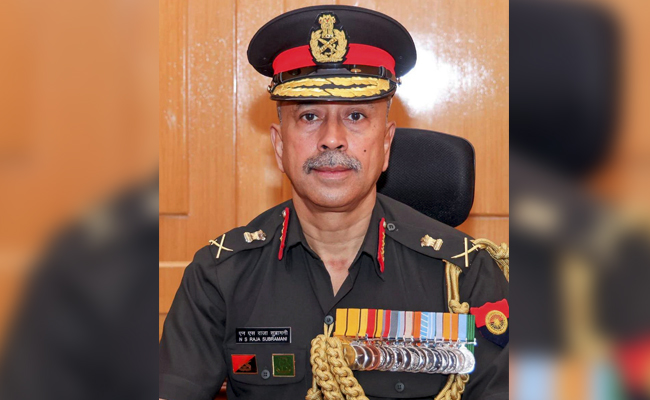
New Delhi (PTI): Lt Gen NS Raja Subramani will be India's new Chief of Defence Staff (CDS) and his key task is set to be to implement the ambitious theaterisation plan that seeks to ensure tri-services synergy.
He will succeed Gen Anil Chauhan whose tenure will come to an end on May 30.
Gen Chauhan, a former Eastern Army Commander, took charge as the country's senior-most military commander in September 2022, over nine months after the first CDS, General Bipin Rawat, died in a helicopter crash in Tamil Nadu.
The government has appointed Lt Gen NS Raja Subramani (Retd) as the Chief of Defence Staff, who will also function as the secretary of the Department of Military Affairs, the defence ministry said on Saturday.
Lt Gen Subramani is currently serving as the military adviser to the National Security Council Secretariat.
Prior to that, he was the Vice Chief of the Army Staff from July 1, 2024 to July 31, 2025, and was General Officer Commanding-in-Chief of the Central Command from March 2023 till June 2024.
As Chief of Defence Staff, Lt Gen Subramani's primary task will be to implement the theaterisation model to bring in tri-services synergy by rolling out integrated military commands.
The officer is a graduate of the National Defence Academy and the Indian Military Academy. He was commissioned into the eighth battalion of the Garhwal Rifles on December 14, 1985.
Lt Gen Subramani is an alumnus of Joint Services Command Staff College, Bracknell (UK), and the National Defence College, New Delhi. He holds a Master of Arts degree from King's College London and an MPhil in defence studies from Madras University.
In his illustrious career spanning over 40 years, Lt Gen Subramani has served across a wide spectrum of conflict and terrain profiles and tenanted a host of Command, Staff and Instructional appointments.
He commanded the 16 Garhwal Rifles in Counter-Insurgency operations in Assam as part of Operation Rhino, the 168 Infantry Brigade in Jammu and Kashmir, and the 17 Mountain Division in the Central Sector, all during a challenging operational environment.
He also has the distinction of commanding two Corps, including the Indian Army's premier strike Corps on the Western Front.