Women of Kerala create history
Women of Kerala have created history again. Having asserted their identity and right to cover their breasts about a century ago, the women of Kerala have again made a mark for themselves by having entered the sanctum sanctorum of Ayyappa Swami temple. With this, they have also upheld the dignity and honour of Supreme Court verdict, along with constitutional values with their act. The leftist government of Kerala had vowed to ensure the verdict of the Supreme Court would be held up, under all circumstances, has held up the word. About 50lakh women had formed a women’s wall along the length of the state, starting from Kasargod to Thiruvananthapuram.
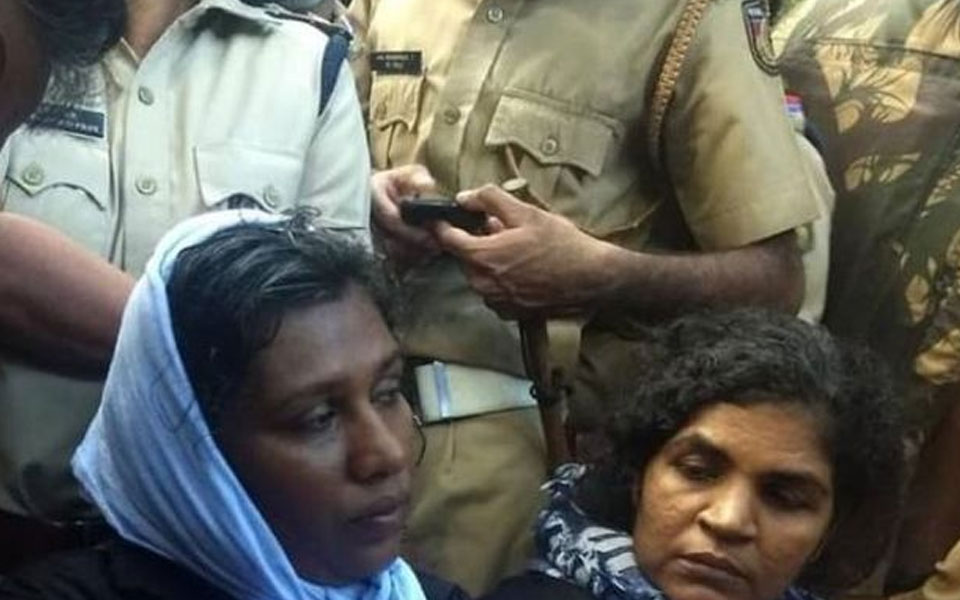
Even as this news was fresh on people’s minds, two women Bindu and Kanakadurga entered the temple of Ayyappa Swamy in Sabarimala, breaking the barrier that stopped them from entering the temple since ages. This barrier was put up by the narrow minded traditionalists for their own benefit. The restriction to women between ages of 10 and 50 is not something that was laid down by the god, but by people. This is an irrational, unscientific and evil belief created and circulated by patriarchal society. This has no space in modern society.
Supreme Court had ruled recently that women have to be given equal opportunity to enter the temple just as men. This has to be implemented by any elected government. Hence, the Pinarayi government that has strong left roots had voiced its commitment to ensure the verdict would be implemented. The Sangh Parivar and BJP were waiting for a change to set foot into Kerala and this ruling came as a big chance to make that happen. Hence they started some violent protests in the name of dissidence.This violence, stone pelting and other ruckus scared the devotees and the number of believers visiting the temple came down. This showed on the income of the temple too. Even then, BJP didn’t reduce its Goondagiri. National President of BJP Amit Shah who should have told his state unit members to not engage in violence, came down to the state and encouraged them to get into more damaging behavior. The person sitting in the chair of PM never parted his lips to even speak against this violence. Now, all of a sudden, he has woken up from the slumber and has spoken about the issues surrounding this verdict.
The tradition of the temple is that women between ages of 10 and 50 shouldn’t enter the temple. Every temple would have its tradition and people believe it should be followed. Nothing is more humiliating than this. What can one expect from people who wanted to bury the constitution and bring in Manu Smriti as a quasi-constitution? Such people need to remember something. Kerala has its own share of wonderful social reforms. Protests had happened owing to entry into the temples such as Vaikum and Guruvayur movements as well. This is a land of rational thinkers such as Narayana Guru, Ayyan Kali, Chattambi Swami, Kelappan and AKG among the others. This is the land where they walked. On a ground like this, there is no space for regressive RSS and other Sangh elements that propose and follow Manu. This has been made clear in Kerala again. People have upheld the constitution and rejected blind practices,
BJP has no other issues to go close to people except for those such as Baba Budan Giri and Sabarimala, to create a base for itself down South. Their government has to face people’s ire over badly managed demonetization, GST implementation and inflation. BJP has not fulfilled any promise they made to the people of this country. Which is why the party had to taste defeat in the election of five states. Opportunist Congress has also joined hands with communal forces in Kerala since there is no tandem between the national president of this party and its state chief. Cong feels hindus will vote for them if they join hands with the BJP on this.
The upper caste vested interests who cannot tolerate an Ezava (lower caste) man Pinarayi Vijayan being the CM of the state, have joined hands with the Sangh on this. A cartoon depicting a man preparing arrack with a tagline of “this is what happens if arrack brewers become the CM” has already stirred huge controversy. Those who want to keep women away from the temples in the name of tradition, will also want lower castes to stay away from temples in the name of same tradition. The Hindu rashtra that they want to build, has same dangerous elements. A big congrats to the leftist government, and progressive women who offered a major setback to the traditionalists and restricted minds who had threatened to take Kerala to dark ages. The state proved itself literate through this step.
Let the Truth be known. If you read VB and like VB, please be a VB Supporter and Help us deliver the Truth to one and all.
'Godman' Kharat held in 8th sexual exploitation case; court denies police remand, sends him to jail
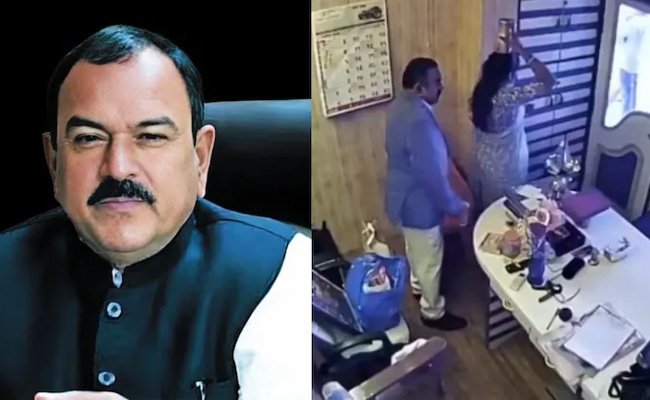
Nashik (PTI): Police took custody of self-proclaimed godman-cum-astrologer Ashok Kharat in an eighth case related to sexual exploitation of women and produced him before a Nashik district court which sent him to jail till May 12 after rejecting the plea for his police remand on Thursday.
On April 29, the Special Investigation Team (SIT) of the Nashik police in north Maharashtra filed a request application in the court demanding Kharat's custody in the eighth case.
After the court granted them the necessary permission, the SIT took custody of Kharat, who was in jail in connection with the seventh case of sexual exploitation registered against him.
The 'godman', named in a dozen FIRs related to rape and financial fraud, was produced before Chief Judicial Magistrate B N Ichpurani in the eighth case through video conferencing due to security reasons.
The eighth case related to Kharat allegedly sexually exploiting a woman who had approached him in search of solutions to her family problems, according to police.
During the hearing, the prosecution demanded police custody of the accused in the latest case.
However, the defence strongly opposed the demand and argued that the SIT was giving same reasons for police custody every time and there was no strong reason for accepting their plea.
The court accepted the argument put forth by the defence and remanded Kharat to judicial custody till May 12 in the eighth case.
The SIT will produce Kharat in the court on Friday again and seek his police custody in the ninth case. As the self-styled godman has been granted judicial custody in the eighth case, he will be sent to Nashik Road Central Jail and the SIT will take his custody from there.
Meanwhile, Kharat's judicial custody in the fourth case ended on Thursday. On April 18, the accused was remanded to judicial custody till April 30 in the fourth case of sexual exploitation of women.
In a related development, the SIT conducted a search at Kharat's office in the 'Canada Corner' area of Nashik city on Wednesday. A 'panchnama' (record of search and seizure proceedings) was conducted and the office was locked and sealed again.
Kharat, a well-heeled man with political connections, was arrested for the first time on March 18 after a woman alleged he had repeatedly raped her for three years.
He is accused of sexually exploiting several women by claiming to have divine powers and knowledge of black magic, and also committing large-scale financial fraud.
The SIT is conducting a probe into 12 cases of sexual exploitation and financial fraud registered against the astrologer in Nashik and Ahilyanagar districts.