Government bans online gambling, yet fears to take on Tobacco
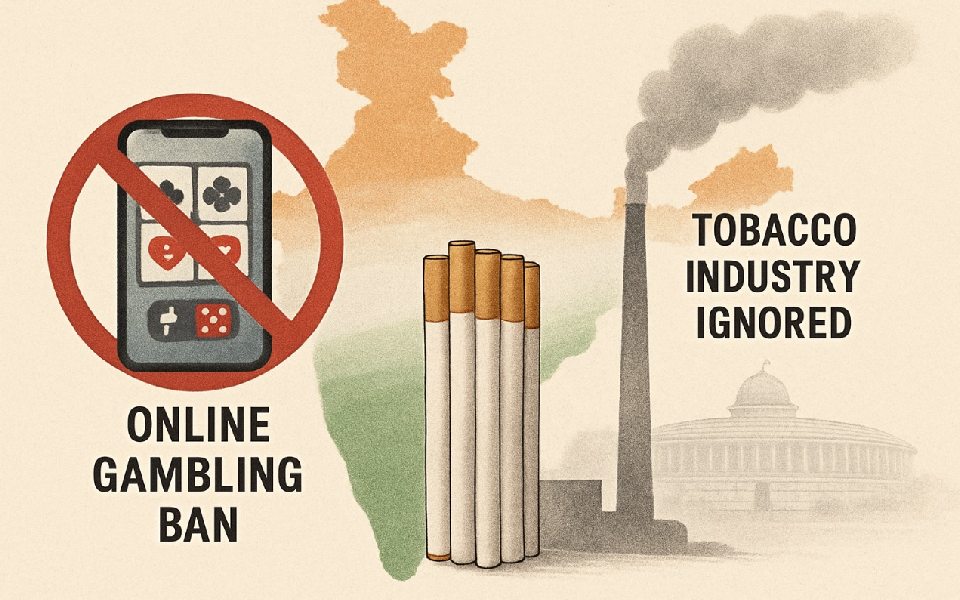
In a rare show of urgency, the Union government this week passed the Promotion and Regulation of Online Gaming Bill, 2025, effectively outlawing all forms of real-money gaming across India. The move was justified on the grounds of protecting citizens from addiction, financial ruin, fraud, and even the possibility of terror financing. The speed and decisiveness with which this bill was introduced and passed left little doubt about the government’s ability to act when it chooses. But while the axe has fallen on online gaming, the same resolve mysteriously evaporates the moment the conversation turns to tobacco, India’s most lethal legal addiction.
The decision to push for a ban on online gambling deserves appreciation. It is a timely move that recognises the silent but dangerous trap of betting apps, which have ruined countless young lives by driving them into debt, stress, and even mental breakdowns. But.
Tobacco: The lingering killers the government won’t face
Tobacco remains the country’s silent killer, claiming 1.35 million Indian lives every single year, and nearly 8 million globally, according to the World Health Organization. To put it simply, tobacco wipes out far more lives than online gambling ever could. The comparison is almost absurd: the worst outcome of online gaming is financial distress, while the outcome of tobacco addiction is slow, painful death. Yet, tobacco continues to enjoy a strange immunity from serious government crackdown.
The economic costs are just as staggering. India spends close to ₹1.77 lakh crore annually on treating diseases directly linked to tobacco use, more than one percent of the nation’s GDP. For every ₹100 earned in tobacco excise, the country loses ₹816 in healthcare costs and lost productivity. This is not just an economic imbalance; it is a moral scandal. And still, the urgency displayed in banning gambling platforms is nowhere to be seen when it comes to curbing tobacco consumption.
On paper, India has laws. The Cigarettes and Other Tobacco Products Act (COTPA), India’s ratification of the Framework Convention on Tobacco Control (FCTC), and periodic awareness drives are trotted out as evidence of government concern. But in practice, enforcement remains pitiful. Cigarettes are cheaper today, not costlier. Shops near schools still openly sell to minors. Flavoured e-cigarettes and smokeless tobacco find their way easily into young hands. Advertising bans are regularly flouted through surrogate branding and indirect promotions. The net result is a ticking health crisis that has been conveniently ignored, even as governments project themselves as champions of public welfare.
Why does the state act like a lion when confronting online gambling but a lamb when it comes to tobacco? The answer lies in politics and profit, not in public health. Tobacco sustains millions of livelihoods tendu leaf collectors, bidi rollers, small vendors, and at the top, corporate giants like ITC, in which the government itself holds significant stakes. To strike tobacco is to risk political backlash, job losses, and a dent in revenue. For a government that prides itself on bold reforms, this is one fight it simply does not want.
Added to this is the deep influence of the tobacco lobby. For decades, the industry has mastered the art of delaying tactics, lobbying, surrogate advertising, and regulatory capture. From softening tax hikes to watering down restrictions, its power is evident in every half-measure that passes as “policy.” The same system that can outlaw gambling apps and websites remains paralysed before tobacco corporations, whose profits are built on addiction and death.
This double standard exposes a deeply uneven moral playbook. The state tells its citizens that their welfare matters, but only selectively. A few crores lost to online gaming justify urgent legislative action. Millions of deaths caused by tobacco addiction draw only polite nods and diluted awareness campaigns. This discrepancy sends a dangerous message: when profits and politics are at stake, human suffering can wait.
If the government is truly serious about protecting public health, it cannot continue to look the other way. Raising taxes marginally will not suffice. What India needs is a steep and consistent annual increase in tobacco taxes, well above inflation, to make cigarettes and bidis less affordable. That revenue must be directly channelled into tobacco cessation programs, large-scale awareness campaigns, and strict enforcement of advertising bans. The sale of tobacco near schools should not only be illegal on paper but strictly punished in practice. E-commerce loopholes that allow youth access to tobacco products must be plugged, and state administrations should be rewarded for ensuring compliance with smoke-free regulations.
It is no longer enough to play safe politics while millions die every year. Banning online gambling may look bold on the surface, but true courage lies in confronting the industries that are politically entrenched and economically powerful. That courage, so far, has been missing. Until the government shows the same urgency against tobacco that it displayed against gambling, it cannot credibly claim to put the public’s health first.
Bravery does not stop with easy targets. Bravery begins at home, and for India, that means finally taking on tobacco.
Let the Truth be known. If you read VB and like VB, please be a VB Supporter and Help us deliver the Truth to one and all.
Real Madrid fines Valverde and Tchouaméni half a million euros each for altercation

Barcelona (AP): Real Madrid slapped players Federico Valverde and Aurélien Tchouaméni with half-a-million-euro ($588,000) fines on Friday for their altercation during practice.
The massive fines came a day after the midfielders tussled when the team trained. Valverde said in a post on social media on Thursday that no punches were thrown. But Valverde knocked his head on a table and he suffered a small cut that required a brief hospital visit.
On social media, Valverde initially called it a “meaningless fight” with a teammate and said “everything has been blown out of proportion."
His employers, however, considered it a significant enough breach of team discipline to nail both Valverde and Tchouaméni with fines that bite even the bank account of a top soccer player. The half-a-million euro penalties reflect the reputational damage the club was enduring in a chaotic end to a disappointing season.
In a statement, the 15-time European champion said its disciplinary action was concluded after both players expressed to the club “their complete remorse for what happened and apologized to one another.”
Madrid added they also apologized to their teammates, the coaching staff and club supporters, as well as showing their willingness to accept whatever disciplinary action the club deemed “opportune.”
Tchouaméni was back training with Madrid on Friday, two days before they play at Barcelona in a clasico. Madrid has to win otherwise Barcelona will be crowned La Liga champion.
After being notified of the fine, he posted a public apology to the club and its fans on social media.
“What happened this week in training is unacceptable,” Tchouaméni wrote. "I say this while thinking about the example we are expected to set for young people, whether in football or at school.
“Above all, I am sorry for the image we projected of the club.”
Valverde was not at practice due to the head knock.
Both players are set to play in the World Cup next month, with Tchouaméni playing for France and Valverde for Uruguay.
Chaotic end to a poor season
===================
The run-in between the players, who for seasons have played side by side in Madrid's midfield, came after they argued this week in previous training sessions. But tempers boiled over on Thursday. Spanish media was rife with reports that the players previously disagreed over the club's decision to let coach Xabi Alonso go after just months on the job.
It was not the only altercation involving Madrid players during training this week. Álvaro Carreras confirmed he was in a “minor” incident with a teammate. Spanish media said he and fellow defender Antonio Rüdiger got into a scuffle.
Álvaro Arbeloa, the coach who was promoted from Madrid's reserve team when Alonso was fired in January, will face tough questions on what went wrong inside the changing room when he gives a press conference on Saturday ahead of the clasico at Camp Nou.
Madrid is facing a second consecutive campaign without a major trophy amid rumors in the Spanish media that club president Florentino Pérez is considering bringing back Jose Mourinho to straighten out his underperforming team.