India boosts Defence spending with Rs 6 Lakh Crore allocation in 2023 Budget
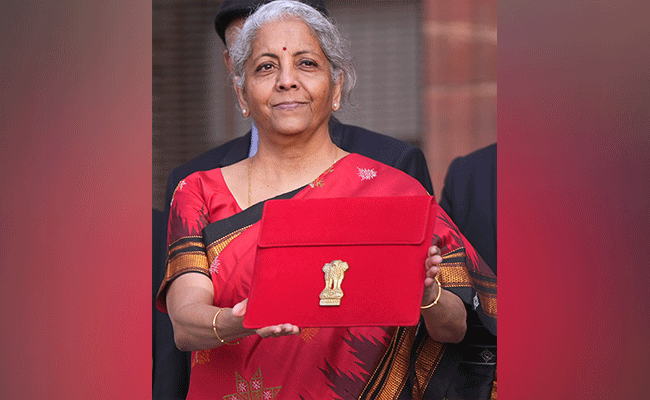
Union Finance Minister Nirmala Sitharaman presented the Union Budget 2023 on Wednesday, February 1st, allocating nearly Rs 6 lakh crore ($8.1 billion) to the defence sector, with a capital outlay of Rs 1.62 lakh crore ($2.2 billion), a 12% increase from last year's Rs 1.44 lakh crore ($1.9 billion). The Ministry of Defence has been given a total budget of Rs 5,93,537.64 crore ($7.9 billion), which is 13.18% of the total budget and includes an amount of Rs 1,38,205 crore ($1.8 billion) for Defence Pensions.
The allocation to the Ministry of Defence makes up 8% of the total Union Budget. India is the third largest military spender, as per the Stockholm International Peace Research Institute (SIPRI). However, according to an analysis by the PRS Legislative Research, India's defence spending as a proportion of total government expenditure and as a percentage of the GDP has been decreasing in recent years. The Indian defence budget allocation has been a topic of concern for many years. In the last decade, the defence budget has grown at an average rate of 8.6% annually, while total government expenditure has grown at 10.8%. This has resulted in a decrease in defence spending as a proportion of the government expenditure, from 16.4% in 2012-13 to 13.3% in 2022-23, according to an analysis by the PRS Legislative Research. Furthermore, defence expenditure as a percentage of the Gross Domestic Product (GDP) declined from 2.3% in 2012-13 to 2% in 2022-23.
The capital outlay for defence includes expenditure on salaries of armed forces and civilians, pensions, modernisation of armed forces, production establishments, maintenance, and research and development organisations. The share of the defence budget spent on capital outlay has declined since 2012-13, with an average annual growth rate of 5% between 2012-13 and 2018-19 and 11% between 2019-20 and 2022-23.
The actual expenditure incurred by the Ministry of Defence has exceeded the budget since 2016-17, while the PRS analysis indicates that the funds allocated to the armed forces in the budget have been less than what was initially projected since 2015-16. In 2022-23, the total allocation for the three forces (including pensions) was Rs 5,25,166 crore ($7 billion), with the Army accounting for 58% of the defence budget, followed by the Air Force at 19% and the Navy at 16%. The allocation of funds to the armed forces in the budget has been less than what was initially projected since 2015-16, according to the PRS analysis. In 2021-22, while the projected funds needed for the three forces were estimated at Rs 4,49,508 crore, the budget allocated a sum of Rs 3,24,658 crore, resulting in a 28% shortfall. The shortfall for revenue expenditure and capital expenditure was 19% and 38%, respectively. The expenditure on the Army, Navy, and Air Force is in the ratio of 3.5:1:1.2, excluding pensions. The ratio of expenditure on these three forces is 2.5:1:1.1, excluding pensions.
The Budget for 2022-23 proposed that 68% of the defence capital procurement budget be earmarked for the domestic industry, up from 58% in 2021-22, in an effort to reduce imports and promote self-reliance. The government has also initiated the process of setting up 100 new Sainik Schools in partnership with NGOs, private schools, and state-owned schools, with 155 expressions of interest received as of January 13th, 2022.
The government has increased the Non-Salary/operational allocations to improve the operational preparedness of the defence services. The Non-Salary Revenue/operational allocation has received a boost of Rs 27,570 crore, augmenting the budgetary outlay from Rs 62,431 crore in BE 2022-23 to Rs 90,000 crore in BE 2023-24. This will cater to the sustenance of weapon systems, platforms, and their logistics, emergency procurement, progress stocking of military reserves, and more. The bloated salary and pension element of the Defence Budget against the slim capital expenditure has been constant concern of defence observers over the years. The slim capex fund leaves little room for modernisation and procurement.
The Union Budget 2023 has allocated a significant amount to the defence sector, with a focus on modernisation and self-reliance. The Ministry of Defence has been given a large portion of the total Union Budget and the capital outlay for defence has seen an increase from last year. However, the defence spending as a proportion of total government expenditure and the GDP has decreased in recent years and the actual expenditure incurred by the Ministry of Defence has exceeded the budget since 2016-17. The Indian defence budget has seen a decreasing trend in allocation over the years, but the government has made efforts to enhance the operational preparedness of the defence services and boost infrastructure and technological development. The Union Budget 2023-24 has allocated increased funds to the Capital Investment Outlay, BRO, DRDO, and innovation initiatives, signalling a commitment to the growth and strengthening of the defence sector.
Girish Linganna
Defence and Aerospace Analyst
Let the Truth be known. If you read VB and like VB, please be a VB Supporter and Help us deliver the Truth to one and all.
Putin meets Iran's FM Araghchi, says Russia ready to do its best to help bring peace to West Asia
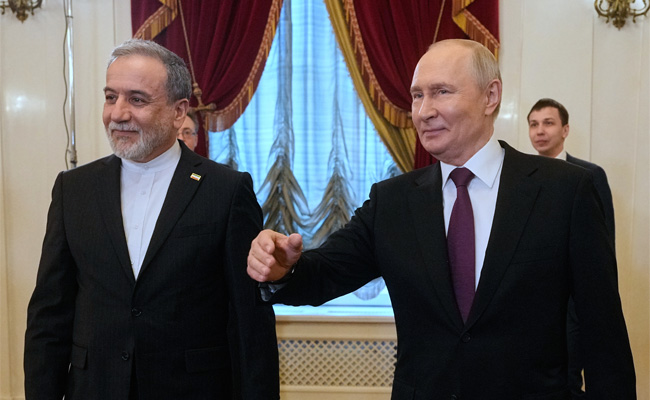
Moscow (PTI): Iran's Foreign Minister Abbas Araghchi on Monday met Russian President Vladimir Putin, who hailed the Iranian people for fighting bravely and heroically for their sovereignty and said Moscow is ready to do its best to help bring peace to West Asia as soon as possible.
Araghchi, who held talks with Omani and Pakistani leadership before arriving in Russia, met Putin in St. Petersburg and thanked him for supporting Iran, state-owned TASS news agency reported.
"Russia is ready to do everything in its power to ensure that peace in the Middle East is achieved as soon as possible," Putin said during his meeting with Araghchi, which was also attended by Russian Foreign Minister Sergey Lavrov.
Revealing that he received a message from Iranian Supreme Leader Mojtaba Khamenei last week, Putin asked Araghchi to convey his "gratitude for this message and best wishes for his health and well-being."
He praised the Iranian people for fighting "bravely and heroically" for their sovereignty, Iran's state-run PRESS TV reported.
"We really hope that, based on the courage and desire for independence, the Iranian people, under the guidance of the new leader, will weather this difficult period of trials and peace will come,” Putin said.
He also stressed that Russia “intends to maintain” its strategic relations with Iran.
Araghchi said that the world witnessed Iran’s strength in countering the US during the recent war, and that the Islamic Republic is a "stable and powerful establishment."
"With their courage, the Iranian people succeeded in resisting the US aggression and will be able to endure it,” he said.
He said that it became clear that Iran has “great friends and allies” like Russia, and conveyed “warmest greetings” from Supreme Leader Mojtaba Khamenei and President Masoud Pezeshkian to the Russian leader.
Araghchi said relations between Moscow and Tehran represent a “strategic partnership at the highest level” and will continue to develop "regardless of circumstances."
"We are grateful to you for the solid and strong positions in support of the Islamic Republic of Iran," he said.
Foreign Minister Lavrov said that the talks between President Putin and the Iranian Foreign Minister were "useful and constructive."
Kremlin Spokesman Dmitry Peskov later said that Russia is "ready to provide any good offices, any mediation services that are acceptable to the parties."
"We will be ready to do everything so that ultimately peace ensues, guaranteed peace, and that there is no return to hostilities," Peskov was quoted as saying by TASS.
He was asked how Moscow can assist in future negotiations on the Iranian settlement.
Araghchi arrived in Russia after his whirlwind trip to Islamabad, which, according to him, was “very productive” and involved “good consultations" with Pakistan's Army Chief Field Marshal Asim Munir, amid uncertainty over the second round of peace talks to resolve the war in West Asia.
"We held good consultations with our friends in Pakistan. The trip was successful. We assessed the outcome of our recent (meetings) and discussed in what direction and under what conditions talks can move on,” Araghchi said in a video posted on his Telegram channel upon his arrival in St Petersburg.
Referring to the second round of talks between the US and Iran to resolve the conflict in West Asia, Araghchi said: "Developments have taken place in the negotiations."
"Despite some progress in earlier rounds, the talks failed to reach their objectives due to the Americans' approach, the excessive demands they made, and the wrong approaches they adopted. Therefore, it was necessary to consult with our friends in Pakistan to review the latest situation,” Iran's official news agency IRNA quoted him as saying.
He said that the trip to Pakistan was a good opportunity to review developments related to the US-Israeli war against Iran, expressing confidence that “these consultations and coordination between the two countries will be highly significant.”
Araghchi arrived at St. Petersburg's Pulkovo Airport early Monday, where he was welcomed by Russian officials and Iran’s ambassador to Russia, Kazem Jalali, the report said.
The first round of peace talks between Iran and the US, held on April 11 and 12, failed to bring the desired result for the parties to the conflict.
The Iranian minister arrived in Islamabad for the second time on Sunday after a short visit to Oman, where he held talks with Sultan Haitham bin Tariq al-Said on security in the Strait of Hormuz and diplomatic efforts to end the Iran-US conflict.
After Araghchi left Pakistan for Oman on Saturday, President Donald Trump announced that US negotiators Steve Witkoff and Jared Kushner would no longer be going to Islamabad for talks with Iran, contending that Washington held all the cards on the matter.
Trump on Sunday reiterated that the US and Iranian officials can talk by phone for a peace solution to the conflict.
On Tuesday, Trump extended the two-week ceasefire with Iran indefinitely to give Tehran more time to prepare a unified proposal to end the war, just hours before the truce was set to expire.
The war began when the US and Israel jointly attacked Iran on February 28, killing Iranian Supreme Leader Ayatollah Ali Khamenei and several top commanders. The retaliation by the Islamic Republic extended the war to the entire Gulf region.