India’s Philippine engagement while navigating diplomatic complexities
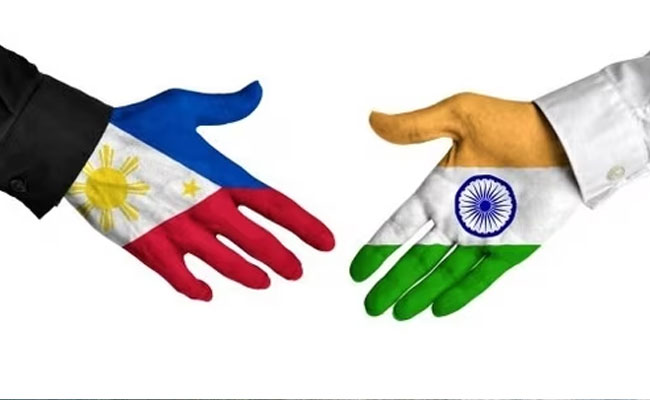
A confrontation took place on December 10 in the waters of the South China Sea, specifically in the waters of Ren’ai Reef and Scarborough Shoal, where a Chinese Coast Guard ship hosed a Philippines Supply ship. Not long after this incident, a warship from the Indian Navy arrived in the Philippines. On December 12, the anti-submarine warfare corvette, the INS Kadmata, of the Indian Navy arrived in Manila, the capital of the Philippines, and immediately began a joint exercise with the Philippine Navy.
It is believed that this indicates that the maritime relationship between the two countries is getting stronger. The ship’s journey to Manila underscores the Indian Navy’s dedication to maintaining maritime peace in the region.
The procurement of BrahMos supersonic cruise missiles from India by the Philippines bolsters Manila’s strategic approach to the South China Sea. In addition to providing a line of credit to support Philippine defence requirements, New Delhi intends to dispatch a defence attaché to Manila to bolster the security partnership.
In a discussion between Indian and Filipino diplomats in June, India amended its position on the South China Sea Arbitration of 2016, which supports Manila’s territorial claims over China. The altered stance on the arbitration—which opposed China’s claims in the South China Sea, including the Nine-Dash Line, and favoured the Philippines in a territorial dispute—comes at a time when India is increasing its security engagement with South-East Asian countries.
During the 5th India-Philippines Joint Commission on Bilateral Cooperation, which took place in New Delhi from June 27 to June 30, Philippine Secretary of Foreign Affairs Enrique Manalo and Indian External Affairs Minister Subrahmanyam Jaishankar met to discuss a variety of issues between the two countries, India revealed its new stance on the ruling that was handed down in 2016. The statement was released in conjunction with the meeting.
According to the statement, one of the issues that the two diplomats emphasised was their shared interest in a free, open and inclusive Indo-Pacific area. The expansion of India-Philippines relations was acknowledged in the statement, which also characterized the two Indo-Pacific nations as dynamic, young democracies with rapidly growing economies.
The joint statement also emphasised the importance of adhering to international law and promoting peaceful resolution of disputes. The two nations referenced the United Nations Convention on the Law of the Sea (UNCLOS) and the arbitral ruling issued in 2016 regarding the South China Sea.
India’s ambassador to Manila, Shambhu Kumaran, expressed a position similar to that of New Delhi on July 12, which was the seventh anniversary of the verdict made by the arbitral tribunal. He stated that, although every nation is responsible for upholding international law, larger nations may have a greater responsibility to ensure that international law is respected.
Before India changed its stance, New Delhi had just acknowledged the award’s outcome. On the other hand, India has been more supportive of countries throughout the region, such as the Philippines, due to the escalation of the Sino-Indian border conflict over the past few years and its involvement in the Quad’s vision of a Free and Open Indo-Pacific.
India has previously stated that it recognizes that China is the only major power that poses a direct threat to its security interests, both on its border and in the Indian Ocean, even though India has previously committed to a non-aligned position and is reluctant to take sides in issues involving major power competition.
According to experts, India can take a moral stance supporting international law without identifying with any major powers if it endorses the arbitral tribunal’s ruling in 2016. This allows India to continue to support its security objectives from the same perspective. Many nations that can reap the benefits of the arbitral tribunal’s decision from 2016 are consumers, or prospective customers, of India for the sale of Indian defence products, especially BrahMos.
Even though India has expanded its efforts in South-East Asia, the nation continues to exhibit pragmatic restraint to prevent the security architecture in the South China Sea from being undermined to a critical level. To avoid giving the impression that it is interfering in the international affairs of the region, the Government of India is taking extra precautions.
China’s military footprint in the Indian Ocean may be comparable to India’s if India engages in more aggressive military actions in the South China Sea. Beijing has characterized New Delhi’s recent support for Manila and its endorsement of the 2016 international tribunal ruling as an attempt to determine where China’s ‘red line’ rests. However, this does not imply that India will not continue to broaden its assistance to South-East Asian states, such as the Philippines, and to participate in strategic engagement with them.
In recent times, New Delhi has undertaken measures to fortify its security alliances with several South-East Asian nations, such as Vietnam and the Philippines. The Association of South-East Asian Nations (ASEAN) and India established a comprehensive strategic partnership in 2022. The inaugural maritime exercises between the two organizations commenced in 2023.
Girish Linganna
Let the Truth be known. If you read VB and like VB, please be a VB Supporter and Help us deliver the Truth to one and all.
Caste census will form basis for future policy decision, says CM Siddaramaiah
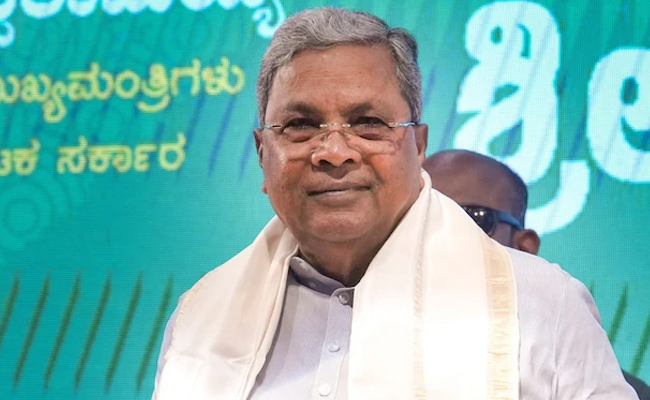
Mysuru (Karnataka) (PTI): Karnataka Chief Minister Siddaramaiah on Wednesday said that the ongoing caste census would form the basis for future policy decisions, asserting that the exercise was crucial to advancing social justice in the state.
Addressing a gathering at the Siddarameshwara Jayanti celebrations here, he said caste enumeration was being carried out for the first time since 1931 and would be followed by deliberations once the report is submitted.
"At present, a caste census (Jaati Sameekshe) is underway. After the report comes, we will discuss it and take necessary decisions," Siddaramaiah said.
He underlined the government’s commitment to equality, stating, "We are committed to social justice. No one should face injustice. Even if not 100 per cent, we will strive to ensure 99 per cent justice."
Referring to measures aimed at addressing intra-caste disparities, the chief minister said the government had already implemented internal reservation based on revised classifications.
"We have gone beyond the Nagamohan Das report and implemented internal reservation… now it has been revised to 5.25 per cent, 5.25 per cent, and 4.5 per cent. This has been approved by the Cabinet," he said.
Siddaramaiah said the broader objective was to ensure equitable distribution of resources and opportunities, while reiterating that policy interventions would be guided by constitutional principles.
"Our objective is equal share and equal life for all," he said.
He also emphasised the role of education in eliminating inequalities, particularly among marginalised communities, and said empowerment was essential to dismantle entrenched caste hierarchies.
"Only when people gain such empowerment can caste divisions be eradicated. Education is essential for this," he added.
The CM said the government would examine demands raised by various communities and take decisions based on feasibility, while ensuring that benefits reached all sections without discrimination.