Internal Reservation: A step forward, But at what cost?
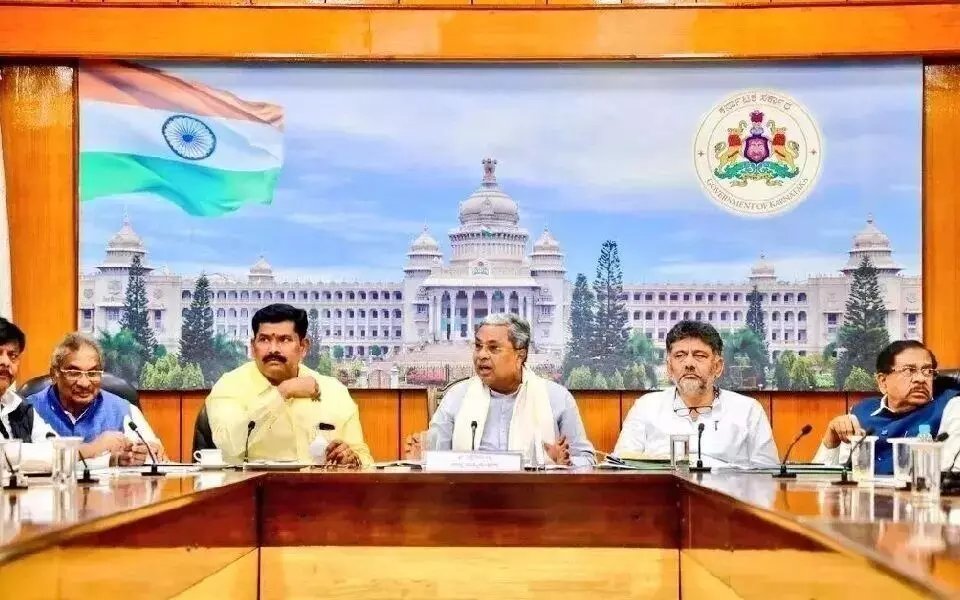
The Siddaramaiah government has finally taken a long-pending decision on the question of internal reservation for Dalits, a subject that has sparked heated debates and created sharp divides within the community. In a special cabinet meeting on Tuesday, it was decided that the 17% reservation meant for Dalits will now be split into three parts: 6% each for the Left-Hand and Right-Hand groups, and 5% for non-untouchable and nomadic communities like Bhovi, Lambani, Koracha, and Korama.
This arrangement marks the end of a decades-long demand for sub-classification within Scheduled Castes. For now, the government appears to have struck a balance. The decision has been welcomed by leaders across communities, with many calling it a step that delivers social justice without causing injustice to any section. For Siddaramaiah, it is not only a political victory but also the fulfilment of a promise that had lingered for more than 30 years.
The debate over internal reservation gathered momentum after the Justice H. N. Nagamohan Das Commission submitted its report. The commission studied 101 Dalit sub-castes and placed them into five categories, recommending distribution of the 17% quota accordingly: 6% for Madigas and other castes facing extreme untouchability, 5% for Holeyas and similar groups, 4% for non-untouchables like Bhovis and Lambanis, and smaller shares for Adi Karnataka, Adi Andhra, and Adi Dravida.
It was this uneven split that triggered opposition. While Madigas welcomed the recommendation, the Holeyas felt shortchanged. Right-Hand leaders demanded that at least 1% from other categories be diverted to them. Nomadic groups, too, demanded a bigger share. The Siddaramaiah government found itself in the middle of a storm. A careless step could have led to protests across the state.
The cabinet initially struggled to build consensus. Opposition came even from within the party. But after multiple rounds of consultations, the government settled on a revised formula, consolidating the five categories into three, while trying to balance representation across subgroups.
Political and legal backdrop
The history of this demand goes back decades. Successive governments both BJP and Congress, spoke of internal reservation but failed to act. The Sadashiva Commission report was ignored by the BJP. Even Congress hesitated, fearing a backlash.
But the legal environment changed last year, when a seven-judge bench of the Supreme Court held that states have the power to introduce internal reservations for the most backward among SCs and STs. This gave a clear push to the demand. At the Congress’s AICC unity convention, Mallikarjun Kharge himself promised to implement it. Siddaramaiah has now delivered on that pledge.
While this decision seems to have resolved one longstanding issue, it also throws up troubling questions. Poet Akka Mahadevi once wrote, “Only those who have suffered can truly understand another’s suffering.” Ambedkar’s struggle too was rooted in this truth. But the bitter reality of today is that Dalit communities often fail to see each other’s suffering.
Instead of uniting against the structures of caste, subgroups have been locked in rivalries. Madigas accuse Holeyas of cornering benefits. Holeyas complain of bias against them. Nomadic groups feel left out altogether. These divisions have weakened Dalit unity, while upper castes have quietly strengthened their hold on power.
Take one example. Without facing the struggles Dalits have faced for decades, economically weaker sections among upper castes managed to secure 10% reservation. Dalits, meanwhile, are still fighting among themselves over how to share 17%. At the same time, government jobs are shrinking due to privatisation. Without extension of reservation to the private sector, even the most carefully designed formulas will mean little.
The perception that one subgroup has cornered more benefits than another may carry some truth. But the bigger truth is that Dalits as a whole remain underrepresented in education, employment, and positions of power. Fighting within only distracts from this larger injustice.
The Siddaramaiah government has made history by implementing internal reservation. But unless Dalit communities use this as a stepping stone towards unity, the decision will remain symbolic. The real danger lies in political forces using these divisions to further weaken Dalit power and representation.
The lesson is clear. Reservation is not just about percentages, it is about dignity, equality, and a fair share in the nation’s opportunities. For that, Dalits must look beyond internal rivalries and recognise the bigger battle that still lies ahead.
Let the Truth be known. If you read VB and like VB, please be a VB Supporter and Help us deliver the Truth to one and all.
Real Madrid fines Valverde and Tchouaméni half a million euros each for altercation

Barcelona (AP): Real Madrid slapped players Federico Valverde and Aurélien Tchouaméni with half-a-million-euro ($588,000) fines on Friday for their altercation during practice.
The massive fines came a day after the midfielders tussled when the team trained. Valverde said in a post on social media on Thursday that no punches were thrown. But Valverde knocked his head on a table and he suffered a small cut that required a brief hospital visit.
On social media, Valverde initially called it a “meaningless fight” with a teammate and said “everything has been blown out of proportion."
His employers, however, considered it a significant enough breach of team discipline to nail both Valverde and Tchouaméni with fines that bite even the bank account of a top soccer player. The half-a-million euro penalties reflect the reputational damage the club was enduring in a chaotic end to a disappointing season.
In a statement, the 15-time European champion said its disciplinary action was concluded after both players expressed to the club “their complete remorse for what happened and apologized to one another.”
Madrid added they also apologized to their teammates, the coaching staff and club supporters, as well as showing their willingness to accept whatever disciplinary action the club deemed “opportune.”
Tchouaméni was back training with Madrid on Friday, two days before they play at Barcelona in a clasico. Madrid has to win otherwise Barcelona will be crowned La Liga champion.
After being notified of the fine, he posted a public apology to the club and its fans on social media.
“What happened this week in training is unacceptable,” Tchouaméni wrote. "I say this while thinking about the example we are expected to set for young people, whether in football or at school.
“Above all, I am sorry for the image we projected of the club.”
Valverde was not at practice due to the head knock.
Both players are set to play in the World Cup next month, with Tchouaméni playing for France and Valverde for Uruguay.
Chaotic end to a poor season
===================
The run-in between the players, who for seasons have played side by side in Madrid's midfield, came after they argued this week in previous training sessions. But tempers boiled over on Thursday. Spanish media was rife with reports that the players previously disagreed over the club's decision to let coach Xabi Alonso go after just months on the job.
It was not the only altercation involving Madrid players during training this week. Álvaro Carreras confirmed he was in a “minor” incident with a teammate. Spanish media said he and fellow defender Antonio Rüdiger got into a scuffle.
Álvaro Arbeloa, the coach who was promoted from Madrid's reserve team when Alonso was fired in January, will face tough questions on what went wrong inside the changing room when he gives a press conference on Saturday ahead of the clasico at Camp Nou.
Madrid is facing a second consecutive campaign without a major trophy amid rumors in the Spanish media that club president Florentino Pérez is considering bringing back Jose Mourinho to straighten out his underperforming team.