LUCAS Vs Shahed: The Battle Of The Billion-Dollar Drone Swarms
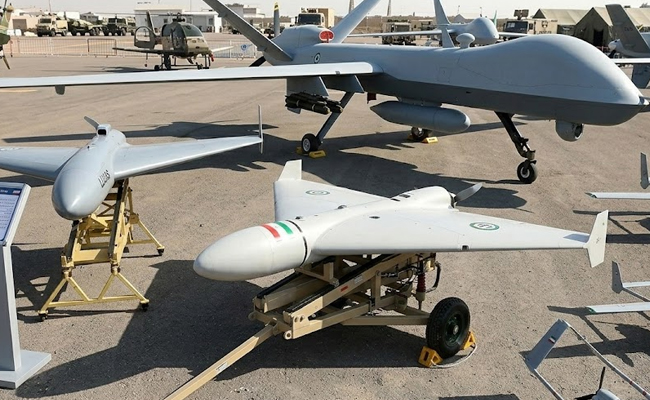
You have heard about drones. Small flying machines. But what if a drone could fly for six hours, stay hidden in the sky, and then suddenly dive down and destroy a missile launcher or a fuel depot — without a single pilot sitting inside it? That is exactly what America just did. And the most interesting part? America learned this trick from Iran.
Let us understand the full story, simply.
What is LUCAS?
LUCAS stands for Low-Cost Uncrewed Combat Attack System. The commercial name is FLM-136, built by an American company called SpektreWorks, based in Arizona. It is what military people call a "loitering munition." Now, loitering means waiting around. So imagine a drone that flies into enemy territory, circles slowly in the sky like a hawk watching its prey, and then — at the right moment — dives and strikes. No pilot. No runway needed. Just launch and forget.
America used this drone in something called "Operation Epic Fury," a joint military campaign with Israel, targeting Iranian military infrastructure. This was not a test. This was a real war mission. According to U.S. Central Command (CENTCOM), LUCAS was deployed by Task Force Scorpion Strike, marking its first combat use in history. The drone, costing around $35,000 per unit, provides a scalable, low-cost alternative to expensive cruise missiles like the Tomahawk, which can run over $2 million each.
Now, What is Shahed-136?
Shahed-136 is Iran's drone. Iran built it because of international sanctions — the world refused to sell Iran advanced weapons, so Iran built its own. These drones are not fancy. They are deliberately cheap, with estimates ranging from $20,000 to $50,000 per unit. The whole idea is not to be powerful — it is to be many. Send hundreds of cheap drones, and even the best air defence system in the world gets tired, confused, and eventually fails. It is like being attacked by a thousand mosquitoes instead of one lion. You cannot kill all of them.
Iran first used its Shahed-131 version in 2019, attacking a Saudi oil refinery. Then Iran-backed groups like the Houthis in Yemen started using them. Then Russia began using Shahed drones against Ukraine. Ukraine's President Zelensky was so angry he called Iran "Putin's accomplice," saying Iran not only gave Russia the drones but also taught them how to build the drones themselves inside Russia. The Shahed-136, with a range of up to 2,000 km and a 40–50 kg warhead, has been produced in thousands, reshaping modern warfare by enabling swarm attacks that overwhelm defenses.
The Smartest Move America Made
Here is where it gets really interesting. After seeing how effective these cheap Iranian drones were on the battlefield, America secretly captured some Shahed-136 drones. American engineers then studied every part of it — the engine, the wings, the navigation system, everything. They reversed the design, understood it fully, rebuilt it, and then improved it. The result? LUCAS.
So America took Iran's own weapon idea, made it better, and is now using it against Iran. That is the irony of modern warfare. Interestingly, the Shahed-136 itself draws design inspirations from Israel's Harpy loitering munition from the 1990s, showing how drone technology often cycles through global borrowing and adaptation. SpektreWorks, under a rapid $30 million contract, transformed their FLM-136 target drone—originally for counter-drone training—into the combat-ready LUCAS in just seven months from unveiling to deployment.
How Powerful is LUCAS?
The drone is about 3 metres long with a wingspan of 2.5 metres. It weighs around 32 kg when empty and 82 kg fully loaded. It runs on a simple 215cc engine — similar in size to a small motorcycle engine. But do not let that fool you.
It can fly for six hours continuously. Its normal speed is about 101 km/h, but during the final attack dive it speeds up to 185 km/h. It can fly above 3,000 metres altitude, which keeps it safely above many short-range anti-drone systems. Its range is about 648 km — meaning it can be launched from a safe location far away and still reach deep inside enemy territory. Some reports indicate a maximum range of up to 822 km, making it suitable for operations across vast areas like the Middle East.
In attack mode, it carries up to 18 kg of explosive warhead. It can destroy radar systems, missile launchers, fuel depots, and reinforced command buildings. When it attacks, it switches from a slow hover to a steep, fast dive — giving the target almost no time to respond.
What makes it even harder to stop is its navigation system. LUCAS uses autonomous guidance with inertial backup, meaning even if the enemy tries to jam its GPS signal, the drone can still find its target. Jamming — which is an enemy's way of confusing a drone electronically — does not work easily on LUCAS. It can also integrate with satellite communications like Starlink for real-time control and swarm coordination, allowing multiple drones to share data and adapt mid-mission.
And most remarkably, in December 2025, America successfully launched LUCAS from a naval warship called USS Santa Barbara, while it was sailing in the Arabian Gulf. No runway. Just an air-powered launcher on the ship's deck. This versatility extends to ground catapults or truck-mounted systems, enabling launches from diverse platforms.
Why Does This Matter?
The big message is simple. Expensive jets and missiles are not always the answer. Sometimes, a hundred cheap smart drones can do more damage with less risk. America realised this watching Iran, Russia, and the Houthis. Now America has its own version — better built, harder to jam, and ready for the modern battlefield. With LUCAS, the U.S. can sustain "swarm-style" attacks, exposing gaps in enemy defenses like Iran's road-mobile air systems. This shift highlights how attritable drones are democratizing warfare, forcing even superpowers to adapt.
War is changing. And the drone that was once Iran's weapon of the poor has now become America's weapon of the smart.
(Girish Linganna is an award-winning science communicator and a Defence, Aerospace & Geopolitical Analyst. He is the Managing Director of ADD Engineering Components India Pvt. Ltd., a subsidiary of ADD Engineering GmbH, Germany.)
Disclaimer: The views and opinions expressed in this article are solely those of the author. They do not necessarily reflect the views, policies, or position of the publication, its editors, or its management. The publication is not responsible for the accuracy of any information, statements, or opinions presented in this piece.
Let the Truth be known. If you read VB and like VB, please be a VB Supporter and Help us deliver the Truth to one and all.
Court can reject anticipatory bail but cannot direct accused to surrender: SC

New Delhi (PTI): A court can reject anticipatory bail of an accused but it has no jurisdiction to direct him to surrender before the trial court, the Supreme Court has said.
A bench of Justices J B Pardiwala and Ujjal Bhuyan made the observation while hearing a plea filed by a man accused of cheating and forgery.
"If the court wants to reject the anticipatory bail, it may do so, but the court has no jurisdiction to say that the petitioner should now surrender," the bench said.
The Jharkhand High Court had rejected anticipatory bail plea of the accused and asked him to surrender and seek regular bail.
In this case, a complaint had been filed before a magistrate alleging offences under Sections 323 (voluntarily causing hurt), 420 (cheating), 467 (forgery of valuable security), 468 (forgery for purpose of cheating), 471 (using forged document) and 120B read with 34 of the IPC, in connection with a land dispute.
The high court had dismissed the second anticipatory bail application of the accused on the ground that no new circumstances were shown.
It had relied on its earlier order rejecting his first anticipatory bail plea, in which the court directed the petitioner to surrender before the trial court and seek regular bail in terms of the decision in Satender Kumar Antil v. CBI.
The top court said such a direction was wholly without jurisdiction and said that if a court chooses to reject anticipatory bail, it may do so, but it cannot compel the accused to surrender.