Mountains Protect, Minds Prevail: Iran’s Silent Strength in War
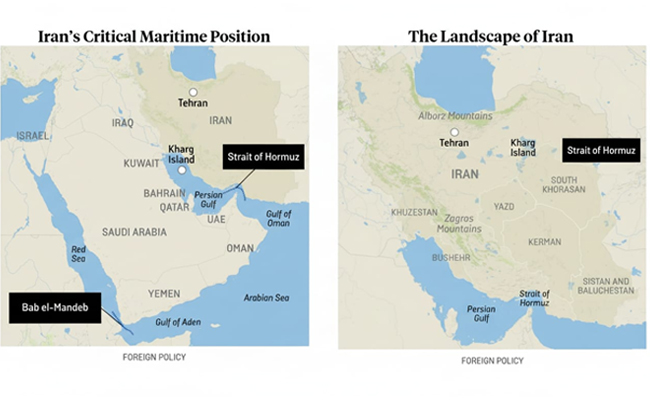
There is a war happening right now that most of us watch on our phones and television screens, reading breaking news alerts while eating our dinner. We see fighter jets, missile strikes, satellite images, and dramatic headlines. We hear about advanced weapons, artificial intelligence, and billion-dollar defence systems. And naturally, we assume that the side with the most powerful weapons will win. That is how wars work, right?
Wrong. At least, not always.
The Iran war — which has now grabbed the attention of the entire world — is quietly teaching us one of the oldest lessons in history. And that lesson is this: geography, meaning the mountains, the deserts, the seas, and the narrow water passages, often decides wars more than any missile or aircraft ever can. Let us understand this properly, like sitting together and talking it through.
Iran Is Not Just Another Country on the Map
First, let us be honest about something. Most of us, when we think of Iran, imagine it as a small, troubled nation somewhere in the Middle East, run by religious leaders, perhaps not very developed, and not particularly powerful. That image is almost completely wrong.
Iran has a population of over 90 million people. That is nearly the size of three Tamil Nadus put together. It is almost four times the size of Iraq. Its literacy rate today stands at around 92 to 93 percent, which is actually higher than the global average of about 86 percent. Back in 1976, that number was barely 48 percent — meaning Iran transformed its entire education system in just a few decades. Its parliament has a high proportion of postgraduates and PhD holders. Iran produces thousands of engineers, researchers, and scientists every year.
In sports, Iran's football team is ranked second in Asia and around 18th in the world, having qualified for the FIFA World Cup multiple times. In the Asian Games, their kabaddi teams — both men's and women's — have beaten India. This is a country with real depth, real intelligence, and real national pride.
One military analyst who studied alongside Iranian students during his school years in the 1970s recalls the strong India-Iran relationship of that era and reflects honestly: "The more I read about Iran today, the more I realise how little I actually knew about the country earlier." That kind of honesty is rare — and important.
The Mountain Wall That History Could Not Break
Now let us talk about Iran's greatest weapon — one that no country can buy, build, or bomb. Its geography.
Iran sits on a high plateau, which is a large, elevated flat land surrounded by mountain ranges. On one side you have the Zagros mountains, and on the other, the Alborz range. These are not small hills. These are massive, ancient, brutal mountain barriers that have stopped armies for thousands of years.
In 36 B.C., the great Roman general Mark Antony tried to move his army into Iran's plateau. He failed. His soldiers struggled through the terrain and were forced to retreat with heavy losses. More recently, during the Iran-Iraq War from 1980 to 1988, Saddam Hussein's Iraqi army pushed hard at the Zagros border. They too were slowed down and eventually stopped.
Why does this matter today? Because it tells us something very important about what any ground invasion of Iran would actually look like.
Think about it this way. In 2003, when America invaded Iraq, they needed over 300,000 soldiers just to begin the operation. Later, around 160,000 troops remained stationed there for years. In Afghanistan, which is smaller and less populated than Iran, America still needed around 100,000 troops. And yet, after twenty years in Afghanistan, America came back home without winning.
Iran is four times larger than Iraq. It has double the population of Iraq. It has mountain barriers, remote deserts, and deep interior regions. A ground war in Iran would require more soldiers, more money, longer supply lines, and a far greater political will than anything America has attempted in recent memory. Even the most expensive American wars in recent history would be "just a minimum comparison," as analysts have noted, for what a full ground war in Iran would truly cost.
This is exactly why no one — not America, not Israel — is seriously planning a ground invasion. The land itself makes it nearly impossible.
Air Power Has Limits Too
So if ground invasion is not possible, what about air attacks? America and Israel have extremely advanced air forces. Their jets can fly deep into Iran, strike targets, and return. Their intelligence systems can track movements. Their precision missiles can hit specific buildings. Surely, air power can finish the job?
Partially. But only partially, and here is why.
Air attacks work most effectively in western and southwestern Iran — places like Khuzestan, Bushehr, and the Zagros border region near Iraq. These areas are close to the Persian Gulf, close to military bases, and can be reached quickly. Air strikes here can be frequent and consistent.
But as you move east and deeper into Iran — into areas like South Khorasan, Yazd, or Sistan and Baluchestan — the situation changes dramatically. These regions are far from sea-based attack points and airfields. Reaching them requires longer flight times, mid-air refuelling, and far more complex coordination. Strikes in these areas are slower, less frequent, and less reliable.
And here is the critical part. Iran knows this. So it hides and spreads its nuclear and military facilities across remote, mountainous areas. If a nuclear site is buried deep inside a mountain in eastern Iran, finding it is hard. Hitting it accurately is harder. Hitting it repeatedly, often enough to fully destroy it, becomes extremely difficult. Geography, once again, acts as Iran's shield.
The Strait of Hormuz — Iran's Most Powerful Card
Now we come to the most important part of this entire story. A narrow strip of water called the Strait of Hormuz.
Imagine a bottleneck — like the narrow neck of a bottle. The Persian Gulf is the bottle. The Strait of Hormuz is the neck. And through that narrow neck, roughly one-fifth of the world's entire oil supply passes every single day. Ships from Saudi Arabia, UAE, Kuwait, Iraq — all carrying oil — must pass through this strait to reach the rest of the world.
How narrow is it? At its tightest point, the strait is only about 39 kilometres wide. The actual shipping lanes used by oil tankers are even narrower — just a few kilometres. Iran sits right along the edge of this passage, with a coastline stretching nearly 2,400 kilometres along the Persian Gulf and Gulf of Oman.
Now think about what this means. Even without winning a single air battle, even without defeating any American aircraft carrier, Iran has the ability to create fear and uncertainty in these waters. If shipping companies believe the strait is unsafe — even if it is not fully blocked — they slow down their ships, take longer routes, or simply refuse to enter. That alone pushes oil prices up across the entire world.
We have already seen this happen. Just the fear of disruption in the strait over recent weeks has pushed up oil prices, increased shipping insurance costs, and disturbed global supply chains. Iran does not need to physically close the strait. It only needs to make people afraid of what might happen. And with missiles, drones, sea mines, and fast-moving attack boats placed along its long coastline, Iran can maintain that fear for a very long time.
Some people think the solution is simple — destroy Kharg Island, which handles about 90 to 96 percent of Iran's oil exports. But Kharg Island and the Strait of Hormuz are two different things. Destroying Kharg Island hurts Iran's oil income. It does not remove Iran's ability to threaten the strait. Iran's control of the strait comes from its overall geographic position — its long coastline, its proximity to narrow sea lanes, and its ability to project force across hundreds of kilometres of water. Removing that advantage would require long-term military control over a vast area of sea, which is enormously expensive and complicated.
Bab el-Mandeb — The Second Chokepoint
And Hormuz is not even the only chokepoint that matters in this conflict.
Further west lies another narrow sea passage called Bab el-Mandeb. This connects the Red Sea to the Gulf of Aden. Think of it as the gateway between Asia and Europe through the Suez Canal route. At its narrowest point, it is only about 32 kilometres wide. Ships are forced through tight lanes here, making them easy targets.
For the past several years — and especially since the Israel-Hamas conflict began in October 2023 — the Houthi group in Yemen has been attacking commercial ships in this area. The Houthis are a non-state armed group that receives ideas, training, and support from Iran. Through them, Iran has effectively extended its influence to a second critical chokepoint — without even sending its own soldiers there.
The numbers tell the full story. About 10 to 12 percent of all global trade passes through Bab el-Mandeb. Around 6 to 9 million barrels of oil move through it every day. If this route gets seriously disrupted, ships must go around the Cape of Good Hope — which is the southern tip of Africa. That adds 10 to 15 extra days to every journey, dramatically increasing fuel, insurance, and shipping costs for the entire world.
A local war in the Middle East, fought between a few countries, can directly raise the price of rice, cooking oil, electronics, and medicines in India, China, Europe, and America — simply because of where these water passages are located on the map.
What Technology Cannot Do
Here is the central truth of this entire situation. Technology is powerful. Artificial intelligence, satellite surveillance, precision-guided missiles, stealth aircraft — all of it is real and impressive. But technology cannot move mountains. It cannot widen narrow sea passages. It cannot make Iran smaller, or relocate the Strait of Hormuz.
As military analysts have pointed out with considerable clarity, highly advanced, high-tech militaries do not always succeed against determined, lower-tech resistance movements. We have seen this with Hamas and Hezbollah. Despite losing top leaders, despite suffering massive destruction, both groups continue to function. Leadership can be removed, but new leaders emerge. Organisations adapt, survive, and keep going — especially when the people behind them feel that they are defending their own land, their own identity, their own nation.
Iran today appears to be exactly that kind of opponent. Its missiles are not being wasted — they are being used with precision. Its military systems are mobile, well-hidden, and continue to function. Its command structure remains intact. Its people appear to have collectively decided that they will not step back.
After long, exhausting, costly, and ultimately unsuccessful wars in Afghanistan and Iraq, how much energy, money, and political will does America genuinely have left for another prolonged conflict — this time against a country four times the size of Iraq, with natural mountain fortresses, a long coastline, and the ability to choke global energy supplies?
That is the real question this war is forcing the world to answer.
The Lesson for All of Us
Wars are usually reported as stories of weapons, leaders, and battles. But underneath every war is a geography — a landscape that quietly shapes every decision, every strategy, and every outcome.
Iran's mountains have protected it for thousands of years. Its location near two of the world's most critical sea passages gives it economic leverage that no missile strike can remove. Its educated, proud population has the depth and determination to sustain a long conflict.
None of this means Iran will "win" in a simple, traditional sense. War rarely has clean winners. But it does mean that the easy, quick, decisive victory that some expected is not coming. What started as a plan to destroy Iran's nuclear and military capabilities has now become something much more complicated — a slow, expensive, unpredictable contest in which geography is quietly holding all the best cards.
The mountains cannot be bombed away. The narrow straits cannot be relocated. And the people living within those mountains and along those shores cannot simply be made to disappear.
That is the oldest lesson of warfare. And the Iran war is teaching it all over again — this time, to the entire world.
(Girish Linganna is an award-winning science communicator and a Defence, Aerospace & Geopolitical Analyst. He is the Managing Director of ADD Engineering Components India Pvt. Ltd., a subsidiary of ADD Engineering GmbH, Germany.)
Disclaimer: The views and opinions expressed in this article are solely those of the author. They do not necessarily reflect the views, policies, or position of the publication, its editors, or its management. The publication is not responsible for the accuracy of any information, statements, or opinions presented in this piece.
Let the Truth be known. If you read VB and like VB, please be a VB Supporter and Help us deliver the Truth to one and all.
3 officials of private banks arrested in Gujarat in Rs 2,500 crore cyber fraud; 20 held so far

Rajkot (PTI): Three officials of leading private banks were arrested for their alleged involvement in a Rs 2,500-crore cyber fraud racket in Gujarat's Rajkot district, bringing the number of those held so far in the case to 20, police said on Monday.
Those arrested were identified as Maulik Kamani, a personal manager at Yes Bank in Padadhari; Kalpesh Dangariya, a manager at Axis Bank in Jamnagar; and Anurag Baldha, a personal banker with HDFC Bank, Rajkot (Rural) Superintendent of Police Vijay Gurjar said.
Dangariya and Baldha were previously employed with Yes Bank, he added.
Kamani allegedly assisted the earlier arrested accused in opening and managing suspicious accounts. He also helped bypass banking alerts triggered by high-value transactions by submitting additional documentation to keep accounts active, the SP said.
Kamani was allegedly involved in cash withdrawals that were later routed through hawala channels (illegal money transfer system), supported by digital evidence recovered from his mobile device, he added.
Dangariya is accused of facilitating the opening of fraudulent accounts using fake or misrepresented identities, police said.
He also assisted in structuring documentation, including Agricultural Produce Market Committee (APMC)-related papers, to prevent transactions from being flagged as suspicious, they said.
On the other hand, Baldha opened new accounts after verification and certification processes as part of the racket, Gurjar informed.
All the three accused are in police custody, while others are in jail under judicial remand, SP said.
So far, police have identified 85 bank accounts linked to the racket with 535 complaints filed on the cyber crime portal.
The total transaction linked to the cyber fraud exceeds Rs 2,500 crore, police said.
The earlier fraud amount was pegged by police at Rs 1,500 crore.