State recruitment exams: A system that tests patience more than merit
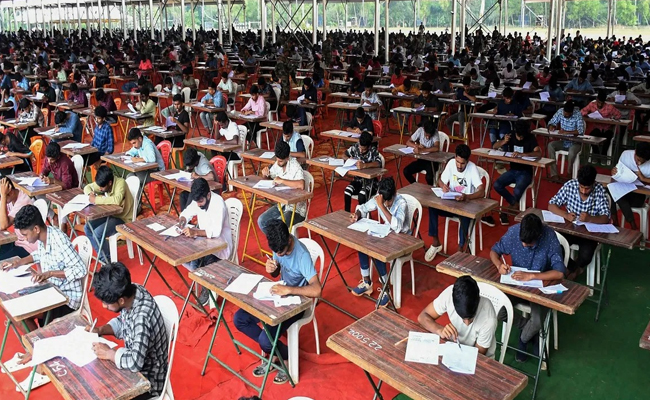
In India, Government exams are seen as a gateway to success in life. They offer job security, social mobility for the subaltern classes, a sense of recognition in society and a decent pay. While central government jobs are more lucrative and rewarding, they involve intense competition across the country, and the lack of nativity advantage pushes people towards state government jobs.
These state government jobs are relatively less competitive, offer a wide range of horizontal reservations, and also provide opportunities for regional aspirants as exams can be taken in regional languages. States like Karnataka even offer a good salary for those entering the government sector. This makes the state government exams more appealing to the aspirants.
Due to the serious unemployment crisis prevailing in India, the government jobs have become even more attractive these days. This has only increased competition further. We see reports of PhD candidates even applying for peon posts in government departments. Each post generally attracts more than 500 applicants and the syllabus too is generally vast for a government exam.
However, the devil lies in the details. What is more concerning is the non-academic aspect of state government exams: the psychological impact on aspirants. It begins with the notification. Once the notification is finalised, the exam dates are released. This exam date undergoes numerous revisions only to enhance the anxiety of hardworking aspirants. These dates are often poorly planned that they clash with other departmental recruitment exams or central government exams or some other important national events. All this owing to the great visionaries behind these exams!
Finally, the exam is conducted on a specified date, only to find that either the question paper was leaked or there were serious lapses in the conduct of the exam. They vary from issues concerning the translation of question paper, malpractice in the exam hall or even issues related to ill-advised answer keys. Then comes another mental agony to the aspirants when the whole exam gets cancelled and a re-exam is ordered.
In between these, hundreds of petitions are filed in the courts owing to the inefficiency of the exam conducting authority. This only pushes the examination dates further up adding to the agony of the candidates. If the examination has multiple levels like that of prelims and mains, these systemic issues occur once again in the lateral stages too.
More to these, there are some so-called organisations who try to make a name for themselves in the name of upholding aspirants’ interest. Their only objective is fame and to gain recognition among the political elites. While there are few who genuinely work for the students’ interest, many only try to gain a name for themselves putting genuine candidates under the bus. They cause more harm to the deserving candidates than upholding their interest.
Currently, in most of the state level government exams, the interview component has either been removed or their marks are reduced. Otherwise, this was another channel of ‘collection’ from the aspirants promising them a pivoted government post. That said, there are still murmurs that this kind of ‘setting’ still happens in various exams as seen in most of the states.
When such things are caught red-handed, it only results in the nullification of the exam and the order to re-conduct the same exam once again. The hard-working genuine aspirants who already faced the brunt of this agony, must face the wrath of this once again from the start.
Moreover, if there arise any structural issues like that of reservation overhaul or the interference of judiciary, the whole recruitment process gets stalled only to add fuel to the fire. All in all, the axe falls every time on the genuine candidates whose dreams now lay shattered!
Take for example the Gazetted Probationers notification of Karnataka released In Feb 2024; the preliminary exam date was postponed multiple times owing to different reasons only for the CM to intervene and strike off the exam due to translation issues. Later when the re-exam was conducted, similar calls were made but to no avail. Further, when the mains exam date was announced, it also underwent multiple changes even to the extent of judiciary stepping in at the last moment and allowing later entry for the mains exam. Even the mains exam was postponed ‘n’ number of times. Finally, when the exam was held, it took approximately 9 months to publish the results. While it’s good news to aspirants that finally the results are published, there are again allegations of corruption in this exam.
While the stakeholders are many in this turn of events – the exam conducting authority, the state government, the student organisations, the judiciary, the students involved in the malpractice – the ultimate casualty is just one, the hardworking genuine aspirants.
It is this bunch of people who have packed their bags and left home to prepare for these exams. They have also stayed socially isolated focussing only on clearing the exam and serving their state. In their prime age of working hard and building a career for themselves, they remain committed to these exams believing that there is light at the end of the tunnel. Many also find it extremely difficult to sustain themselves and depend on odd menial jobs to help themselves. A large proportion of these aspirants come from the lower to mid economic class and this makes their case even more painstaking.
It is high time that the state governments reform the examination authorities and align it with that of the standard of the UPSC. The judiciary should also exercise judicial restraint and ensure the process is not stagnated further. The student organisations should stop working for fame and start working for the interests of genuine candidates. Only then the real objective of state government jobs can be fulfilled in ensuring mutual benefits to the people, state government and deserving candidates. A system meant to reward merit must not become a test of endurance. Reforming state recruitment processes is no longer a policy choice - it is a moral obligation.
Disclaimer: The views and opinions expressed in this article are solely those of the author. They do not necessarily reflect the views, policies, or position of the publication, its editors, or its management. The publication is not responsible for the accuracy of any information, statements, or opinions presented in this piece.
Let the Truth be known. If you read VB and like VB, please be a VB Supporter and Help us deliver the Truth to one and all.
PM leads mega roadshow in Sikkim, to attend celebrations marking 50 years of statehood on Tuesday
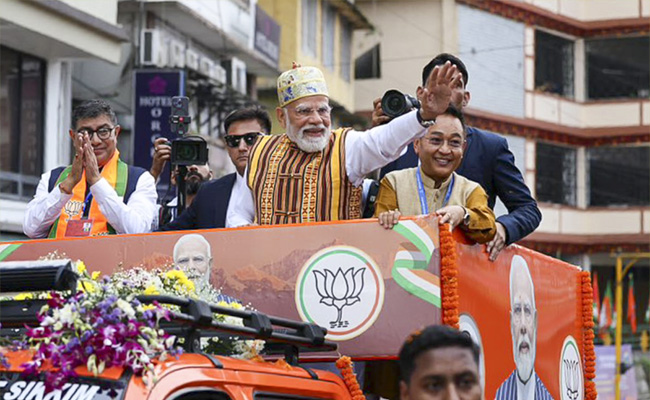
Gangtok (PTI): Prime Minister Narendra Modi led a mega roadshow in Gangtok on Monday evening after arriving in Sikkim to attend the closing ceremony of 50 years of statehood celebrations.
Modi, who wore a traditional Bhutia cap and a Lepcha coat, was received at the Libing helipad by Governor Om Prakash Mathur and Chief Minister Prem Singh Tamang.
From the helipad, the PM began the roadshow, which concluded at Lok Bhavan, where he will stay overnight.
On the open vehicle, Modi was flanked by CM Tamang on his left and state BJP president D R Thapa on his right.
Large crowds lined the roads for hours, waving national flags and waiting to catch a glimpse of the Prime Minister.
As his convoy moved slowly through the city, people broke into celebrations. Some enthusiastic supporters chanted "Modi, Modi, Modi", while a few women were seen showering flower petals in his direction.
Modi acknowledged the cheering crowds by waving continuously.
Tamang was also seen urging the gathered people to cheer for the PM during the roadshow.
The route of the roadshow was decorated, with arch gates erected at several points and large cut-outs of Modi placed along the roads.
On Tuesday, Modi will visit the Orchidarium in Gangtok. To commemorate the golden jubilee of Sikkim's statehood and showcase the state's ecological and floral heritage, the 'Swarnajayanti Maitri Manjari' Park has been developed as a world-class Orchid Experience Centre.
The PM will also participate in the closing ceremony of Sikkim's 50th statehood celebrations at Paljor Stadium, where he will unveil development projects worth over Rs 4,000 crore.
The projects cover several sectors, including infrastructure, connectivity, healthcare, education, power, urban development, environment, tourism and agriculture.
Modi is also scheduled to address the gathering on the occasion.
He was expected to attend the opening ceremony of the year-long celebrations last year, but could not reach the venue due to inclement weather. However, he addressed the event virtually from Siliguri in neighbouring West Bengal.
Tamang later thanked the people for giving the grand reception to the PM during the hour-long roadshow in the state capital.
"With immense fervour and heartfelt enthusiasm, the people of Sikkim accorded a grand and resounding welcome to Hon’ble Prime Minister Shri Narendra Modi ji on his arrival in Gangtok," he said in a social media post.
Tamang said people from all walks of life gathered in large numbers to greet him, reflecting the deep respect and warm affection the people of Sikkim hold for his leadership.
"It was indeed an honour to join him during the roadshow and witness the overwhelming love and support of the people firsthand," he said.