Targeting Desalination: Iran’s Strategic Threat to Middle East Survival
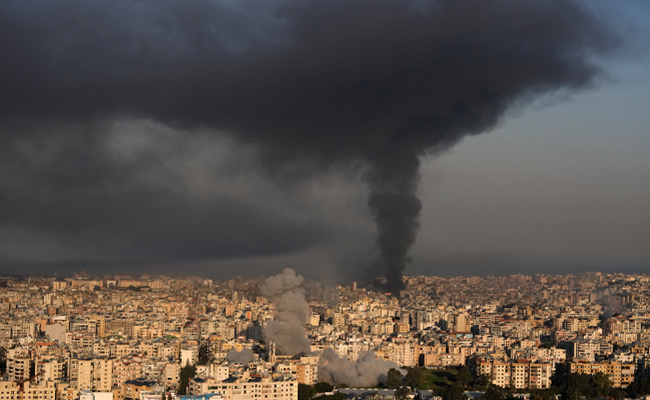
What happens when a country at war decides to attack not soldiers, but the basic things people need to survive? That is exactly the fear right now as the Iran-America war keeps getting worse day by day.
We all know that bombs and missiles are dangerous. But what many common people do not realise is that modern wars are not just fought on battlefields anymore. They can be fought by cutting off your drinking water, shutting down your banks, or crashing your airport systems. And that is the terrifying direction this war may be heading.
Let us understand this simply. After America and Israel launched massive air strikes on Iran, killing its Supreme Leader Ayatollah Ali Khamenei in the very first attack, Iran hit back hard. It fired hundreds of missiles and drones at nine countries. It killed American soldiers, British troops were narrowly saved, and civilians in Israel and Gulf nations lost their lives. Iran even attacked a British airbase in Cyprus. So the war has already crossed many borders.
But here is the really scary part. Iran may now go after something much more dangerous — water desalination plants. Now, you might ask, what is a desalination plant? In simple words, it is a factory that takes salty sea water and converts it into clean drinking water. In the Middle East, where there is very little natural fresh water, these plants are like lifelines. Without them, millions of people would have nothing to drink.
Just imagine how serious this is. Kuwait gets almost all its drinking water — 90 percent — from desalination. Oman is not far behind at 86 percent. Even a massive country like Saudi Arabia depends on these plants for 70 percent of its water, and the UAE for 42 percent. Now picture what happens if Iran fires missiles at these plants. Entire cities could run out of drinking water within days. According to leaked American diplomatic messages from 2009, if just one major plant in Saudi Arabia was destroyed, the country might have to evacuate its own capital city Riyadh within just one week. One week. That is how serious it is. And these plants are easy targets. They are big, they sit out in the open, and they cannot be hidden or moved. A few well-aimed missiles, and lakhs of families could be left without water.
But water is not the only weapon Iran might use. There is another kind of attack that most people do not even think about — cyber attacks. You see, in today's world, almost everything runs on computers. Your bank, your hospital, your airport, your electricity supply, your government offices — all of them depend on computer systems and the internet. A cyber attack means someone sitting thousands of kilometres away can crash all these systems without firing a single bullet.
Iran has done this before. In 2012, it carried out a massive cyber attack against Saudi Arabia's oil giant Aramco and Qatar's RasGas. Those attacks caused serious damage to their computer networks. Now, groups linked to Iran's Revolutionary Guards have already threatened to do this again. A man named John Hultquist, who works with Google's threat intelligence team, has confirmed that these groups are getting ready.
One common type of cyber attack is called a "denial of service" attack. Think of it like this — imagine a narrow road that can handle only 100 cars at a time. Now someone sends 10,000 cars onto that road all at once. What happens? The road gets completely jammed and nobody can move. That is exactly what hackers do to websites and computer systems. They flood them with so many fake requests that the system crashes. Banks stop working. Airport screens go blank. Power grids fail. All without a single bomb being dropped.
This is what makes this war different from any war we have seen before. It is not just about armies and tanks anymore. It is about attacking the basic systems that keep normal life running — water, electricity, internet, banking. The common man sitting in Dubai or Riyadh or Doha, who has nothing to do with this war, could suddenly find his tap running dry or his bank account frozen.
Wars in the Middle East have always pulled many nations in. But this one has missiles flying in more directions and across more borders than ever before. And if Iran decides to go after water plants and computer systems, the real victims will not be soldiers. They will be ordinary families just trying to live their daily lives.
That is the bitter truth of modern warfare. The battlefield is no longer far away. It is right inside your home.
(Girish Linganna is an award-winning science communicator and a Defence, Aerospace & Geopolitical Analyst. He is the Managing Director of ADD Engineering Components India Pvt. Ltd., a subsidiary of ADD Engineering GmbH, Germany.)
Disclaimer: The views and opinions expressed in this article are solely those of the author. They do not necessarily reflect the views, policies, or position of the publication, its editors, or its management. The publication is not responsible for the accuracy of any information, statements, or opinions presented in this piece.
Let the Truth be known. If you read VB and like VB, please be a VB Supporter and Help us deliver the Truth to one and all.
If Constitution amendment bill is passed, democracy will be finished in India: Priyanka
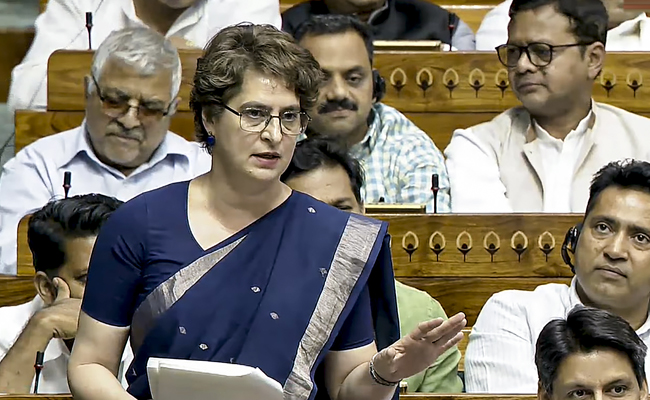
New Delhi (PTI): In a stinging attack, Congress leader Priyanka Gandhi Vadra on Thursday said the government began finishing off democracy by putting pressure on institutions, such as the Election Commission (EC) and the judiciary, but now, an "open attack" has been launched on democracy with the Constitution amendment bill.
Participating in a debate in the Lok Sabha on three bills introduced for amendments in the women's-quota law and setting up a delimitation commission, Priyanka Gandhi asked why can't the government give 33 per cent reservation to women on the current 543 seats of the Lok Sabha.
She said the bill talks of increasing the number of Lok Sabha seats to up to 850 -- to be done by a delimitation commission on the basis of the 2011 Census data.
"This seems fine on the surface but the real meaning comes to the fore when one carefully reads it. It smells of politics," the Congress leader said.
She said on reading the fine print, it shows that the three members of the delimitation commission will decide the fate of the states and their representation in Parliament.
"The government began finishing off democracy by putting pressure on institutions, such as the Election Commission, the judiciary, the media etc., but now, an open attack on democracy is being launched," Priyanka Gandhi said.
If this Constitution amendment bill is passed in Parliament, democracy will be finished in India, she added.
The Congress MP also narrated a background to the issue of women's reservation in legislative bodies.
"This issue is close to the heart of every woman. There is a background to this issue. The prime minister said this issue was blocked for 30 years. This was started by a person called Nehru. Not the Nehru they avoid so much but Motilal Nehru, who as the president of a committee prepared a list of 19 rights which were then passed as a resolution at the Karachi session of the Congress and formed the basis of giving women equal rights in Indian politics," she said.
She said it was Rajiv Gandhi who, as the prime minister, brought a bill for women's reservation in panchayats and nagarpalikas and finally, the bill for it was passed during the P V Narasimha Rao government of the Congress.
"Under the UPA, this was passed in the Rajya Sabha but a consensus could not be reached in the Lok Sabha. In 2018, Rahul Gandhi wrote a letter to Prime Minister Narendra Modi, calling for women's reservation," Priyanka Gandhi said.
Taking a swipe at Modi, she said it seems from the prime minister's address that the ruling Bharatiya Janata Party (BJP) is a champion of women's reservation.
"Any woman would tell you that women easily recognise those who try to mislead them," she said and urged the BJP to be careful.
"In 2023, when this law was passed, the Congress supported it and today also, the Congress is strongly in support of women's reservation. But the truth is that the debate is not on women's reservation. The bill that the government has brought has changed the direction of the debate," Priyanka Gandhi said and hit out at the BJP over the delimitation provisions in the bill.
The Constitution (131st Amendment) Bill to tweak the women's-quota law was introduced in the Lok Sabha on Thursday after a division of votes.
Two ordinary bills -- the Delimitation Bill and the Union Territories Laws (Amendment) Bill to implement the proposed amended women's-quota law in the Union territories of Delhi, Puducherry and Jammu and Kashmir -- were also introduced in the House.