War Reaches India's Backyard. Now What?
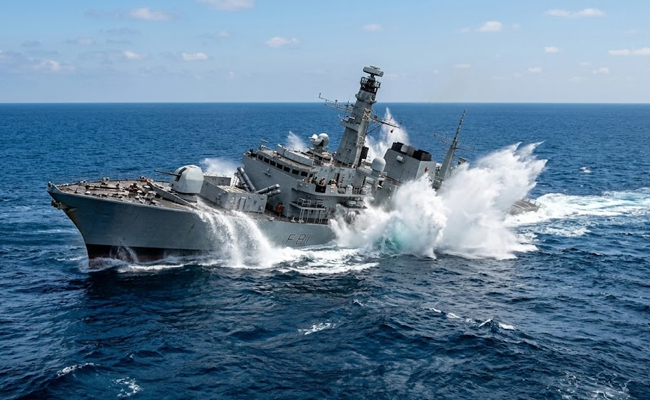
On Wednesday, 4th March, something happened in the waters near Sri Lanka that should have made every Indian stop and think. A United States submarine fired a torpedo — an underwater missile that travels silently through the sea and explodes on impact — and sank an Iranian warship called IRIS Dena. At least 80 sailors lost their lives. This was not happening somewhere far away in the Middle East. This happened just off the coast of a country that shares the Indian Ocean with us.
The IRIS Dena was not doing anything suspicious at the time. It was simply returning home after attending the MILAN-2026 naval exercise near Visakhapatnam, an international event proudly organised by the Indian Navy last month. The ship was on what is called a peaceful passage — quietly sailing back through international waters, not threatening anyone, not engaged in any battle. And then it was gone.
This is what makes this incident so deeply unsettling.
The war between the US-Israel alliance and Iran was supposed to be confined to West Asia and the Gulf region. With this single torpedo strike, that war has now moved into the Indian Ocean — right into India's neighbourhood. The question every Indian should now be asking is simple: what does this mean for us, and are our seas safe?
To understand the full picture, you need to know what international maritime law says — because this is where things get complicated. The main rulebook for the world's oceans is called UNCLOS, the United Nations Convention on the Law of the Sea. Think of it as the constitution of the seas. However, the United States has never signed this agreement. That alone tells you something important.
UNCLOS mostly covers peacetime rules — who owns which sea area, fishing rights, trade routes, and so on. But during a war, a separate set of naval warfare laws kicks in alongside it. Under these laws, since IRIS Dena was an Iranian Navy warship, it was technically considered a valid military target — regardless of where it was sailing or what it was doing at that moment. The Indian Express reported that several Indian Navy officers noted this uncomfortable legal reality clearly.
The UN Charter says in Article 2(4) that countries must not use military force against other countries. That sounds clear. But then Article 51 creates an exception — a country can attack in self-defence if it faces an armed threat. Additionally, the UN Security Council can give special permission for military strikes, as it did during the 1990 Gulf War. But getting that permission requires a majority vote, and none of the five permanent members — the US, Russia, China, the UK, and France — should veto it. Veto power means any one of these five countries can simply say no, and the entire decision is blocked.
It is also worth noting that the US Treasury Department placed official sanctions on the IRIS Dena back in February 2023. Sanctions are basically financial penalties and restrictions placed on a vessel or country — they don't prevent a ship from sailing, but they signal deep suspicion. At the time of the attack, the ship carried close-in weapon systems — rapid-fire guns used to shoot down incoming missiles or drones — and wider area defence systems. Despite this, it was caught completely off guard.
Vice Admiral G Ashok Kumar (Retd), former Vice Chief of the Indian Navy and India's first National Maritime Security Coordinator, told The Indian Express that in the maritime domain, there are simply no fixed boundaries for war zones. Once a conflict begins, it has no clear walls on the sea. The fighting had already started after the ship left Indian shores, he explained. He also noted that since the attack happened inside Sri Lanka's Exclusive Economic Zone — the sea belt where Sri Lanka holds special rights over resources — rescue teams could begin operations relatively quickly.
However, Rear Admiral Sudhir Pillai NM (Retd) raised a harder question. He pointed out that attacking a foreign warship on the high seas — international waters that belong to no single country — is generally considered illegal unless clearly justified as self-defence.
A senior Navy official, as reported by The Indian Express, called this strike a major escalation. The Iranian ship was not in a conflict zone. It was on a peaceful morning passage. Nobody on board would have imagined a torpedo was silently tracking them beneath the waves.
That is the terrifying reality of modern warfare at sea. There are no safe lanes, no guaranteed boundaries, no sacred stretches of water. The ocean is open — and today, it is deeply unpredictable.
India is watching. And India must think very carefully about what comes next.
(Girish Linganna is an award-winning science communicator and a Defence, Aerospace & Geopolitical Analyst. He is the Managing Director of ADD Engineering Components India Pvt. Ltd., a subsidiary of ADD Engineering GmbH, Germany.)
Disclaimer: The views and opinions expressed in this article are solely those of the author. They do not necessarily reflect the views, policies, or position of the publication, its editors, or its management. The publication is not responsible for the accuracy of any information, statements, or opinions presented in this piece.
Let the Truth be known. If you read VB and like VB, please be a VB Supporter and Help us deliver the Truth to one and all.
Iran offers to reopen Strait of Hormuz if US lifts its blockade and the war ends: officials
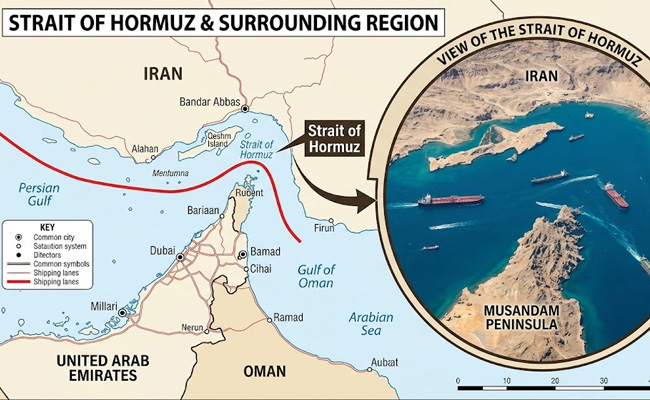
Cairo (AP): Iran has offered to end its chokehold on the Strait of Hormuz in exchange for the US lifting its blockade on the country and an end to the war, while proposing that discussions on the larger question of its nuclear programme would come in a later phase, two regional officials said Monday.
US President Donald Trump seems unlikely to accept the offer, which was passed to the Americans by Pakistan and would leave unresolved the disagreements that led the US and Israel to go to war on February 28.
With a fragile ceasefire in place, the US and Iran are locked in a standoff over the strait, through which a fifth of the world's traded oil and gas passes in peacetime. The US blockade is designed to prevent Iran from selling its oil, depriving it of crucial revenue while also potentially creating a situation where Tehran has to shut off production because it has nowhere to store the oil.
The strait's closure, meanwhile, has put pressure on Trump, as oil and gasoline prices have skyrocketed ahead of crucial midterm elections, and it has pressured his Gulf allies, which use the waterway to export their oil and gas.
The closure has also had far-reaching effects throughout the world economy, raising the price of fertilizer, food and other basic goods.
The proposal would push off negotiations on Iran's nuclear programme to a later date. Trump said one of the major reasons he went to war was to deny Iran the ability to develop nuclear weapons.
The two officials, who had knowledge of the proposal, spoke on condition of anonymity to discuss the closed-door negotiations between Iranian and Pakistani officials this weekend. The Axios news outlet first reported Iran's proposal.
It came as Iran's foreign minister visited Russia, which has long been a key backer of Tehran. It's unclear what, if any, assistance Moscow might offer now.
Strait of Hormuz remains blocked
===================
Iran's ability to choke off traffic in the Strait of Hormuz, the narrow mouth of the Persian Gulf, has proved one of its biggest strategic advantages in a war that has often boiled down to which side can take more pain.
Oil prices have risen steadily since the war began and tankers full of crude became stranded in the Persian Gulf, unable to safely transit through the strait and reach global distribution points.
On Monday, the spot price of Brent crude, the international standard, was trading at around $108 per barrel, nearly 50 per cent higher than when the war began.
Iranian foreign minister holds talks as negotiations with US stall
===============================
Trump last week indefinitely extended the ceasefire the US and Iran agreed to on April 7 that has largely halted fighting. But a permanent settlement remains elusive in the war that has killed thousands of people.
Iran's state-run IRNA news agency said Foreign Minister Abbas Araghchi landed in St. Petersburg on Monday morning ahead of a meeting with Russian President Vladimir Putin.
“It is a good opportunity for us to consult with our Russian friends about the developments that have occurred in relation to the war during this period and what is happening now,” Araghchi said in a video interview posted by IRNA.
It comes as Pakistan has been seeking to revive stalled talks between Iran and the US, and negotiations had been expected in Islamabad over the weekend. Instead, Trump called off a trip by his envoys and suggested the talks could take place by phone instead.
Over the weekend, Araghchi made two stops in Pakistan and a visit to Oman, which shares the strait with Iran. He also spoke by phone with counterparts in Qatar and Saudi Arabia on Sunday.
Iran wants to persuade Oman to support a mechanism to collect tolls from vessels passing through the strait, according to a regional official who spoke on condition of anonymity because he was not authorised to discuss the matter.
Oman's response wasn't immediately clear.
The official, who is involved in mediation efforts, also said Iran insisted on ending the US blockade before new talks and that Pakistan-led mediators are trying to bridge significant gaps between the countries.
Trump says Iran has offered a much better proposal
===========================
Trump told journalists Saturday that after he called off a trip by his envoys to Pakistan, Iran sent a “much better” proposal.
He did not elaborate but stressed that one of his conditions is that Iran “will not have a nuclear weapon”.
Iran insists its programme is peaceful, but the US wants to remove Tehran's stockpile of highly enriched uranium, which could be used to build a bomb, should Tehran choose to pursue one.
Since the war began, at least 3,375 people have been killed in Iran and at least 2,509 people in Lebanon, where fighting between Israel and the Iran-backed Hezbollah militant group resumed two days after the Iran war started. Another 23 people have been killed in Israel and more than a dozen in Gulf Arab states. Fifteen Israeli soldiers in Lebanon, 13 US service members in the region and six UN peacekeepers in southern Lebanon have been killed.
The ceasefire between Israel and Hezbollah has been extended by three weeks. Hezbollah has not participated in the Washington-brokered diplomacy.