We have to make people aware that they are consuming false news and narratives: Ismat Ara
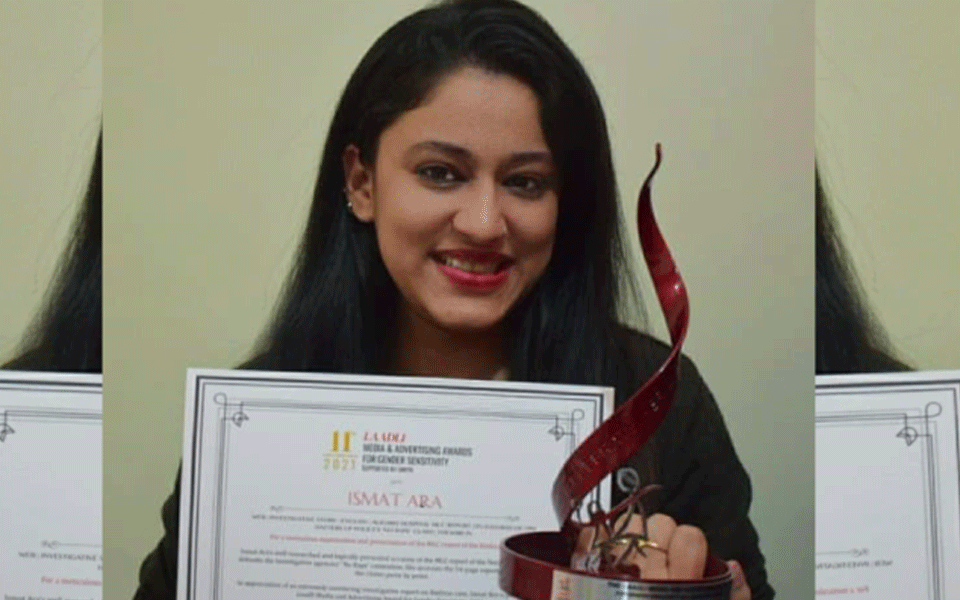
Ismath Ara is a young journalist with the web news portal thewire.in, who covers Uttar Pradesh-related special reports. Her reports and writings have previously been featured in The Hindu, News18, The Quint, and HuffPost among others. The manner in which Uttar Pradesh’s Hathras gang rape and murder case had been handled by the police had inadvertently brought the entire country to a shocking reverie. The UP police had claimed that the young Dalit woman had not been subjected to rape. But, after following and obtaining the statement given by the victim in her medical report before her death, Ismath Ara exposed that the police had been lying and confirmed the bitter truth that the victim had indeed been raped. Based on this report, even the CBI had finally cited a mistake on the part of Uttar Pradesh police and submitted a charge sheet confirming the gang rape of the Hathras victim.
Ismath Ara was honoured with this year’s ‘Ladli Award’ for her special report on the case. Speaking to ‘VarthaBharathi’ here, Ismath Ara conversed about the Hathras report, and the challenges faced whilst covering instances of Hate Crime.
You have contributed to some mainstream/legacy Media houses before joining The Wire? How have those works been different compared to your experience at present?
Depends on what one sees as “mainstream” media. I think that a lot of us in being critical of the mainstream media forget to appreciate new and upcoming web portals like The Wire and several others which are making an active attempt to revive journalism in the country. In the past, I have written for The Hindu, BBC Hindi and News 18 besides some other platforms. All of them offered different learning experiences.
At a time when Press Freedom in India is under attack, large sections of the media in India openly work like the government's propaganda machinery. As a journalist, how have you dealt with such pressures?
It is true that journalism in India is at an all time decline. From acting like PR of the ruling government to propagating hatred against marginalized communities like Christians, Dalits and Muslims, news channels are now doing the exact opposite of what they are supposed to be doing.
I entered journalism at an early stage when I was still a student because I strongly felt that voices from marginalized communities must fight for space in the media industry and take up as much space as possible. It is only when voices of Dalits, Christians, Muslims get some space that instances of injustice against these communities find some space in the media or are reported. As for me, the only challenge is to keep doing my job as a reporter from the ground consistently and to not look away from the problems of the common people.
As a woman journalist with a Muslim name, when you go to the ground and cover hate crimes, what kind of challenges, questions do you face?
Being a woman journalist is a challenging job, but also rewarding. Sometimes, as women, we get the opportunity to interact with women in close quarters where male reporters are traditionally not allowed to enter, especially when covering rural India. But of course, there is always an ever-present threat of sexual harassment. The fact that my seniors have often advised me to not travel alone while reporting for safety reasons also indicates the level of vulnerability that women face on ground.
Covering hate crimes is another challenging job. Anybody who asks questions to the majority community is looked at with suspicion. I remember during the Delhi riots, a reporter from the majority community was forced to prove his Hindu identity just because he dared to ask questions. You can imagine how tricky it can get if one belongs to the minority community which is currently a constant target for mobs and state forces.
You recently won the Laadli Award. How would you acknowledge your work?
I am grateful that my work on the Hathras gangrape and murder case of 2020 was recognized by the Laadli Award jury and Population First team. As a young journalist and reporter who does not fall into the mainstream category and as a result her work is constantly dismissed, it was a great honour. The story that won the award was an investigative piece on the medical report of the victim.
Please share your experience working on Hathras report which won you the Laadli award. ( How did you land that assignment ? What were the challenges ? How did you manage to dig out that information ? etc.)
I covered the Hathras case in my first year at a full time job. I had not even finished my Masters when I was sent to cover this case in UP. Covering it taught me a lot about the society and crimes against women in general but also of course about the flawed caste equations in Uttar Pradesh. While covering the case, I got an incomplete lead from a source. I instantly knew that if I could get a hold of the medico legal case (MLC) report of the victim before her death, it would disprove the state police theory that no rape had occured. Ultimately, after several days of investigation, I managed to get access to the document. Of course the process involved some sleepless nights and anxiety provoking steps, but I have no complaints.
Do you think media reports like the one you did, gave justice to Hathras' victim?
I don't know if the Hathras victim has been given justice yet. The case is still ongoing in court and we are still waiting for a judgment. For all the talk about women empowerment, rape cases in India still take years before they reach any conclusion. The family of the victim still lives in fear. CRPF personnel are instructed to guard the family but the family's demands to be given a house out of their village remains unmet.
But I do believe that my report definitely had an impact on the CBI chargesheet that was filed in December, as it drew its conclusion after a careful reading of the victim's testimony that I had first reported on in my story on the MLC report.
The CBI chargesheet invoked gangrape and murder charges along with charges under SC/ST Prevention of Atrocities Act against the four accused on the basis of the victim's written statement and her medical examination.
How challenging is it to cover hate crimes, violence? How does it affect you?
Covering hate crimes is something I choose to do. There is a constant influx of information from people across the country and especially Uttar Pradesh who reach out to me and other reporters who cover hate crimes in the hope that their voices will get a platform. It is anxiety inducing and can sometimes also give us sleepless nights. I remember during the Delhi riots when a doctor sent me a photograph of a Muslim man's genitals that had been torn apart, I couldn't shake that image off my mind. I could not sleep that night. There were other reporters, my friends, who also went through similar trauma. As a journalist however, I believe that it is my job to amplify stories of people who end up becoming victims of hate crimes in an increasingly polarized India.
Many young journalists either don't want to become reporters or they just don't take up serious issues that demand hard work, meticulous study and have to face other challenges. They are more interested in the glamour associated with the Media/TV Channels. What is the solution to this?
I don't completely believe that young men and women do not want to take up serious issues or do hard work. The young, aspiring journalists that I have either spoken to or mentored, have told me that they are afraid that they will have to go to jail or they will get beaten up if they become reporters. This is the result of the way journalists have been treated in the country, especially in the past few years.
In the recent past, journalists have been booked for exposing bad conditions in schools, picked up by the police from protest spots while reporting, arrested for a tweet and charged with sedition. In such circumstances, it is understandable that young men and women are scared to enter the profession.
The profession has always been demanding, but the added layers of threat and reduced personal safety have made it especially difficult for young students to even convince their families to allow them to choose journalism as a profession.
In this era of people believing in Whatsapp more than mainstream media and Godi Media doing government propaganda, what is the future of media in India according to you?
There is a famous saying, "People get the leaders they deserve." Messages with fake news on WhatsApp do more rounds than verified news these days. There has to be a coordinated effort to make people aware that they are consuming false news and narratives. I am as uncertain about the future of Indian journalism as anyone else, and all we can do is to keep reporting.
You are facing a case in Uttar Pradesh for your report on the death of a protesting farmer. What is the status of the case and how has it affected you professionally, personally?
Yes. A case was filed against my editor as well as me for a report we did during the farmers' protest. The report carried the version of a farmer's family. The farmer had lost his life during the Republic day tractor parade on 26 January, 2020. This story was carried by several news organizations. A few senior reporters were booked under sedition too for carrying the family's version. I and my editor were booked by Rampur police for "public mischief" and actions "prejudicial to national integration." Since the case was filed, the courts have given us anticipatory bail multiple times and when we filed an application in Supreme Court for quashing the FIR, it directed us to the high court and observed that it is "against the muzzling of the press." I have full faith in the judiciary.
What is the response to your kind of journalism from the general public ?
For all the trolling, negative comments, rape and death threats, there is an overwhelming level of support that I receive from people. Young students who get inspired, and the elderly who silently support us. This support may not be as visible but it is enough to keep going.
There is a feeling that your kind of Journalism is reaching only educated, elite , intellectual class and the general public is still behind the TV channels which are spreading lies and hatred. Do you agree?
I don't agree. I think now increasingly more and more people are realizing that TV channels are not the only medium of getting news. For example, during the Farmers protest, we saw that the farmers launched their own newspaper. They shunned those channels which demonized them and used the power of social media to their advantage. Most of them were not formally educated or "elite".
What is your suggestion to aspiring journalists?
I would urge aspiring journalists to constantly look for stories around them. Look around for stories that do not find space in mainstream media. Look for stories about issues from your villages, towns and communities that are overlooked. Learn to craft the pitch in a way that the story sounds interesting to editors. Before you pitch any story, ask yourself, "Why should the world know about this? What makes this story important?"
Let the Truth be known. If you read VB and like VB, please be a VB Supporter and Help us deliver the Truth to one and all.
Hijab decision taken out of fear of Karnataka Muslim convention, alleges Kumaraswamy
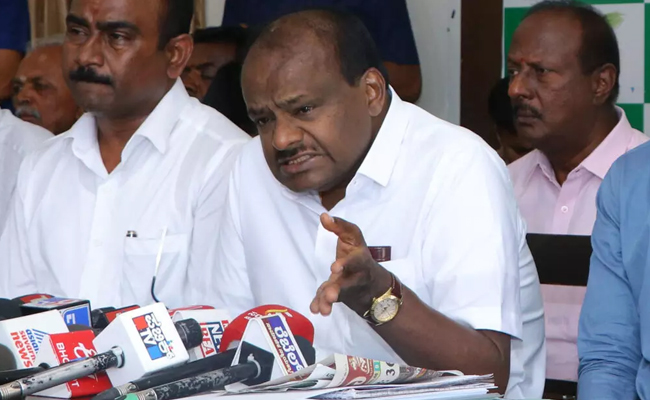
Bengaluru: Union Minister H. D. Kumaraswamy has alleged that the Karnataka government announced its decision on the hijab issue out of fear of the ‘Karnataka Muslim Convention’ scheduled to be held in Bengaluru on May 16 organized by Federation of Karnataka Muslim Organisations.
Addressing a press conference at the JD(S) state office, GP Bhavan, in Bengaluru on Thursday, Kumaraswamy said he respects all religions and has expressed his views on the issue on several public platforms in the past.
Questioning the timing of the government’s move, he said the Congress has been in power for three years and had taken no decision on the hijab issue during that period.
He alleged that the decision was taken only because the ‘Karnataka Muslim Convention’ is scheduled to be held at Town Hall in Bengaluru on May 16.
“If the government had the courage, it should have taken this decision immediately after coming to power. Why did it remain silent for three years?” he asked.
Kumaraswamy accused the Congress of making the announcement to appease a particular community.
He further said the matter is still pending before the courts and claimed that an interim order relating to the hijab issue remains in force.
According to him, issuing such an order before the legal proceedings are concluded amounts to disrespect towards the judiciary.
Kumaraswamy also alleged that the Congress brought the issue back into focus after the Davanagere by-election results.