When the World Ran Out of Gas, These Kitchens Did Not
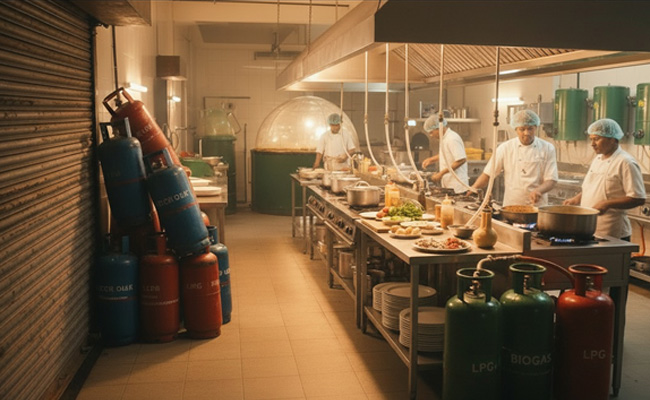
Imagine waking up one morning, turning the knob of your gas stove, and hearing — nothing. No flame. No hiss. Just silence. This is not a scene from a film. This is what thousands of hotels, restaurants, and small eateries in Bengaluru experienced in March 2026, when a war being fought thousands of kilometres away in West Asia quietly walked into Indian kitchens.
The conflict between the United States, Israel, and Iran choked the Strait of Hormuz — a narrow sea passage through which nearly one-fifth of the world's oil and gas travels. India depends on this single waterway for over 90 percent of its LPG imports. When the Strait was effectively blocked from March 1, LPG shipments to India slowed dramatically. The flame under Bengaluru's stoves flickered dangerously low.
Karnataka felt this almost overnight. On March 9, 2026, the State government capped commercial LPG supply at just 7,000 cylinders per day — with only 1,000 reserved for hotels, restaurants, and dhabas. To put that in context: Bengaluru alone has nearly 25,000 eating establishments. Menus shrank. Breakfast counters shut. Small eateries that were already struggling with a ₹115 hike in cylinder prices were forced to reduce operations or close entirely. The Bruhat Bengaluru Hoteliers' Association estimated losses of ₹150 crore in just three weeks.
But while most kitchens scrambled desperately for cylinders, two kitchens in Bengaluru never even noticed the shortage. Their secret? They had stopped depending on LPG years ago.
Konarak: The Kitchen That Feeds Itself
Konarak Hotels has been a landmark in Bengaluru's vegetarian dining world for over four decades. Its Residency Road and Kasturba Road outlets are popular, busy, and deeply loved. And when the LPG crisis hit, both kitchens kept cooking — without a single imported gas cylinder.
How? Four years ago, Konarak partnered with Carbon Age, a Bengaluru-based clean energy start-up, and installed a compact biogas plant right within its premises. The idea is beautifully simple. Every kitchen generates waste — vegetable peels, leftover food, scraps. Instead of throwing this waste away, Konarak feeds it into a digester. Bacteria inside the digester break down this organic waste and release methane-rich gas — the same gas that burns on your stove. This gas is then purified through scrubbers and compressed into cylinders, ready for use.
"It burns just like LPG," says Managing Director K. Ramamurthy. "We didn't have to change our burners at all. It's cheaper, cleaner, and always available."
That last part — always available — is what made all the difference during the crisis. While competitors were rationing meals and turning away customers, Konarak's chefs cooked normally, served fully, and lost nothing.
There is another beautiful detail here. After the gas is extracted, what remains is a thick, nutrient-rich liquid called digestate or slurry. Konarak sends this to nearby farms, where it works as high-quality organic manure. So the same tomatoes and vegetables that arrive in Konarak's kitchen may one day grow better because of the waste that kitchen produced. It is a complete circle — waste becomes gas, gas cooks food, leftover slurry grows more food.
This is not just smart business. It is a model that any hotel, hostel, temple kitchen, or large canteen can replicate.
Adamya Chetana: Feeding 2 Lakh Children Without LPG
If Konarak's model is impressive, what Adamya Chetana Foundation does is nothing short of extraordinary.
Founded by the late Union Minister Ananth Kumar and now led by Tejaswini Ananth Kumar, Adamya Chetana runs one of India's largest community kitchens in Basavanagudi, Bengaluru. Every single day, this kitchen cooks and distributes nearly two lakh mid-day meals to children in government schools across the city under the Akshara Dasoha programme.
In 2016, long before anyone was talking about energy crises, Adamya Chetana had already begun its journey away from LPG. In partnership with the Indian Institute of Science (IISc), the Bangalore Bio Innovation Centre, and the Bruhat Bengaluru Mahanagara Palike (BBMP), the foundation installed an advanced bio-methanation and solar hybrid system. This plant processes around 1.5 tonnes of food and vegetable waste every day. The methane generated is purified, stored, and piped directly to industrial burners that cook rice, sambar, and vegetables for lakhs of young children.
The numbers are staggering. The plant generates 130 to 140 cubic metres of biogas daily — equivalent to replacing 150 commercial LPG cylinders every month. This saves between ₹90,000 to ₹1 lakh monthly. It also prevents over 30 tonnes of carbon emissions every year.
Today, over two million meals have been cooked using biogas at this single kitchen. The foundation has also installed a solar-steam system for boiling water. The result: the entire kitchen runs completely free of LPG and diesel.
"We cannot depend on imported fuel every time a global crisis breaks out," says Tejaswini Kumar. "Waste and sunlight are free — that is where our energy security lies."
The Lesson Every City Needs to Hear
India consumes around 31 million tonnes of LPG every year. Domestic production meets less than half of that. Every conflict in West Asia, every blocked shipping lane, every drone strike near a refinery — all of it directly hits Indian kitchens. That is the fragile reality we live in.
But Konarak and Adamya Chetana have proved something important: we do not have to live this way. Our own kitchen waste, our own sunlight, our own ingenuity — these are enough to keep the flame burning, even when the world goes dark.
When the next crisis hits, the kitchens that planned ahead will keep cooking. The rest will wait in line for a cylinder that may never arrive.
(Girish Linganna is an award-winning science communicator and a Defence, Aerospace & Geopolitical Analyst. He is the Managing Director of ADD Engineering Components India Pvt. Ltd., a subsidiary of ADD Engineering GmbH, Germany.)
Disclaimer: The views and opinions expressed in this article are solely those of the author. They do not necessarily reflect the views, policies, or position of the publication, its editors, or its management. The publication is not responsible for the accuracy of any information, statements, or opinions presented in this piece.
Let the Truth be known. If you read VB and like VB, please be a VB Supporter and Help us deliver the Truth to one and all.
Siddaramaiah stresses need to establish Supreme Court bench in South India
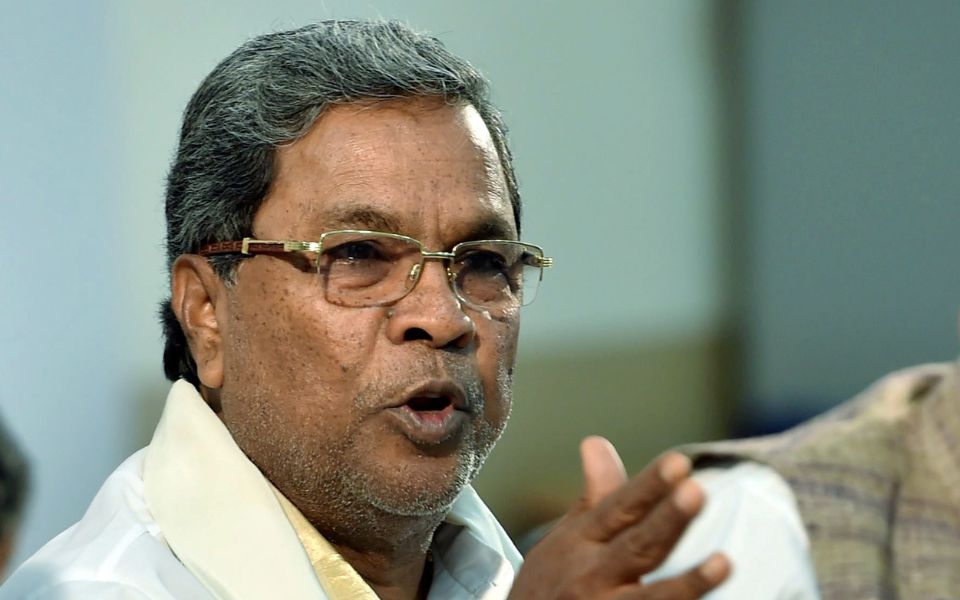
Bengaluru (PTI): Karnataka Chief Minister Siddaramaiah on Saturday stressed the need to improve accessibility to the highest court of the land, asserting that establishing a Supreme Court bench in South India would go a long way in ensuring justice.
Speaking at the 22nd Biennial State Level Conference of Judicial Officers with a theme 'Reimagining the Judiciary in the era of Artificial Intelligence', he said, the authority of a judge must never be overshadowed by the authority of an algorithm.
"Even as we explore these new frontiers, we must remain mindful of the enduring challenges facing our judiciary," the chief minister said.
"Pendency of cases continues to be a serious concern that affects the timely delivery of justice. While technology can provide tools to address this, it must be complemented by systemic reforms through strengthening infrastructure, increasing judicial capacity, and modernising court processes," Siddaramaiah said.
"There is also a strong and compelling need to improve accessibility to the highest court of the land. The establishment of a Supreme Court bench in South India would go a long way in ensuring justice," he said.
Chief Justice of India, Surya Kant, Supreme Court Judges B V Nagarathna and Aravind Kumar and Chief Justice of High Court of Karnataka Vibhu Bakhru were among those present.
The CM said, "We stand today at a defining juncture where law and technology are no longer separate domains, but interconnected forces shaping governance, rights, and the very nature of justice itself."
"Artificial Intelligence is emerging as a transformative force that challenges how we interpret evidence, how we understand facts, and how decisions are arrived at. It offers immense promise, aiding faster legal research, improved case management, and the possibility of reducing pendency through intelligent systems," he said.
"Yet, it also raises profound concerns. Algorithmic bias can undermine the guarantee of equality before law. Opaque systems may weaken the doctrine of reasoned decisions, which lies at the heart of our judicial process," he added.
Siddaramaiah said, Judicial independence, which is the cornerstone of our democracy, must be preserved not only from external pressures but also from subtle technological dependence.
"The authority of a judge must never be overshadowed by the authority of an algorithm," he said.
Pointing out that the emergence of AI-generated evidence presents new challenges for our legal system, the CM said, Deepfakes, synthetic data, and machine-generated content compel us to revisit established doctrines relating to admissibility, burden of proof, and authenticity.
"The courts will increasingly be called upon to determine what constitutes reliable evidence in a digital age. In doing so, we must ensure that truth remains grounded in verifiability and integrity, not merely in technological sophistication," he said.
Hoping that the judiciary will play a defining role in shaping the regulatory framework for artificial intelligence in India, he further said, "through well-established constitutional doctrines such as due process, proportionality, and the right to privacy, our courts will determine the contours within which AI must operate."
"The judiciary, therefore, is not only a user of technology but also the ethical compass that will guide its deployment in society," he added.
Noting that technology also offers meaningful opportunities to strengthen judicial processes, Siddaramaiah said, AI-assisted legal research may democratise access to precedents and reduce disparities in legal knowledge.
Siddaramaiah also said that blockchain technology holds promise in ensuring secure, tamper-proof judicial records. Stating that the intelligent case management systems can streamline court functioning and reduce delays, he said, "However, these innovations must be adopted with care, ensuring that efficiency does not come at the cost of fairness."
"In this transformation, the capacity of our judicial institutions becomes critical. Judges of the future must be equipped not only with legal acumen but also with a clear understanding of technological systems," he added.
Stating that the question is how artificial intelligence intersects with the fundamental principles of equality and social justice, the CM said, if not carefully designed and regulated, AI systems can replicate and even amplify existing social inequalities.
No algorithm can replace the human capacity for empathy, the wisdom that comes from lived experience, or the moral reasoning that defines judicial decision-making, he said, "Technology can assist, but it cannot replace the human conscience that lies at the heart of justice."
Siddaramaiah said, the Government of Karnataka remains committed to building robust judicial infrastructure, facilitating digital transformation, and creating an ecosystem where innovation and justice can progress together.