AI reshaping music, filmmaking in Kannada cinema
Bengaluru: Artificial Intelligence is slowly changing the way music and creativity are produced in the Kannada film industry, raising concerns among musicians, singers and technicians, The New Indian Express reported on Sunday.
Music composer, actor and director V Manohar reportedly said, AI is being used to write lyrics, especially in low-budget movies. Once lyrics are generated, AI can suggest thousands of tunes. It even asks whether the voice should be male or female. With one click, a complete song is ready.
“If this continues, singers and musicians will have less or no work in the coming days. But it may not succeed either. A few years ago, dubbing was allowed and people could watch movies in any language they preferred. But not many took to it as they wanted to watch a movie in the original,” TNIE quoted him as saying.
According to the report, Filmmaker Avinash U Shetty, a National Award winner, said resistance to new technology is not new. Those who resisted shifting from analogue to digital films years ago have now embraced it. The industry is now using only 10% of the AI potential. If it is scaled up, it can do unimaginable things. What we consider bad now, may not be after five years.
Highlighting the cost advantage, Sangamesh, an independent creator reportedly said, he made a three-minute video using AI for just Rs 4,500. Earlier, the same work would have cost nearly Rs 15 lakh. I finished the entire project in three days. The only expense was the AI software subscription, he said.
These days, it has become difficult to differentiate between the real and AI. AI is creating artistes. Scenes like war, big fights and dance can be shot with a lesser number of artistes. Then with the aid of visual effects and AI, you can achieve what you have in mind, he said.
Actor-director D P Raghuram felt that while AI has made an impact on music, it lacks emotional depth. Cinema earlier involved hard work and strong emotional connections. AI can help improve our work, but creativity should remain human, he reportedly said.
As per the report, earlier, Kannada cinema employed hundreds of junior artistes, who not only earned wages but also shared meals on sets and formed lasting bonds with stars like Dr Rajkumar, Vishnuvardhan and Ambareesh. Today, filmmakers fear that increasing dependence on AI could reduce such human connections, turning creativity into just another automated process.
Let the Truth be known. If you read VB and like VB, please be a VB Supporter and Help us deliver the Truth to one and all.
Karnataka CM Siddaramaiah calls for strong governance to drive clean energy transition
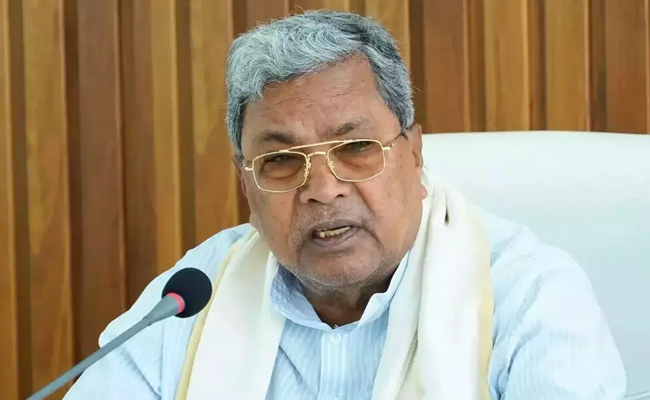
Bengaluru (PTI): Karnataka Chief Minister Siddaramaiah on Saturday said governments must act as enablers by creating stable policy frameworks, investing in innovation, and ensuring that clean energy remains affordable and accessible to all sections of society.
Public policy must align economic growth with environmental responsibility, he said.
Addressing the International Conference on Sustainable Energy: An Agenda for India at 2047, the CM said, “At a time when India is poised for a historic transformation as we approach 100 years of Independence, this dialogue assumes profound significance.”
Describing the conference as a multidisciplinary platform, he said it is not merely an academic or policy exercise but a convergence of law, governance, technology, and justice.
Siddaramaiah said the global energy transition stands at a critical juncture today, with extreme weather events, resource stress, and ecological imbalance affecting livelihoods across continents. However, while the transition to clean energy is a global necessity, he said it must be guided by the principles of equity and justice.
“Developed nations, which have historically contributed the most to carbon emissions, carry a greater responsibility—not only in reducing emissions but also in enabling technology transfer, climate finance, and capacity building for developing economies,” he said.
He further said the sustainable development goals provide a shared global framework guiding nations in aligning growth with sustainability, equity, and responsible governance.
“India’s path must therefore be unique—balancing growth with sustainability, and ambition with inclusiveness. Energy is not just a resource; it is the backbone of dignity, development, and resilience,” he said.
The CM emphasised the role of governance, stating that markets, by their very nature, do not assume responsibility for equity or long-term sustainability.
“Therefore, the transition to sustainable energy cannot be left to markets alone; it requires strong and visionary governance,” he said.
“Governments must act as enablers by creating stable policy frameworks, investing in innovation, and ensuring that clean energy remains affordable and accessible to all sections of society. Public policy must align economic growth with environmental responsibility,” he added.
On the role of the judiciary, he said, “Equally important is the role of the judiciary. In a constitutional democracy like ours, the judiciary acts as the guardian of environmental justice and intergenerational equity.”
“In India, this responsibility is deeply anchored in our constitutional framework. The directive principles of state policy call upon the state to protect and improve the environment, while the fundamental duties place an obligation on every citizen to safeguard natural resources for future generations,” he noted.
Highlighting judicial interventions, Siddaramaiah said the Supreme Court has expanded the scope of the right to life to include the right to a clean and healthy environment.
“Landmark interventions have ensured stricter environmental regulations, promoted sustainable industrial practices, and reinforced the principle that development cannot come at the cost of ecological destruction,” he said.
“Judicial doctrines such as the polluter pays principle, the precautionary principle, and intergenerational equity have strengthened environmental governance and guided India’s path towards sustainable development,” he added.
Detailing Karnataka’s progress, the CM said the state is proud to be at the forefront of India’s renewable energy journey. “Karnataka has actively promoted clean technologies, encouraged private investment, and built progressive regulatory frameworks that support innovation and sustainability,” he said.
The state has an installed renewable energy capacity of over 25,700 MW, with solar contributing more than 10,500 MW, hydro nearly 3,800 MW, and wind close to 7,900 MW, making it one of the leading states in clean energy deployment, he added.
“But our vision goes beyond capacity creation. We are working towards strengthening grid infrastructure and energy storage systems, promoting green hydrogen and emerging clean technologies, and advancing energy access to every household,” he said.
“We were among the first states in India to introduce a dedicated renewable energy policy. Under our Resource Adequacy Plan, we are targeting over 38 GW of additional wind and solar capacity, supported by battery energy storage systems to ensure reliability and grid stability as renewable penetration increases,” he said.
Highlighting skill development efforts, he said programmes such as Surya Mitra and Vayu Mitra, along with collaborations with global institutions and incubation centres, are preparing the next generation to lead this transition.
Calling for long-term vision, Siddaramaiah said, “The choices we make today will define the world we leave behind for future generations.”
“The transition to sustainable energy is not merely about reducing carbon footprints; it is about redefining our development paradigm. It is about ensuring that growth does not come at the cost of our planet, and that progress does not exclude the vulnerable,” he said.