AR Rahman was 'starving' to look thin a day before his Oscar win
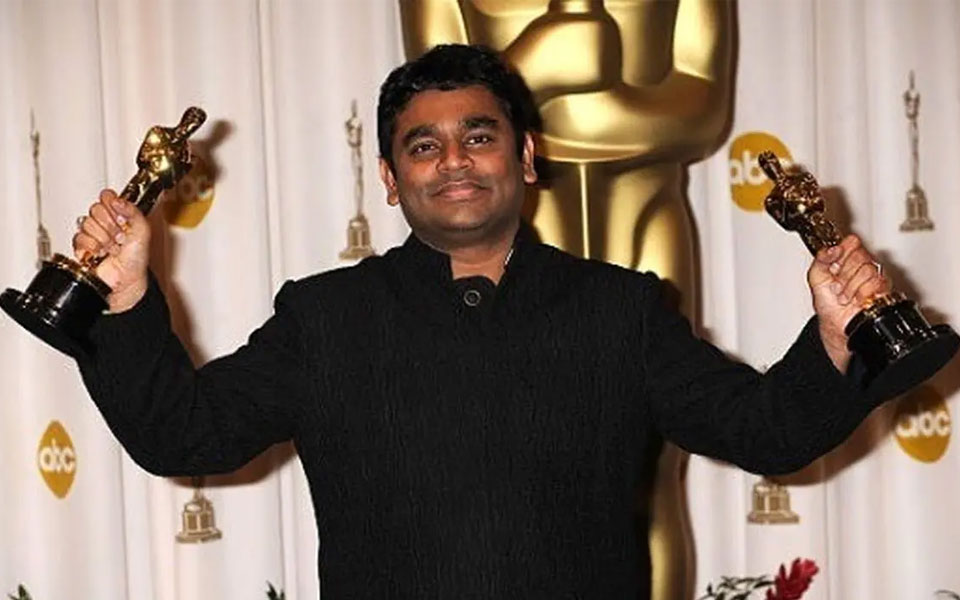
Mumbai, Feb 5: AR Rahman created history in 2009 by becoming the first ever Indian to win two Academy Awards in a single night but the music composer says on the eve of the ceremony, he was "starving" to look in shape.
Rahman bagged two Academy Awards, one for the original score for "Slumdog Millionaire" and the other for the hugely popular global hit "Jai Ho."
While things changed dramatically for Rahman post his win, when asked what was his mental space on the eve of the big award event, Rahman told PTI, "Actually nothing. I was just starving to look thin for the ceremony!"
The Danny Boyle-directed drama swept the 81st Academy Award with 8 trophies out of 10 nominations.
Rahman shot to global fame with his win and went on to get two more Oscar nominations in 2011 for his original score and song for Boyle's "127 Hours".
When asked if it is difficult to move past the shadows of two Oscars, Rahman said, "Yes. I have moved on because it's a great identity for me and I needed that identity to be in Hollywood. Now, whenever I am mentioned there, people know my name.
"That helped me move further not just in music, but also producing movies and going into technologies like virtual reality and cinematic virtual reality and so much of the stuff that's going to come this year. So, all this freedom came with this power."
The composers was speaking at a special ceremony to celebrate the film's ten years of Oscar win, Monday.
The event took place in Dharavi, Asia's largest slum, as an ode to "Slumdog Millionaire", which chronicled the story of a boy's journey from rags to riches.
On the occasion, Rahman narrated an incident how Anil Kapoor missed watching him bag the Golden Globe award as the actor went out to get a drink for him.
"I was sitting next to Anil and I was so thirsty. He was very kind and said he'll get a Sprite for me. By the time he went and got it, I got the award," Rahman said.
To which Anil replied, "I'll never forgive him! I was waiting for him to get an award. But he was thirsty so I said I'll go. There was so much crowd at the bar counter, by the time I was back he got the award!
"But then I saw the Oscar, which was the cherry on the cake. You don't know what I felt when he went on stage and the song was played. I wish I could break the protocol and start dancing on stage. I had to control myself," he added.
Let the Truth be known. If you read VB and like VB, please be a VB Supporter and Help us deliver the Truth to one and all.
Nursing college student from Kerala dies by suicide at hostel, parents allege foul play
Bengaluru (PTI): A 19-year-old student from Kerala, who was studying at a private nursing college here, allegedly died by suicide in his hostel room, police said on Friday.
The deceased was identified as Adhityan P A, a second-year student at a nursing college in Bommasandra, they said.
On April 29, he was found hanging from a ceiling fan in his hostel room, police said, adding that he left behind a suicide note stating that no one was responsible for his death.
Preliminary investigation suggested that he may have been suffering from depression, and there may have been other issues which are being probed, a senior police officer said.
According to police, in his complaint, the deceased's father, Pradeep S, claimed that a college representative informed him upon his arrival in Bengaluru that his son had died under suspicious circumstances and that it was a case of suicide in the college hostel.
"However, I firmly believe that my son would not have taken such a step. He was of good character and mentally strong. Therefore, I strongly suspect foul play in his death," he claimed.
He also highlighted an incident that occurred approximately 20 days ago, when his son informed him that some of his hostel roommates were involved in drug use and were caught by hostel authorities.
"They were warned along with my son, although he was innocent and not involved in the incident. This situation may be relevant to the present case," he stated.
The complainant has urged the police to conduct a thorough and impartial investigation into the matter and take appropriate legal action.
A case of unnatural death has been registered at Hebbagudi Police Station here. Further investigation is underway, and all allegations are being examined, police said.