Banu Mushtaq’s Kannada short story collection ‘Heart Lamp’ on International Booker Prize shortlist
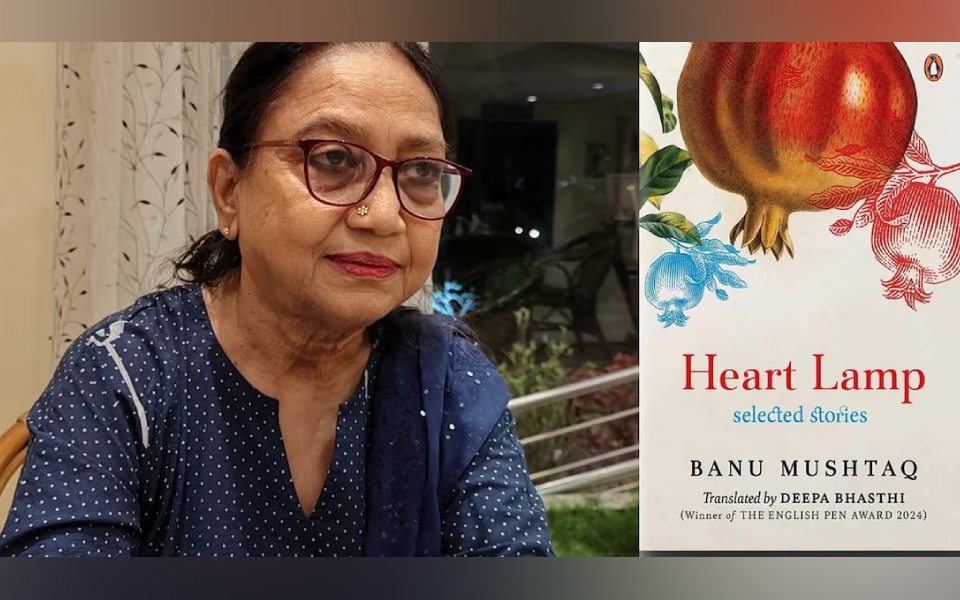
London, Apr 9 (PTI): Karnataka-based writer, activist and lawyer Banu Mushtaq’s short story collection ‘Heart Lamp’, translated from Kannada to English by Deepa Bhasthi, was on Tuesday shortlisted for the International Booker Prize 2025 in London.
It marks the first time a Kannada title has made it this far in the race for the coveted GBP 50,000 literary prize – divided between author and translator.
Shortlisted among six worldwide titles, Mushtaq’s work appealed to the judges for its “witty, vivid, colloquial, moving and excoriating” style of capturing portraits of family and community tensions.
“Stories about encroaching modernity, as told through the lives of Muslim women in southern India. An invigorating reading experience,” reads the judges’ reason for including it on the shortlist.
The 12 stories, published originally between 1990 and 2023, will now go head-to-head with authors from across the world.
“My stories are about women – how religion, society, and politics demand unquestioning obedience from them, and in doing so, inflict inhumane cruelty upon them, turning them into mere subordinates,” Mushtaq said in a statement.
“The daily incidents reported in the media and the personal experiences I have endured have been my inspiration. The pain, suffering, and helpless lives of these women create a deep emotional response within me. I do not engage in extensive research; my heart itself is my field of study,” she said.
The book’s translator, Deepa Bhasthi, added: “For me, translation is an instinctive practice, and each book demands a completely different process. With Banu’s stories, I first read all the fiction she had published before I narrowed it down to the ones that are in ‘Heart Lamp’.
“I was lucky to have a free hand in choosing what stories I wanted to work with, and Banu did not interfere with the organised chaotic way I went about it.”
In a statement, Penguin Random House India said, "This achievement marks a historic moment, with Heart Lamp becoming one of the very few Kannada-language works to be recognised at this level".
Moutushi Mukherjee, Penguin Commissioning Editor who worked on the book, said, "To see Heart Lamp on the International Booker shortlist is an extraordinary affirmation of the power of Indian regional literature and the importance of translation".
The annual prize celebrates the best works of long-form fiction or collections of short stories translated into English and published in the UK and/or Ireland between May 2024 and April 2025.
The other five books shortlisted from the longlist for this year’s prize are: ‘On the Calculation of Volume I’ by Solvej Balle, translated from Danish by Barbara J. Haveland; ‘Small Boat’ by Vincent Delecroix, translated from French by Helen Stevenson; ‘Under the Eye of the Big Bird’ by Hiromi Kawakami, translated from Japanese by Asa Yoneda; ‘Perfection’ by Vincenzo Latronico, translated from Italian by Sophie Hughes; and ‘A Leopard-Skin Hat’ by Anne Serre, translated from French by Mark Hutchinson.
Max Porter, International Booker Prize 2025 Chair of judges, said: “This list is our celebration of fiction in translation as a vehicle for pressing and surprising conversations about humanity. These mind-expanding books ask what might be in store for us, or how we might mourn, worship or survive. They offer knotty, sometimes pessimistic, sometimes radically hopeful answers to these questions.
“Taken together they build a miraculous lens through which to view human experience, both the truly disturbing and the achingly beautiful. They are each highly specific windows onto a world, but they are all gorgeously universal.”
Each shortlisted title is awarded a prize of GBP 5,000 – shared between author and translator – and the announcement of the 2025 winning title will take place May 20 at a ceremony at Tate Modern in London, with the winning author receiving GBP 25,000 and the translator or translators dividing the other half of GBP 25,000.
In 2022, Geetanjali Shree and translator Daisy Rockwell won the coveted prize for the first-ever Hindi novel ‘Tomb of Sand’, with Perumal Murugan’s Tamil novel ‘Pyre’, translated into English by Aniruddhan Vasudevan making it to the longlist in 2023.
Fiammetta Rocco, Administrator of the International Booker Prize, adds: “With all six books on the list published by independents for the first time, I'd like to thank the publishers for their ongoing commitment to bringing so many original and exciting international writers and translators to English language readers.
“Their passion, along with that of the many booksellers and librarians championing global writing, has no doubt helped to fuel a very welcome boom in translated fiction in the UK and Ireland.”
Let the Truth be known. If you read VB and like VB, please be a VB Supporter and Help us deliver the Truth to one and all.
Centre spent Rs 76.13 lakh on print media ads for RSS centenary, reveals RTI

New Delhi: The Union Ministry of Culture allegedly spent Rs 76.13 lakh on print advertisements marking the 100-year celebrations of the Rashtriya Swayamsevak Sangh (RSS), according to a Right to Information (RTI) reply.
The information was sought by RTI activist Ajay Basudev Bose, who filed an application seeking details on expenditure incurred by the ministry for advertisements commemorating the RSS centenary.
Bose shared a picture of the reply from the ministry on his official ‘X’ handle.
“It is informed that an amount of Rs 76,13,129 has been spent on advertisement given in various print media by the Ministry of Culture on the occasion of the completion of 100 years of RSS,” the government’s reply stated.
RTI reply shows Min of Culture Govt of India spent a Whopping Rs 76L,13K,129 on Advertisement in Print Media on occasion of 100 yrs of #RSS
— AJAY Basudev Bose (@AjayBos93388306) April 16, 2026
When Everyone knows RSS is Not Registered & Does not Pay any Tax is it justified to spend Tax Payers Money on such Private event??@RSSorg… pic.twitter.com/dW4IUtdNCg
Bose questioned the expenditure in the post X, “when Everyone knows RSS is Not Registered & Does not Pay any Tax is it justified to spend Tax Payers Money on such Private event??”
Reacting to the development, Karnataka’s IT-BT and Panchayat Raj Minister Priyank Kharge also criticised the spending.
In a post on X, he asked why public money was being used for what he described as a “private ideological project.”
"Modi Sarkar spent Rs 76,13,129 of public money on newspaper advertisements to celebrate 100 years of the RSS. Why is Government spending taxpayers money on an unregistered, non-tax-paying organisation to celebrate their centenary?," he added.
Why is public money being used to serve a private ideological project?
— Priyank Kharge / ಪ್ರಿಯಾಂಕ್ ಖರ್ಗೆ (@PriyankKharge) April 16, 2026
Modi Sarkar spent ₹76,13,129 of public money on newspaper advertisements to celebrate 100 years of the RSS.
Why is Government spending taxpayers money on an unregistered, non-tax-paying organisation to… pic.twitter.com/EoZ6Pim3IM
According to reports, the RSS describes itself as a volunteer-based organisation and has stated that it functions as a body of individuals rather than a registered entity.
Founded by Keshav Baliram Hedgewar in 1925, the organisation is marking its centenary year beginning from Vijaydashami in 2025, with the milestone observed on October 2.