Cobrapost sting operation: Why Vidya Balan said no in cash for tweet sting

Mumbai, Feb 22: Actor Vidya Balan, who was among the four people who said no to cash for tweet in a sting operation, said she declined the offer because she was "uncomfortable" in using her social media handle for something like that.
Over 30 Bollywood, TV and music personalities were caught on tape by Cobrapost reporters agreeing to promote the agenda of political parties in exchange for money.
Vidya, Arshad Warsi, Raza Murad and Saumya Tandon were the only ones who refuses to do it.
When asked about it, Vidya told reporters, "I can't pass a judgement on anyone else but all I will say is I'm uncomfortable doing it, which is why I didn't do it. To each his own.
"May be they didn't even realise because today on social media, people are commenting on anything. May be they thought this was not big. We should not become judge, jury and executioners at the drop of hat. I could not do it so I didn't."
She was speaking at the launch of her Radio show "Dhun Badalke Toh Dekho" on 92.7 Big FM.
At the event, the actor was also asked about her opinion on banning Pakistani artistes after the Pulwama attacks in the valley.
Vidya said though she is a believer that art unites, but the attack was too much.
"I did believe that there's no better way to bring people together than arts. Whether it is music, dance, theatre. May be for now we should take a break. Some tough calls have to be taken at some point. We as Indians are very large-hearted, accepting, forgiving. But after a point..."
Let the Truth be known. If you read VB and like VB, please be a VB Supporter and Help us deliver the Truth to one and all.
Allahabad court restrains FIR order against Gandhi
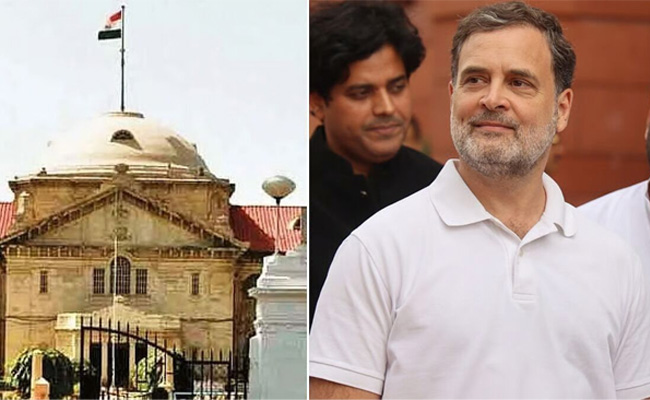
Lucknow (PTI): The Lucknow bench of the Allahabad High Court has restrained its order directing an FIR against Congress MP Rahul Gandhi in connection with the alleged dual citizenship controversy.
The court will now hear the parties on whether prior notice to the accused was legally required.
A bench of Justice Subhash Vidyarthi, which had in Friday in an oral order observed that prima facie cognisable offences appeared to be made out against Gandhi, and permitted the Uttar Pradesh government to hand over the probe to a central agency, said it would first examine the legal position on issuance of notice before passing any direction.
The development came after the bench, before signing its dictated order, came across a full court verdict mandating that notice be issued to the proposed accused in such matters.
The court noted that none of the counsel brought this legal requirement to its attention in the earlier hearing.
ALSO READ: Argument over bike accident leads to murder, triggers mob violence, arson in Ahmedabad; 2 held
The bench has posted the matter for April 20.
The order was passed on a plea filed by Karnataka-based BJP worker S Vignesh Shishir.
During the Friday proceedings, Deputy Solicitor General of India S B Pandey produced records of the Centre relating to the citizenship controversy, while government advocate V K Singh submitted on behalf of the state that the allegations prima facie disclosed cognisable offences.
After a hearing, the bench observed that material on record indicated that Gandhi had allegedly committed cognisable offences and that the matter warranted investigation.
In his petition, Shishir alleged that Gandhi was a UK citizen and had incorporated a company, M/s Backops Ltd, in August 2003, declaring his nationality as British.
The petitioner claimed that Gandhi submitted the company's annual returns in October 2005 and October 2006 listing his nationality as British, and that the firm was dissolved in February 2009.
He sought registration of an FIR against the former Congress president under provisions of the Bharatiya Nyaya Sanhita, the Official Secrets Act, the Foreigners Act and the Passport Act.
The complaint was initially filed before a special MP/MLA court in Rae Bareli and was later transferred to Lucknow on the petitioner's request.