‘Dangal’ is my best-acted film, made only one mistake in it: Aamir Khan
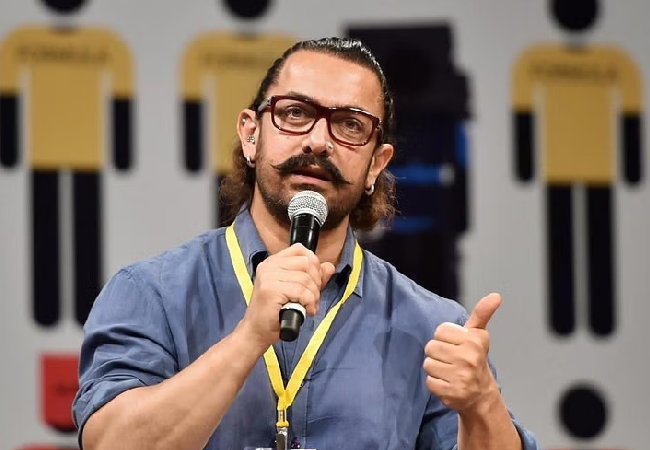
Mumbai (PTI): Bollywood star Aamir Khan says he considers "Dangal", the blockbuster 2016 sports drama, the finest film of his career, even though there was a single shot where he slipped out of character.
The actor, who played the role of Mahavir Singh Phogat in the Nitesh Tiwari-directed movie, said it was megastar Amitabh Bachchan who immediately noticed the flaw in his performance.
“It is difficult for me to say which is my favourite film. ‘Dangal’ is my best-acted film. There is only one shot in the film, which I did wrong, and Mr Amitabh Bachchan is so sharp that he got that shot. I asked him, ‘How did you find the film?’ and he said, ‘Very good but in one shot you were out of character.’
"The particular scene is during one of the wrestling sequences in the film I get up and say, ‘yes’, so that shot I got wrong because the character of Mahavir Phogat can never say yes. He could've said, ‘waah’ or ‘shabhash’ because ‘yes’ is a very English or Mumbai thing. That didn't get cleared in editing. So, in every film I've done something wrong, no film's perfect,” Aamir said.
Aamir was speaking last evening at the Red Lorry Film Festival, where his 1988 film, “Qayamat Se Qayamat Tak” was screened.
"Dangal" was based on the inspiring story of Phogat, who taught wrestling to his two daughters --Geeta and Babita (played by Fatima Sana Shaikh and Sanya Malhotra). Geeta eventually won the gold medal at the 2010 Commonwealth Games.
The film, which also featured Zaira Wasim, Suhani Bhatnagar, Sakshi Tanwar and Aparshakti Khurana, is the highest grossing Indian film with a reported earnings around Rs 2,000 crore.
Let the Truth be known. If you read VB and like VB, please be a VB Supporter and Help us deliver the Truth to one and all.
Belagavi youth’s murder case projected as road accident, cracked in Uttara Kannada; Three arrested
Karwar: Uttara Kannada police have cracked a murder case in which a Belagavi youth was killed and his body burnt inside a car to make it appear like a road accident.
Addressing a press meet in the city, Superintendent of Police Deepan M.N. said three accused from Old Hubballi have been arrested in connection with the case. The crime was a pre-planned act driven by personal enmity, he said.
The case came to light on April 8 morning when a car (KA-04/MJ-8996) was found completely burnt in a roadside ditch near Talekumbri bus stand in Yellapur. Only charred human remains were found inside the vehicle. Initially, it was suspected to be an accident caused by overspeeding, and a case was registered at Yellapur police station based on a complaint filed by the deceased’s father, Jagannath Dhapale.
However, the father later expressed suspicion that his son’s death was not accidental, prompting a detailed investigation.
Taking the matter seriously, two special teams were formed under the leadership of Yellapur Inspector Ramesh Hanapur. On analysing technical evidence and CCTV footage, police found that it was a planned murder.
The accused have been identified as Abdul Raheem Basheer Ahmed Mujawar (32), Maulasab Bavahan Wada (36) and Dadapeer alias Aftab Mehboob Saab Balasangi (22), all chicken traders from Old Hubballi.
Police have seized the car used in the crime along with two scooters. The accused have been remanded to judicial custody.
Investigations revealed that the accused killed Nitesh Dhapale due to personal enmity and later set the car on fire along with the body to project it as an accident.
SP Deepan M.N. appreciated the efforts of Inspector Ramesh Hanapur, PSIs Rajashekhar Vandali and Siddappa Gudi, and the entire team for solving the complex case.