Had suicidal thoughts till 25 years of age, says AR Rahman

Mumbai, Nov 4 : Before the country recognised the talent of AR Rahman, the celebrated composer says there was a phase in his life where he felt like a failure and thought about ending his life almost every day.
The Oscar-winning composer says the initial low phase of his career eventually helped him emerge braver.
"Up until 25, I used to think about suicide. Most of us feel they are not good enough. Because I lost my father, there was this void... There were so many things happening.
"(But) that in a way made me more fearless. Death is a permanent thing for everyone. Since everything created has an expiry date, so why be afraid of anything?" Rahman told PTI.
The turnaround for the 51-year-old composer came when he built his recording studio Panchathan Record Inn in his backyard in hometown Chennai.
"Before that, things were dormant so may be it (the feeling) manifested then. Because of my father's death and the way he was working, I didn't do many movies. I got 35 movies and I did two.
"Everyone wondered 'How are you going to survive? You have everything, grab it.' I was 25 then. I couldn't do that. It's like eating everything. You become numb. So even if you eat small meals, make it fulfilling," he adds.
The composer talks about hard times and other events in his life in "Notes of a Dream: The Authorized Biography of AR Rahman".
Written by author Krishna Trilok, the biography, in association with Landmark and Penguin Random House, was launched here, Saturday.
Rahman was nine when his father RK Shekhar, who was film-score composer, passed away and the family had to rent out his musical equipment to get by. Rahman, thus, took to music at a very young age.
"I finished everything between the age of 12 to 22. It was boring for me to do all the normal stuff. I didn't want to do it," he says.
In his 20s, before he made his debut as a composer with Mani Ratnam's "Roja" (1992), Rahman along with his family embraced Sufi Islam.
He reinvented himself by letting go not only the baggage from the past, but also his birth name - Dileep Kumar, which he says, he despised.
"I never liked my original name Dileep Kumar. I don't even know why I hated it. I felt it didn't match my personality. I wanted to become another person. I felt like that would define and change my whole (being). I wanted to get rid of all the past luggage," he says.
With "Roja", Rahman shot to instant fame as the wonder kid in the industry, who changed the grammar of music and sounds.
But creating music is not a lonely process for the musician as much as it is "internal".
"You manifest who you are and let it out. So when you are ideating on your mental drawing book, you need a lot of self-analysis and you have to dive deep within you.
"You need to listen to yourself. It's hard to listen to your inner side. But once you do, you have to let lose and forget yourself," he adds.
It was for this reason, Rahman says, that he works only during late nights or early mornings.
"If I am going deep inside something and suddenly there's a knock on the door, I'll come to reality from a very different world and I won't be able to go back to the same spot again. This is one of the reasons I prefer (being at work) very early mornings like 5 AM or 6 AM or the nights," he says.
Rahman says the most important thing for him is not to feel bored and constantly try to do something new; be it professionally or personally.
"You feel jaded if you do the same thing. You need to find different things to do. For me travelling, parenting and spending time with my family though I can't do that much is beautiful. It helps a lot."
Let the Truth be known. If you read VB and like VB, please be a VB Supporter and Help us deliver the Truth to one and all.
How Indian AI Is Booming with GEOX AI Leading the Next Wave of Geolocation Intelligence
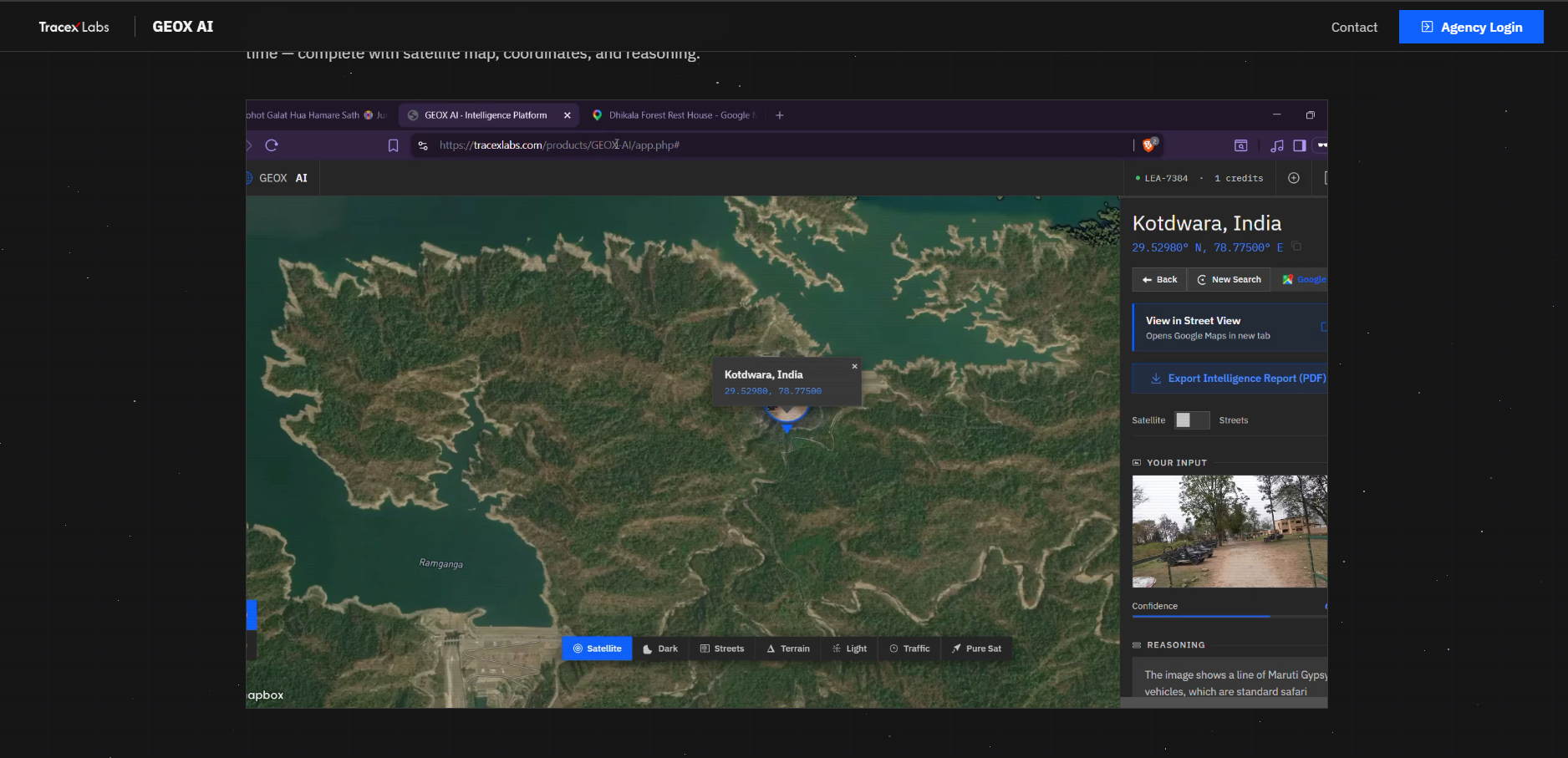
TraceX Labs has announced the launch of GEOX AI, an advanced artificial intelligence platform capable of identifying the real-world location where a photograph or video was taken using only the visual content within the media.
Positioned as an enterprise-grade intelligence solution, GEOX AI leverages advanced computer vision and multi-agent AI to analyze pixel-level details such as architecture, road patterns, vegetation, signage, lighting, and environmental context. By interpreting these visual clues, the system can estimate—and in many cases precisely determine—the origin of an image or video.
AI-Powered Geolocation Intelligence
Marketed under the concept of “Locate Anywhere From Any Image,” GEOX AI is designed for intelligence operations where speed, accuracy, and reliability are critical. The platform currently supports:
- 400+ analyses available
- <10 seconds average response time
- Up to 99% accuracy on landmark-based identification
- Global coverage across diverse terrains and environments
Core Capabilities
GEOX AI integrates multiple intelligence features into a single platform:
- Precise Geolocation:
Identifies exact geographic coordinates using visual landmarks, architecture, vegetation, and cultural indicators. - Satellite Map View:
Results are plotted on live satellite imagery with 2D/3D viewing options and multiple map styles for deeper analysis. - AI Reasoning Analysis:
Provides a detailed explanation of how the system arrived at a conclusion, including confidence scoring. - Multi-Result Analysis:
Returns multiple possible locations ranked by confidence, enabling cross-verification. - Intelligence PDF Export:
Allows one-click generation of professional reports containing maps, coordinates, analysis, and structured findings. - Credit-Based Access:
Agencies are allocated credits, with each analysis consuming one credit. Additional credits can be requested directly.
Speed Meets Intelligence
GEOX AI is designed to balance rapid processing with analytical depth:
- Fast Mode: Delivers results within seconds for clear and high-context images
- Advanced Mode: Performs deeper multi-step analysis for complex or ambiguous visuals
- Built for real-time decision-making in high-pressure environments
How GEOX AI Works
The platform follows a simple and efficient workflow:
- Upload any image or video frame
- AI analyzes visual clues such as structures, terrain, and environment
- The system identifies location with coordinates, confidence score, and reasoning
- Results are displayed on an interactive satellite map
- Export a professional intelligence report in one click
A Breakthrough for Investigations
GEOX AI is expected to have wide-ranging applications across multiple domains:
- Tracking the origin of images from social media and open sources
- Supporting digital forensics and cyber investigations
- Assisting law enforcement and intelligence operations
- Helping journalists and OSINT analysts verify visual content
- Providing support in missing person cases and threat intelligence scenarios
Enterprise Access and Deployment
GEOX AI is available to verified law enforcement agencies, intelligence organizations, and authorized enterprises. Access is provided through a structured system where organizations can request credentials and define their operational use cases.
Interested users can request access via tracexlabs.com or contact contact@tracexlabs.com, with response times typically within 24–48 hours.
Privacy Debate Intensifies
The launch of GEOX AI has also sparked renewed discussion around digital privacy. By demonstrating how location data can be extracted purely from visible elements within images, the platform highlights the potential risks associated with sharing photos online without considering what those visuals may reveal.
Conclusion
With GEOX AI, TraceX Labs is entering the rapidly evolving geolocation intelligence space with a platform that combines speed, precision, and real-world usability. As artificial intelligence continues to advance, tools like GEOX AI are expected to play a critical role in shaping the future of investigations, security, and digital intelligence.