HC asks actor Nawazuddin, his brother to avoid remarks against each other on social media
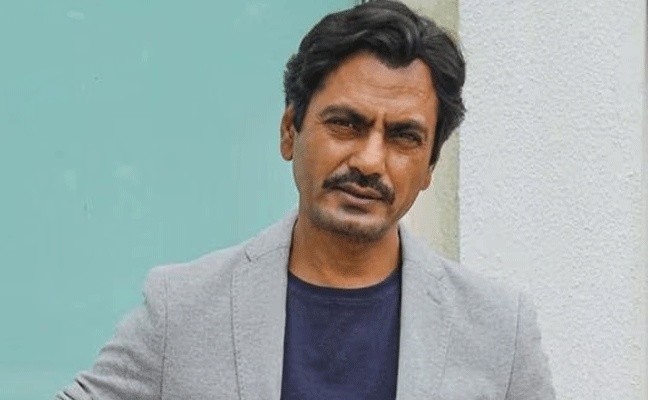
Mumbai (PTI): The Bombay High Court on Wednesday directed Bollywood actor Nawazuddin Siddiqui and his brother Shamasuddin not to post or upload any remarks against each other on social media for the "sake of maintaining equity" and in light of efforts to amicably resolve issues between them.
A single bench of Justice R I Chagla gave the direction while hearing a defamation suit filed by the 48-year-old actor seeking Rs 100 crore in damages from his brother for posting alleged defamatory statements against him on social media.
The bench directed the brothers to remain present in his chambers along with their lawyers on May 3 to explore the possibility of an amicable settlement.
The suit has also named the actor's ex-wife Zainab, but on Wednesday Nawazuddin Siddiqui's counsel Abhinav Chandrachud told the court that said since the former couple was trying to resolve their issues amicably the actor did not wish to pursue the defamation suit against her.
Advocate Rumi Mirza, appearing for Shamasuddin Siddiqui, told the HC settlement talks are going on between Nawazuddin Siddiqui and his ex-wife due to intervention of a division bench of the high court and that with the help of this bench, a similar arrangement could take place between the warring brothers.
Chandrachud, however, said any talks between the brothers could begin only when Shamasuddin Siddiqui takes down his defamatory posts in which the award winning actor has been allegedly called a "rapist and molester".
The court agreed and said for any settlement, the posts in question will have to be deleted and both the brothers shall refrain from posting on social media any further remarks against each other.
"In view of settlement talks, there will not be any (social media) posts against each other, there will be no aspersions cast against each other, in view of possibility of an amicable settlement. It is to maintain equity between parties so that there are no further posts against each other," Justice Chagla said.
Meanwhile, a division bench of Justices Revati Mohite Dere and Sharmila Deshmukh was on Wednesday informed that the discord between the 'Gangs of Wasseypur' actor and his ex-wife Zainab over education of their two minor children has been resolved.
The court was told the children would be travelling back to Dubai to attend their school.
The bench was hearing a petition filed by Nawazuddin Siddiqui seeking a direction to Zainab to reveal the whereabouts of the two children.
The 'Sacred Games' star had claimed Zainab had brought the children back to India without informing him and that they were not attending school in Dubai.
Let the Truth be known. If you read VB and like VB, please be a VB Supporter and Help us deliver the Truth to one and all.
BWSSB to extract biogas from sewage sludge
Bengaluru (PTI): The Bangalore Water Supply and Sewerage Board (BWSSB) is set to roll out a major biogas initiative to extract compressed biogas from sewage sludge, aiming to generate over Rs 120 crore in additional revenue over the next two decades.
The project approved by the state cabinet is expected to be the largest of its kind in the country, utilising about 550 MLD of sewage across five major sewage treatment plants, according to an official release.
"This brilliantly structured PPP model allows us to generate over Rs 120 crore in fresh revenue without investing a single rupee in capital or operations," BWSSB Chairman Ram Prasath Manohar said in the statement.
Under the project, raw biogas currently used for in-house power generation or flared will be upgraded to CBG meeting national standards for injection into the city gas distribution network or use as a clean transport fuel, the release said.
The initiative will be executed on a public-private partnership model, with the private concessionaire bearing the entire Rs 85 crore capital expenditure and operational costs, while BWSSB will provide land within treatment plant premises.
Describing it as a step towards energy security and the circular economy, officials said the project could serve as a national model for similar urban initiatives.