I take higher cut in film profits, says Aamir
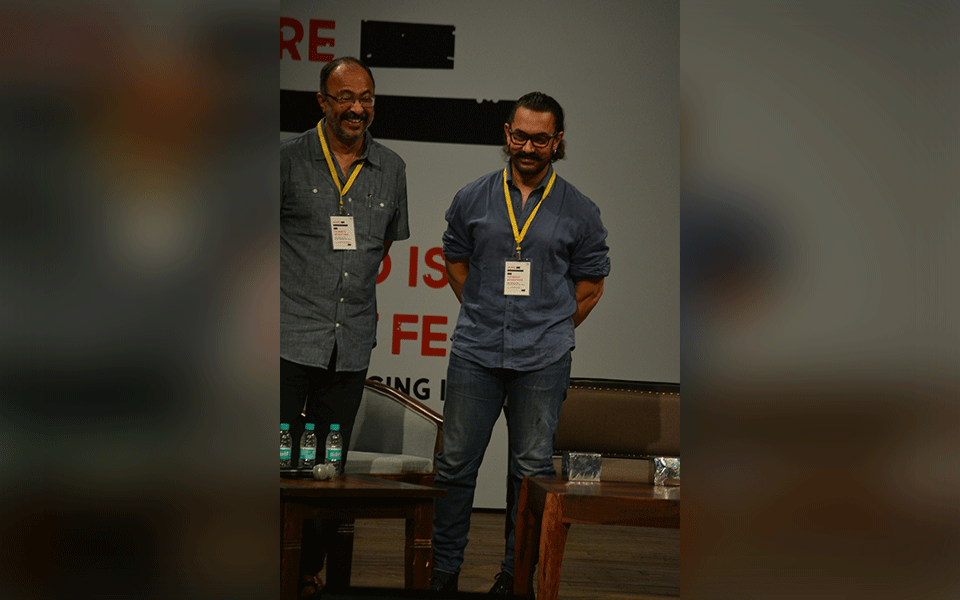
Mumbai, Aug 1 : Superstar Aamir Khan says he takes a higher cut in films' profits because he risks his time on projects. But he does so only after the cost of each film is recovered in every aspect.
The actor-producer gave out the information on the inaugural day of the fifth Indian Screenwriters Conference here on Wednesday.
During an interactive session on the topic ‘Writers VS Producers: Can they never be allies?', Aamir was asked: "There is a worrying trend that now the star has started taking about 80 per cent of the film, not profit but actually as his fees. Even though he is letting his fees go, it ultimately comes to the actor taking away 80 per cent. In 20 per cent how are we going to make a successful film?"
The actor replied: "My first rupee comes to me when the film's cost is recovered in every aspect, after the producer's and everybody else's money is recovered. That's the model I work with, and certainly, I take a higher cut in the percentage because I am risking my time on that, and I think producers are happy with that too."
Explaining the model, he shared: "The model that I work on is that, say a film costs Rs 100 crore to make. It consists of everything - cast, crew, production cost, post-production cost and everything comes in that. I don't take any money in that. I take nothing.
"So, when the film releases, I get zero money. And as it starts earning money, that money goes into P and A (Promotions and Advertising), which is over and above Rs 100 crore. Say P and A is Rs 25 crore, it then goes into recovering that.
"Once P and A is recovered, the producer has recovered his money, and everybody has got their fees...then I go into the percentage of profits. This way, there is no way that the producer can lose any money. And if for some reason, the film has not recovered the money, that it didn't do well, then I don't get any money," he said.
Being part of some of the iconic films like "Dangal", "PK", "3 Idiots" and "Lagaan", Aamir believes that the script plays an important role in the success of a film.
"I think the script is the foundation (of a film) and I make sure that once I love the story and the film is in the making, people who are investing money should not be in loss. I don't allow the producer to shoulder the responsibility alone," he said.
He believes that sharing the responsibility of making the film commercially successful also secures his career and builds trust with the producers and financiers of films.
"I think this is the best business model for film and our business because in most of my films, if producer is not losing money, it is but obvious that he will sign me for the next film. That is why I always ensure that if I am signed in a film, there is no loss," he said.
Citing the example of the 2001 film "Lagaan", Aamir said: "Since that film was one of the expensive films of that time and was breaking a lot of rules of mainstream Indian cinema and that is why I felt the importance of taking the responsibility.
"That apart, I know when I come on board, producers and financiers do not question me on the subject I chose for a film because they trust me, they have faith in me. That is why I want to ensure the profit."
Let the Truth be known. If you read VB and like VB, please be a VB Supporter and Help us deliver the Truth to one and all.
Two arrested in K'taka for assaulting minors, uploading CSAM content

Bengaluru (PTI): Two men were arrested for allegedly sexually assaulting two minor girls, recording the acts on mobile phones and uploading the videos online as child sexual abuse material, police said on Thursday.
The accused have been identified as Kiran Kumar (29), hailing from Chitradurga district, and Aditya M K (20), hailing from Shivamogga district, they said.
A probe was initiated after information was received from the NCRP portal regarding a suspected instance of creation of Child Sexual Abuse Material (CSAM) for online dissemination, police said.
Accordingly, a case was registered at Kaggalipura Police Station under relevant sections of the IT Act on May 10, they added.
Investigation revealed that two minor girl victims were exploited and videos were created and uploaded to the internet. The child victims have subsequently recorded their statements as per procedure and further necessary legal steps have been taken, Pronab Mohanty Director General of Police, Cyber Command, said in a statement.
Based on the statements of the victims, the accused persons, who allegedly assaulted the minors, recorded the acts on mobile phones and uploaded the videos online, were arrested, he said.
Following the probe, sections 65(2) (rape) and 70 (gangrape) of the Bharatiya Nyaya Sanhita, along with relevant sections of the POCSO Act, have been added to the FIR, police said.
Officials collected relevant information and on May 12, arrested the accused persons and seized three mobile phones belonging to them, in which the videos had allegedly been recorded, he said.
The accused were later produced before the court and taken into police custody for further investigation, he added.
According to him, in CSAM cases, police usually apprehend offenders who have downloaded such content or have kept them in their possession after obtaining them from elsewhere, usually the internet.
"The present case is one of the very few instances where content creators and uploaders have been apprehended," Mohanty added.