Israel-Palestinian documentary ‘No Other Land’ wins an Oscar for best documentary
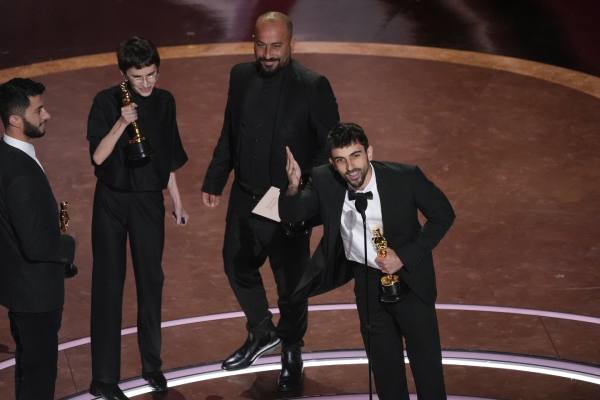
Los Angeles (AP): “No Other Land,” the story of Palestinian activists fighting to protect their communities from demolition by the Israeli military, won the Oscar for best documentary on Sunday.
The collaboration between Israeli and Palestinian filmmakers follows activist Basel Adra as he risks arrest to document the destruction of his hometown at the southern edge of the West Bank, which Israeli soldiers are tearing down to use as a military training zone. Adra’s pleas fall on deaf ears until he befriends a Jewish Israeli journalist who helps him amplify his story.
“We made this film as Palestinians and Israelis because, together, our voices are stronger,” said Israeli journalist and filmmaker Yuval Abraham. He used his acceptance speech to call out his country’s government for what he called “the atrocious destruction of Gaza and its people.” And he urged Hamas to release all Israeli hostages.
“No Other Land” came into the night a top contender after a successful run on the film festival circuit. It did not, however, find a U.S. distributor after being picked up for distribution in 24 countries. For the Oscar, it beat out “Porcelain War,” “Sugarcane,” “Black Box Diaries” and “Soundtrack to a Coup d’État.”
The documentary was filmed over four years between 2019 and 2023.
In the film, Abraham embeds in a community fighting displacement, but he faces some pushback from Palestinians who point out his privileges as an Israeli citizen. Adra says he is unable to leave the West Bank and is treated like a criminal, while Abraham can come and go freely.
“When I look at Basel, I see my brother, but we are unequal,” Abraham said on stage. “We live in a regime where I am free under civilian law and Basel is under military laws that destroy his life. There is a different path, a political solution without ethnic supremacy, with national rights for both of our people.”
United States foreign policy under President Donald Trump is “helping to block this path,” he said.
The film is heavily reliant on camcorder footage from Adra’s personal archive. He captures Israeli soldiers bulldozing the village school and filling water wells with cement to prevent people from rebuilding.
Residents of the small, rugged region of Masafer Yatta band together after Adra films an Israeli soldier shooting a local man who is protesting the demolition of his home. The man becomes paralyzed, and his mother struggles to take care of him while living in a cave.
“About two months ago, I became a father,” Adra said Sunday. “My hope to my daughter (is) that she will not have to live the same life I’m living now, always fearing settlers, violence, home demolitions and forcible displacements. We call on the world to take serious actions.”
#Oscars2025 🇵🇸 @basel_adra: “We call on the world to take serious actions to stop the injustice and to stop the ethnic cleansing of the Palestinian people.” #NoOtherLand pic.twitter.com/2yVfryoAWC
— State of Palestine (@Palestine_UN) March 3, 2025
Let the Truth be known. If you read VB and like VB, please be a VB Supporter and Help us deliver the Truth to one and all.
Belagavi youth’s murder case projected as road accident, cracked in Uttara Kannada; Three arrested
Karwar: Uttara Kannada police have cracked a murder case in which a Belagavi youth was killed and his body burnt inside a car to make it appear like a road accident.
Addressing a press meet in the city, Superintendent of Police Deepan M.N. said three accused from Old Hubballi have been arrested in connection with the case. The crime was a pre-planned act driven by personal enmity, he said.
The case came to light on April 8 morning when a car (KA-04/MJ-8996) was found completely burnt in a roadside ditch near Talekumbri bus stand in Yellapur. Only charred human remains were found inside the vehicle. Initially, it was suspected to be an accident caused by overspeeding, and a case was registered at Yellapur police station based on a complaint filed by the deceased’s father, Jagannath Dhapale.
However, the father later expressed suspicion that his son’s death was not accidental, prompting a detailed investigation.
Taking the matter seriously, two special teams were formed under the leadership of Yellapur Inspector Ramesh Hanapur. On analysing technical evidence and CCTV footage, police found that it was a planned murder.
The accused have been identified as Abdul Raheem Basheer Ahmed Mujawar (32), Maulasab Bavahan Wada (36) and Dadapeer alias Aftab Mehboob Saab Balasangi (22), all chicken traders from Old Hubballi.
Police have seized the car used in the crime along with two scooters. The accused have been remanded to judicial custody.
Investigations revealed that the accused killed Nitesh Dhapale due to personal enmity and later set the car on fire along with the body to project it as an accident.
SP Deepan M.N. appreciated the efforts of Inspector Ramesh Hanapur, PSIs Rajashekhar Vandali and Siddappa Gudi, and the entire team for solving the complex case.