Mumbai, Mar 19: Savita Raj Hiremath, one of the producers of megastar Amitabh Bachchan's "Jhund", has said that she is "perplexed" why her film was not made tax-free as it not only witnessed positive audience reaction but also had a subject that is "crucial to our country's growth".
"Jhund", which released theatrically on March 4 to glowing reviews, featured Bachchan as Vijay Barse, a Nagpur-based retired sports teacher who pioneered a slum soccer movement.
The movie marked the Hindi debut of filmmaker Nagraj Manjule, known for his acclaimed Marathi films "Fandry" and "Sairat".
A week after "Jhund", filmmaker Vivek Agnihotri's "The Kashmir Files", based on the exodus of Kashmiri Pandits from the Valley in the 1990s, opened in cinemas.
The film garnered support from the central government, including Prime Minister Narendra Modi, Union Home Minister Amit Shah and several leaders from the ruling Bharatiya Janata Party (BJP), who endorsed the movie.
"The Kashmir Files", featuring Anupam Kher, Darshan Kumar, Mithun Chakraborty and Pallavi Joshi, was also declared tax-free in states like Uttar Pradesh, Gujarat, Madhya Pradesh, Uttarakhand, Haryana, Karnataka, Tripura and Goa.
On Friday, Hiremath took to Facebook and wrote that while "The Kashmir Files" is an important film, "Jhund" was no less.
"I recently watched 'Kashmir Files' and as the story of Kashmiri Pandits exodus it's heartbreaking and is a story that needed to be told. It is a good voice for Kashmiri Pandits!
"But as the producer of 'Jhund', I am perplexed. After all, 'Jhund', is also an important film and has a story and a big message that has received tremendous acclaim and word of mouth from the audience," she said.
"Jhund" is also produced by Bhushan Kumar, Krishan Kumar, Raaj Hiremath, Gargee Kulkarni, Meenu Aroraa and Manjule.
Hiremath further wrote she was curious to know what is the criteria for the government to select a film and exempt it from entertainment tax.
"So I want to find out what's the criterion on which the government selects a film to support it so strongly by making it tax free, endorsing it through social media and asking Offices to showcase the film or give a half day holiday to its employees.
"After all 'Jhund' also has a subject that is so crucial to our country's growth. 'Jhund' is not just talking about the disparity between caste and economic disparity but also shows a way to make the lower strata of society find their success story," she added.
While "The Kashmir Files" has clocked in approximately Rs 116 cr at the box office, "Jhund" has netted more than Rs 15 cr so far.
Let the Truth be known. If you read VB and like VB, please be a VB Supporter and Help us deliver the Truth to one and all.
HC says Bhojshala complex is Goddess Saraswati temple, scraps ASI order on namaz on premises
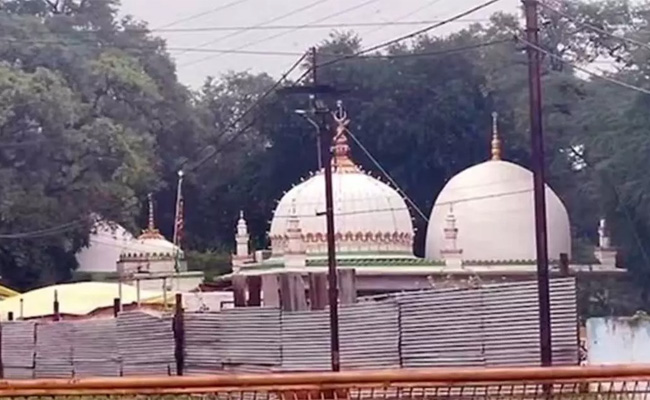
Indore (PTI): In a big win for the Hindu side, the Madhya Pradesh High Court on Friday declared that the disputed Bhojshala complex in Dhar district is a temple dedicated to Goddess Saraswati, and the Centre and ASI can decide on its administration and management.
The HC's Indore bench, which was hearing the case, also said the Muslim community, which called the 11th century monument Kamal Maula Mosque, may approach the state government for allotment of separate land in the district for construction of a mosque.
In its much-awaited verdict in the Bhojshala Temple-Kamal Maula Mosque complex dispute, the court observed that there were indications of a Sanskrit teaching centre and a temple of Goddess Saraswati existing in Bhojshala.
The religious character of the disputed complex of Bhojshala-Kamal Maula Mosque indicates it is a temple of Goddess Saraswati, noted the HC.
ALSO READ: Bihar CM walks to secretariat from official residence after PM's appeal to spend wisely
"If the Maulana Kamaluddin Welfare Society applies for land allotment for building a mosque in Dhar district, the state government can consider it," maintained the division bench.
The HC scrapped the 2003 Archaeological Survey of India (ASI) order which allowed Muslims to offer Friday prayers on Bhojshala premises.
Nearly 1,200 police personnel were deployed in and around the complex ahead of the HC ruling.
Dhar Collector Rajeev Ranjan Meena warned of strict action against anyone spreading objectionable content on social media, as the administration erected barricades at the site where Friday prayers coincided with the court verdict.
The long-running dispute pertains to the religious nature of the ASI-protected monument in Dhar district.
The Hindu community considers Bhojshala to be a temple dedicated to Vagdevi (Goddess Saraswati), while the Muslim side calls the monument Kamal Maula Mosque. A petitioner from the Jain community claims the disputed complex is a medieval Jain temple and gurukul.
After the controversy over the Bhojshala complex erupted, the ASI issued an order on April 7, 2003, permitting Hindus to worship at the complex every Tuesday and Muslims to offer namaz there every Friday. The Hindu side challenged the order in the HC, seeking exclusive rights to worship at the complex.
A division bench of Justices Vijay Kumar Shukla and Alok Awasthi of the HC's Indore bench began regular hearings on five petitions and one writ appeal related to the case on April 6 this year.
After hearing all the parties against the backdrop of differing religious beliefs, historical claims, complex legal provisions, and thousands of documents related to the disputed monument, the bench had reserved its decision on May 12.
During the hearing, petitioners from the Hindu, Muslim, and Jain communities presented detailed arguments and sought exclusive worship rights for their communities at the monument.
The ASI, after conducting a scientific survey of the monument, indicated in its over 2,000-page report that a massive structure dating back to the reign of the Parmar kings of Dhar predated the mosque, and that the current disputed structure was built using repurposed temple components.
The Hindu side claimed that coins, sculptures, and inscriptions found by the ASI during its scientific survey prove the complex was originally a temple.
However, the Muslim side argued in court that the ASI's survey report was "biased" and prepared to support the claims of the Hindu petitioners.
Refuting this, the ASI told the court the scientific survey process was carried out with the help of experts, including three from the Muslim community.
The HC had ordered the ASI to conduct a scientific survey of the Bhojshala Temple-Kamal Maula Mosque complex on March 11, 2024. The ASI began the survey on March 22 that year and, after a detailed 98-day survey, submitted its report to the High Court on July 15.