Mangal Dhillon, star of 'Junoon' and 'Buniyaad', dies at 64
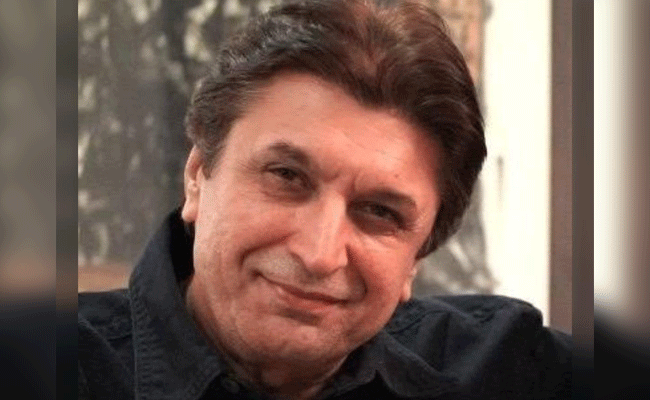
Ludhiana(PTI): Actor Mangal Dhillon, best known for his performance in hit TV serials such as "Junoon" and "Buniyaad", died battling cancer on Saturday in Ludhiana district's Neelo Kalan village, his family said. He was 64. Dhillon, also known for Hindi films such as "Khoon Bhari Maang" and "Vishwatma", was admitted to a private hospital before his family took him home a few days ago.
According to his sister Ranjeet Kaur, the actor passed away late last evening in the village Neelo Kalan.
Dhillon was born in village Wander Jattana in Faridkot district and later moved to Uttar Pradesh, where his father owned agricultural land.
In a career spanning over three decades, Dhillon garnered popularity for his role of Labhaya Ram in Ramesh Sippy's TV soap opera "Buniyaad" (1986-87) and as Sumer Rajvansh in the 1994 drama serial "Junoon".
He worked both in Hindi and Punjabi movies, including "Khalsa", for which he was honoured by the Punjab government.
SAD chief Sukhbir Singh Badal remembered Dhillon for his "captivating voice".
"Saddened to learn about the demise of noted actor, writer, director and producer of Punjabi cine industry Mr Mangal Dhillon.
"It's a big loss to the world of Indian Cinema. His captivating voice and theatrical displays will be missed by many. I extend my heartfelt condolences to the bereaved family, friends and fans," Badal wrote on Twitter.
Anmol Gagan Mann, Punjab Tourism and Culture Affairs Minister, also expressed grief over Dhillon's passing at a press conference. Actor Yashpal Sharma, who found out about Dhillon being admitted to a cancer hospital a week ago, said the late actor had "bid adieu to acting".
"About a year-and-half ago, I got to know that he had become a motivational speaker. He was working towards the betterment of society," Sharma told PTI.
"Dahaad" star Gulshan Devaiah shared Dhillon's photo on Twitter with the caption: "'Mangal Dhillon' Shradhanjali'.
Dhillon is survived by a son and a daughter.
Let the Truth be known. If you read VB and like VB, please be a VB Supporter and Help us deliver the Truth to one and all.
BWSSB to extract biogas from sewage sludge
Bengaluru (PTI): The Bangalore Water Supply and Sewerage Board (BWSSB) is set to roll out a major biogas initiative to extract compressed biogas from sewage sludge, aiming to generate over Rs 120 crore in additional revenue over the next two decades.
The project approved by the state cabinet is expected to be the largest of its kind in the country, utilising about 550 MLD of sewage across five major sewage treatment plants, according to an official release.
"This brilliantly structured PPP model allows us to generate over Rs 120 crore in fresh revenue without investing a single rupee in capital or operations," BWSSB Chairman Ram Prasath Manohar said in the statement.
Under the project, raw biogas currently used for in-house power generation or flared will be upgraded to CBG meeting national standards for injection into the city gas distribution network or use as a clean transport fuel, the release said.
The initiative will be executed on a public-private partnership model, with the private concessionaire bearing the entire Rs 85 crore capital expenditure and operational costs, while BWSSB will provide land within treatment plant premises.
Describing it as a step towards energy security and the circular economy, officials said the project could serve as a national model for similar urban initiatives.