#MeToo movement: Actress Sruthi Hariharan accuses Arjun Sarja of "lewd" behaviour

Bengaluru, Oct 20: Actress Sruthi Hariharan Saturday accused prominent south Indian actor Arjun Sarja of "lewd and complete unprofessional behavior" with her during the shooting for a bilingual film in 2016.
The actress, who has essayed roles in several Kannada films, in a post on her Facebook page praising "#metoo" movement has shared about the incident that left her "startled" and took a while for her to "recover".
Sarja, a multi-lingual actor, has said he is pained by the allegation and would file a case.
Narrating the incident that she alleged happened in 2016, Sruthi said, she was shooting for a bilingual film which starred Arjun Sarja, a man whose movies she grew up watching, and was excited about the opportunity.
"The first few days seemed normal, I played his wife in the film and that day we were to do a romantic scene where we had to hug each other after a brief dialogue.
During the rehearsal, we delivered our lines and Mr Arjun hugs me. With no forewarning or permission, he runs his hands intimately up and down my back," her post said.
"He pulls me closer with my body taut against his and asks the director if we could use this idea of foreplay in the scene. I was aghast," she said in the post.
Sruthi said she was all for depicting realism in cinema, but this felt "absolutely wrong."
"His intent seemed anything but professional. I hated that he did it and angry that I didn't know what to say then,"she said, adding that every actor she has worked with before and after Arjun Sarja, have never resorted to this.
Further noting that the director sensed her "discomfort", Sruthi said she made sure that she let the direction department know that she was not interested to be a part of rehearsals and would come directly for takes.
She also shared the incident with her make up team right after, Sruthi said in her post.
"The incident happened in front of at least 50 people on a shooting set- it happened at my workplace.
I wanted nothing but to stay away from him rather than be tolerant and put up with his lewd and complete unprofessional behavior,"she said.
She said she continued shooting as a "professional," During the course of production, every "smutty innuendo" he made, created an "unpalatable" work environment for me, the post said.
"His salacious invitations to meet him after work appalled me. Looking back I remember attempting to normalise his behaviour and ignore his comments- lest there be issues in the production of the film in entirety.
I maintained a cordial distance. All the while knowing he was wrong and wondering why he never stopped," Sruthi said.
Explaining about her intention to come out now, she said "henceforth I think Mr Arjun Sarja needs to make sure he doesn't cross the thin line between two actors and use his position of power to cause another person discomfort or hurt.
"I choose to do this publicly- cos this movement is more than you and me and our individual experiences. It is a collective voice to question an existing system of power play and to call a spade for what it is," the actress added.
In his reaction to the charge to a local Kannada news channel that has been posted on Arjun Sarja's Facebook post by his team, he said, "..I don't have the cheap mentality, keeping the profession as the medium. I'm deeply pained.
I don't know how to react to this, but hundred per cent I'm going to file a case against this."
The actor said he has great respect for womanhood from childhood, adding he has never involved in any incident that is disrespectful of women or embarrass them.
He said he respects "#metoo" and values it, but cautioned about it being misused, leading to the movement losing its value.
He said in 150 movies that he has acted in, he has shared screen space with 60-70 actresses and has good relationship with all of them.
"If somebody is making such allegation against me, I feel pity for her. What to tell this girl.She had expressed intentions that she wants to act more films with me. I'm surprised," the actor said.
He also questioned as to why Sruthi did not react, if she felt that he misbehaved with her.
Let the Truth be known. If you read VB and like VB, please be a VB Supporter and Help us deliver the Truth to one and all.
Punjab CM Mann calls twin blasts 'minor', blames BJP for creating atmosphere of fear
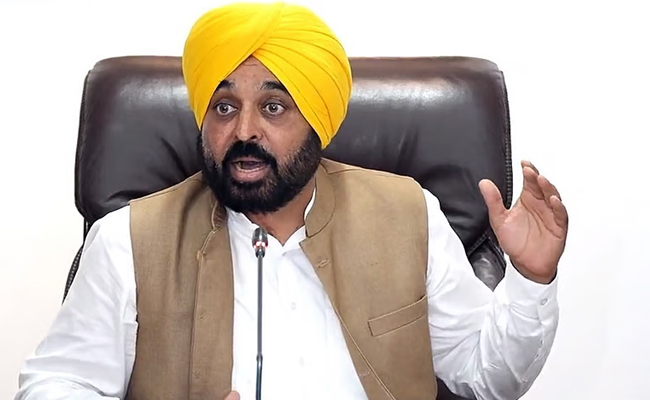
Chandigarh (PTI): Terming the twin blasts in Amritsar and Jalandhar "minor", Punjab Chief Minister Bhagwant Mann on Wednesday targeted the BJP and said this was how the party was preparing for the upcoming assembly elections in the state.
Two blasts occurred on Tuesday night, one outside the Border Security Force's Punjab Frontier headquarters in Jalandhar at around 8 pm and another near the army cantonment area in Khasa, Amritsar, at around 11 pm.
The BJP wants to create an atmosphere of fear, Mann told reporters, adding that the party wanted to scare people into getting their votes. "BJP is a communal party. The assembly elections are over in West Bengal, and they (BJP) have said that now it is Punjab's turn, which indicates that these minor blasts are part of their preparation for the Punjab assembly elections," the chief minister said, adding that investigations are underway.
Mann further alleged that the BJP always sought to gain votes by inciting violence and intimidating the public.
"I urge the BJP to cease such tactics. Punjab is a peaceful state. We are the people who always seek the welfare of the world," Mann said while speaking to reporters in Anandpur Sahib after starting his four-day 'Shukrana Yatra' for the implementation of the anti-sacrilege law.
He claimed that the BJP had a penchant for stirring up trouble in states where it is contesting elections.
Noting the significance of the newly enacted anti-sacrilege law -- the Jaagat Jot Sri Guru Granth Sahib Satkar Amendment Act, 2026 -- Mann stated that it counteracts the BJP's efforts to provoke conflict between communities.
"With the anti-sacrilege law in place, no one will engage in sacrilegious acts at their behest," he said, further alleging that the law contradicts the BJP's agenda.
Mann expressed concern regarding the BJP's tactics, saying, "The BJP claims it is ready for Punjab. Are they trying to scare people with these minor blasts to secure votes? Punjab has already experienced dark times in the past."
"This is the BJP's style of working. In every state where it contests elections, it instigates riots, carries out minor blasts, and divides people based on religion and caste. This demonstrates their preparation for Punjab," he further alleged.
Mann also noted that Punjab often plays a significant role whenever the country faces a crisis. He emphasised that peace, along with law and order, will be maintained at all costs.
Later, in a statement, Mann alleged that the bomb blasts in Amritsar and Jalandhar were part of a deliberate strategy to destabilise the state after the passage of the anti-sacrilege law.
Drawing parallels with West Bengal, Mann alleged that the BJP "thrives on creating communal tension, panic and unrest in poll-bound states to polarise voters," but asserted that peace-loving Punjabis would never allow the saffron party to destroy the hard-earned harmony of Punjab for electoral gains.
He further alleged that the BJP was trying to create "unrest" in Punjab on the pattern of West Bengal ahead of elections, but the people of Punjab are politically aware and united against such conspiracies.
"Violence, divisiveness and communal tension are the patent of the BJP and an integral part of the saffron party's politics. BJP is trying to incite violence and fear in Punjab on the pattern of Bengal to win the ensuing polls. However, BJP's nefarious designs will never succeed in Punjab because anything can germinate on the fertile land of Punjab, but seeds of hatred can never grow here," the chief minister claimed.
Condemning the blasts in the state, Mann alleged such incidents reflected the BJP's "brand of politics", aimed at spreading terror and panic to polarise society and garner votes. "This divisive politics is being pursued by the BJP in every poll-bound state for electoral gains," he alleged.
Mann said those responsible for the blasts would soon be exposed and brought to justice. "All those involved in this heinous crime against humanity will be brought to book and put behind bars very soon. Strict punishment will be ensured for these people because the Punjab Government has zero tolerance for any activity that threatens the peace, safety and integrity of Punjab," he said.
In response to a question about the West Bengal assembly elections, Mann mentioned Mamata Banerjee's complaints regarding the looting of the electoral mandate. "The Election Commission is also facing accusations. It should clarify its stance, ensuring it is not one-sided," Mann added.