'MS Dhoni' actor Sandeep Nahar dies after posting 'suicide video' and note

Mumbai, Feb 15: Actor Sandeep Nahar died on Monday evening in Mumbai after posting a video and a "suicide note" on Facebook in which he purportedly blamed his wife and also mentioned "politics" he faced in Bollywood, police said.
Nahar, who was in his 30s and featured in films like Akshay Kumar's "Kesari" and Sushant Singh Rajput starrer "MS Dhoni", was found unconscious at his flat in suburban Goregaon in evening by his wife Kanchan and friends who took him to SVR Hospital, where he was declared dead on arrival, a police official said.
The actor had posted a "suicide note" on Facebook, along with a nine-minute video.
In the video in Hindi, the actor can be heard saying that he was "frustrated" with constant fights with his wife and was being harassed and blackmailed by her and also by his mother-in-law.
"I would've died by suicide a long time ago but I chose to give myself the time and hope that things would get better, but they didn't. I now have nowhere to go. I don't know what awaits me after I take this step, but I've been through hell in this life.
"I have only one request, after I am gone, please don't say anything to Kanchan (his wife) but do get her treated," he said.
The police official said Nahar probably made this video around three hours before his death.
The official said they are awaiting postmortem report to understand the cause of Nahar's death and how he died.
In the "suicide note", purportedly written by Nahar, he mentioned about "politics" he faced in Bollywood, "unprofessional functioning and the lack of emotions in people working in the industry".
Further investigation is underway, the official added.
Here's the video and note that Sandeep Nahar shared on Facebook:
Let the Truth be known. If you read VB and like VB, please be a VB Supporter and Help us deliver the Truth to one and all.
Karnataka bypolls: BJP criticism driven by ‘fear of defeat’, says CM Siddaramaiah
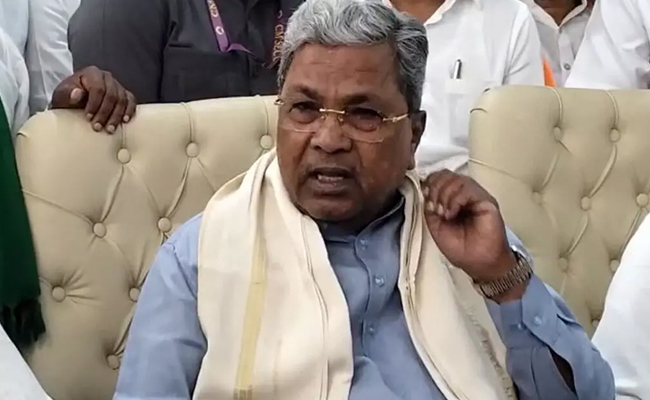
Bagalkote (Karnataka) (PTI): Karnataka Chief Minister Siddaramaiah on Saturday said the BJP’s criticism of the Congress government reflects a "fear of defeat" ahead of the April 9 bypolls.
He added that the state’s guarantee schemes are an investment in social commitment and inclusive development.
Speaking to reporters in Bagalkote, he expressed confidence that the Congress would win both bypoll-bound constituencies, adding that the campaign has received an unprecedented response, surpassing expectations.
The bypolls were necessitated by the demise of sitting Congress MLAs Shamanur Shivashankarappa and H Y Meti, who represented the Davanagere South and Bagalkote constituencies, respectively.
"We have provided schemes for people belonging to all castes, religions, and languages. The BJP is opposing the guarantee schemes out of fear of defeat, but these guarantees are an investment that delivers social commitment. This, too, is development," Siddaramaiah said.
The guarantee schemes are ‘Shakti’, ‘Gruha Lakshmi’, ‘Gruha Jyoti’, ‘Yuva Nidhi’ and ‘Anna Bhagya’.
He added that development is not limited to physical infrastructure.
"Development does not mean only roads, bridges, and buildings. It also includes providing economic and social security," he said.
The CM stated that the BJP has opposed welfare measures since their inception and rejected claims that the state’s finances are under strain.
Referring to remarks by PM Narendra Modi and others, he said, "They (BJP leaders) have been claiming that the state will go bankrupt. However, guarantee schemes have been in force for the past three years, and till March 24, 2026, Rs 1.31 lakh crore has been spent on them." He maintained that spending on key sectors has not been curtailed.
"While Rs 42,000 crore was spent last year, more than Rs 44,000 crore is being spent this year," Siddaramaiah said, adding that expenditure on irrigation, public works, rural development, drinking water, policing, and SCSP/TSP schemes has not been reduced.
Development works have not slowed down, he added.
Accusing the BJP of running a smear campaign, Siddaramaiah said that allegations of excessive borrowing were "false propaganda".
"Saying that I have taken excessive loans is a blatant lie. We have not violated the norms of the Fiscal Responsibility Act and have maintained fiscal discipline," Siddaramaiah said.
Further, the CM advised BJP leaders to properly read the Fiscal Responsibility Act.
"The fiscal deficit should be within 3 per cent of GDP, and debt within 25 per cent of GDP. Our debt stands at 24.94 per cent, so it has not exceeded the limit," he said.
Stressing adherence to fiscal norms, he added that no state can borrow indiscriminately, as borrowing limits are fixed by the Union Finance Ministry.
He also claimed that Karnataka’s economic performance is stronger than that of the Centre.
Stating that the Centre’s GDP growth is 7.14 per cent while Karnataka’s is 8.1 per cent, Siddaramaiah said the state has outperformed the union government.
Drawing a comparison on public debt, he said that during the tenure of former Prime Minister Manmohan Singh, and cumulatively since Independence, total debt stood at Rs 53.11 lakh crore, which has risen to Rs 218 lakh crore by March 2026.
He alleged that in the past 12 years, Prime Minister Narendra Modi alone has added Rs 165 lakh crore in debt.
The CM criticised the BJP’s track record in the state, saying it failed to deliver on its promises despite being in power for nine years.
"Out of 165 promises made in the Congress manifesto in 2013, 158 were fulfilled. The BJP has not even fulfilled 10 per cent of its promises. They should speak the truth before the people during elections instead of spreading lies," he said.
In addition, he urged the BJP to highlight its own achievements instead of criticising Congress.
"During my tenure, the quantity of rice under the Anna Bhagya scheme was increased, which the BJP government later reduced. It was the Congress-led central government that implemented the Food Security Act, the Right to Work, and the Right to Education," he said.
Taking a swipe at the opposition’s campaign strategy, Siddaramaiah alleged that the BJP had stooped to a low level by using expelled MLA Basanagouda Patil Yatnal for campaigning.
"They have resorted to such acts out of fear of defeat. We will not react to statements of the opposition; we will present the work of the government before the people," he added.