Ravi Teja announces new film titled 'Mr Bachchan'
New Delhi (PTI): Actor Ravi Teja on Sunday announced that his next film is titled "Mr Bachchan" after his favourite megastar Amitabh Bachchan.
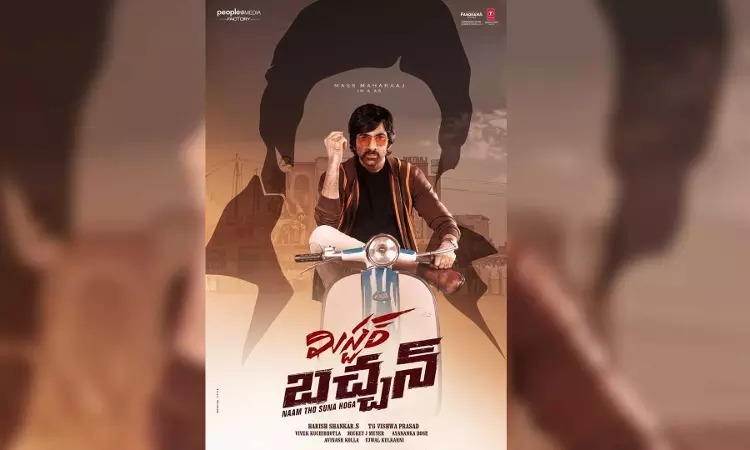
Directed by Harish Shankar, the tagline of the upcoming Telugu movie is "Naam Tho Suna Hoga (You must have heard the name)".
Also starring Bhagyashri Borse, "Mr Bachchan" is backed by People Media Factory, Panorama Studios and T-Series.
Ravi Teja shared the film announcement on his official X page.
"#MrBachchan Naam tho suna hoga. Honoured to play the character with the name of my favourite @SrBachchan saab @harish2you @peoplemediafcy @TSeries," the actor wrote.
The makers also released the first look of the film in which Ravi Teja can be seen riding a scooter with shades on and a haircut resembling Bachchan from his 1970s films. A silhouette of the screen icon's face and a crowd standing in front of a cinema hall called 'Natraj' is embossed as the background of the poster.
Actor Ajay Devgn also shared the poster of the film and captioned it as: "This is going to be (fire emoji)."
Shankar thanked Devgn for his support.
"Thank you So much Ajay Sir @ajaydevgn this is more than a surprise for us . What a great day to start a film with your wishes . Thanks a lot," the filmmaker wrote.
"Mr Bachchan" is Ravi Teja and Shankar's third collaboration after "Shock" (2006) and "Mirapakay" (2011).
Let the Truth be known. If you read VB and like VB, please be a VB Supporter and Help us deliver the Truth to one and all.
Telangana survey flags 89,000 child labourers, highlights caste disparities in employment
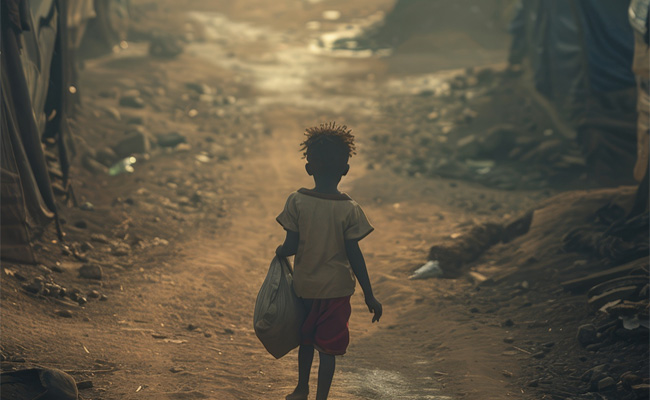
Hyderabad: A caste-based survey conducted by the Telangana government for 2024–25 has identified around 89,000 children engaged in labour across the state, with a large share belonging to Scheduled Caste (SC) and Scheduled Tribe (ST) communities.
The findings are part of the Socio, Economic, Educational, Employment, Political and Caste (SEEEPC) Survey, which covered about 3.5 crore people across 242 caste groups. According to the report, nearly one per cent of individuals below 18 years are involved in daily wage work. While the percentage appears small, officials noted that the absolute number reflects a serious concern.
The survey found that 11 per cent of identified child labourers belong to the ST Lambadi community, while 14 per cent are from the SC Madiga community. The highest incidence was reported among the ST Kolam group, where 7.2 per cent of minors are engaged in daily wage labour.
The data also revealed wider socio-economic disparities. Nearly half of the Scheduled Caste population is dependent on daily wage work, while only around 5 per cent are employed in the private sector, compared to about 30 per cent among General Castes.
State Welfare Minister Ponnam Prabhakar said the findings show that SC and ST communities remain three times more backward than General Castes, while Backward Classes are about 2.7 times more disadvantaged.
The report further noted that, on average, 31.3 per cent of people in the 25–65 age group depend on daily wage work. Among communities, the BC-A Odde group recorded the highest share at 55 per cent. In contrast, only 2.6 per cent of OC Brahmins rely on such work.
Several SC and ST communities, including Kolam, Beda, Madiga, Koya, Gond, Yerukulas and Mala Sale, were found to have among the highest proportions of daily wage earners. On the other hand, most General Caste communities and some Backward Class groups such as Goldsmiths and BC-C Christians showed lower dependence on daily wage employment.
The survey also pointed to inequalities in access to formal employment. Communities such as OC Rajus, OC Brahmins and Kapus were found to have a higher presence in private sector jobs, with up to 27 per cent of their population employed in such roles.