Rishab Shetty’s ‘Kantara: Chapter 1’ mints Rs 427.5 crore worldwide in six days

New Delhi, Oct 8 (PTI) Actor-director Rishab Shetty’s "Kantara: Chapter 1" has taken the box office by storm, grossing Rs 427.5 crore worldwide within six days of release, the makers said in a statement.
The movie is a prequel to Shetty’s 2022 blockbuster “Kantara”, which became a cultural phenomenon for its rooted storytelling, exploration of folklore and divine traditions of coastal Karnataka, and went on to become one of the highest-grossing Kannada films of all time.
Released on October 2 in Kannada, Hindi, Telugu, Malayalam, Tamil, Bengali, and English, the movie is produced by Hombale Films.
In a statement, the makers said the film is on track to reach Rs 500 crore in its opening week.
"In just six days, 'Kantara: Chapter 1' has collected a staggering Rs 427.5 crore worldwide, emerging as a global phenomenon. With such an extraordinary pace, the film is expected to touch the Rs 500 crore mark within a week and is steadily inching closer to the historic Rs 1000 crore milestone.
"The strong word-of-mouth, glowing reviews, and massive buzz across social media are all working in the film’s favour," the makers said.
Set in pre-colonial Karnataka during the reign of the Kadambas from Banavasi, “Kantara: Chapter 1” depicts the conflict between the tribals of the Kantara forest and a tyrannical king.
Shetty, who directed, wrote and headlined the prequel, had earlier won the National Film Award for Best Actor as well as Best Popular Film Providing Wholesome Entertainment for “Kantara”.
Let the Truth be known. If you read VB and like VB, please be a VB Supporter and Help us deliver the Truth to one and all.
Belagavi youth’s murder case projected as road accident, cracked in Uttara Kannada; Three arrested

Karwar: Uttara Kannada police have cracked a murder case in which a Belagavi youth was killed and his body burnt inside a car to make it appear like a road accident.
Addressing a press meet in the city, Superintendent of Police Deepan M.N. said three accused from Old Hubballi have been arrested in connection with the case. The crime was a pre-planned act driven by personal enmity, he said.
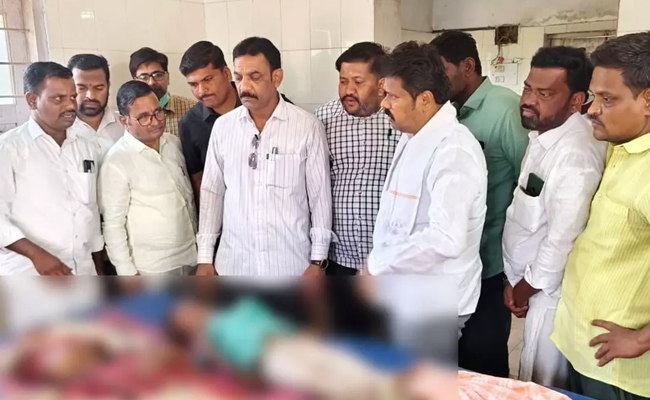
The case came to light on April 8 morning when a car (KA-04/MJ-8996) was found completely burnt in a roadside ditch near Talekumbri bus stand in Yellapur. Only charred human remains were found inside the vehicle. Initially, it was suspected to be an accident caused by overspeeding, and a case was registered at Yellapur police station based on a complaint filed by the deceased’s father, Jagannath Dhapale.
However, the father later expressed suspicion that his son’s death was not accidental, prompting a detailed investigation.
Taking the matter seriously, two special teams were formed under the leadership of Yellapur Inspector Ramesh Hanapur. On analysing technical evidence and CCTV footage, police found that it was a planned murder.
The accused have been identified as Abdul Raheem Basheer Ahmed Mujawar (32), Maulasab Bavahan Wada (36) and Dadapeer alias Aftab Mehboob Saab Balasangi (22), all chicken traders from Old Hubballi.
Police have seized the car used in the crime along with two scooters. The accused have been remanded to judicial custody.
Investigations revealed that the accused killed Nitesh Dhapale due to personal enmity and later set the car on fire along with the body to project it as an accident.
SP Deepan M.N. appreciated the efforts of Inspector Ramesh Hanapur, PSIs Rajashekhar Vandali and Siddappa Gudi, and the entire team for solving the complex case.