Robert Redford, Oscar-winning actor, director and indie patriarch, dies at 89
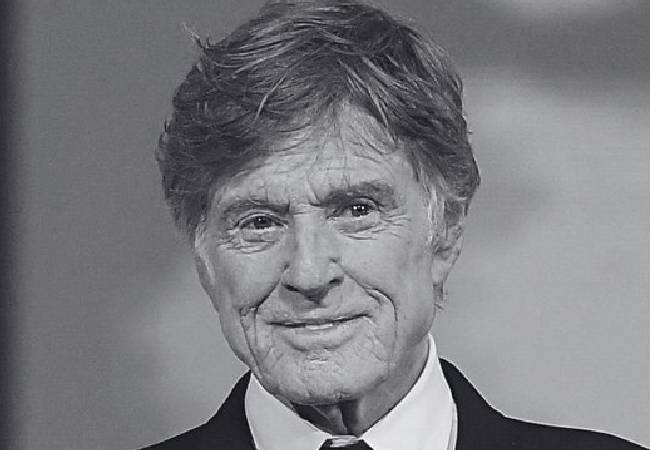
Provo (AP): Robert Redford, the Hollywood golden boy who became an Oscar-winning director, liberal activist and godfather for independent cinema under the name of one of his best-loved characters, died Tuesday at 89.
Redford died “at his home at Sundance in the mountains of Utah — the place he loved, surrounded by those he loved,” publicist Cindi Berger said in a statement. No cause of death was provided.
After rising to stardom in the 1960s, Redford was one of the biggest stars of the '70s with such films as “The Candidate”, “All the President's Men” and “The Way We Were”, capping that decade with the best director Oscar for 1980's “Ordinary People”, which also won best picture in 1980.
His wavy blonde hair and boyish grin made him the most desired of leading men, but he worked hard to transcend his looks — whether through his political advocacy, his willingness to take on unglamorous roles or his dedication to providing a platform for low-budget movies.
His roles ranged from Washington Post journalist Bob Woodward to a mountain man in “Jeremiah Johnson” to a double agent in the Marvel Cinematic Universe, and his co-stars included Jane Fonda, Meryl Streep and Tom Cruise.
But his most famous screen partner was his old friend and fellow activist and practical joker Paul Newman, their films a variation of their warm, teasing relationship off screen.
Redford played the wily outlaw opposite Newman in 1969's “Butch Cassidy and the Sundance Kid”, a box-office smash from which Redford's Sundance Institute and festival got its name.
He also teamed with Newman on 1973's best picture Oscar winner, “The Sting”, which earned Redford a best-actor nomination as a young con artist in 1930s Chicago.
Film roles after the '70s became more sporadic as Redford concentrated on directing and producing, and his new role as patriarch of the independent-film movement in the 1980s and '90s through his Sundance Institute. But he starred in 1985's best picture champion “Out of Africa” and in 2013 received some of the best reviews of his career as a shipwrecked sailor in “All is Lost”, in which he was the film's only performer. In 2018, he was praised again in what he called his farewell movie, “The Old Man and the Gun”.
“I just figure that I've had a long career that I'm very pleased with. It's been so long, ever since I was 21,” he told The Associated Press shortly before the film came out. “I figure now as I'm getting into my 80s, it's maybe time to move toward retirement and spend more time with my wife and family.”
Redford had watched Hollywood grow more cautious and controlling during the 1970s and wanted to recapture the creative spirit of the early part of the decade.
Sundance was created to nurture new talent away from the pressures of Hollywood, the institute providing a training ground and the festival, based in Park City, Utah, where Redford had purchased land with the initial hope of opening a ski resort.
Instead, Park City became a place of discovery for such previously unknown filmmakers as Quentin Tarantino, Steven Soderbergh, Paul Thomas Anderson and Darren Aronofsky.
“For me, the word to be underscored is independence,” Redford told the AP in 2018. “I've always believed in that word. That's what led to me eventually wanting to create a category that supported independent artists who weren't given a chance to be heard.
“The industry was pretty well controlled by the mainstream, which I was a part of. But I saw other stories out there that weren't having a chance to be told and I thought, Well, maybe I can commit my energies to giving those people a chance.' As I look back on it, I feel very good about that.”
Sundance was even criticised as buyers swarmed in looking for potential hits and celebrities overran the town each winter.
“We have never, ever changed our policies for how we program our festival. It's always been built on diversity,” Redford told the AP in 2004. “The fact is that the diversity has become commercial. Because independent films have achieved their own success, Hollywood, being just a business, is going to grab them. So when Hollywood grabs your films, they go, 'Oh, it's gone Hollywood.'”
By 2025, the festival had become so prominent that organisers decided they had outgrown Park City and approved relocating to Boulder, Colorado, starting in 2027.
Redford, who had attended the University of Colorado Boulder, issued a statement saying that “change is inevitable, we must always evolve and grow, which has been at the core of our survival.”
Redford's affinity for the outdoors was well captured in “A River Runs Through It” and other films and through his decades of advocacy for the environment, inspired in part by witnessing the transformation of Los Angeles into a city of smog and freeways.
His activities ranged from lobbying for such legislation as the Clean Air Act and Clean Water Act to pushing for land conservation in Utah to serving on the board of the Natural Resources Defense Council.
Redford was married twice, most recently to Sibylle Szaggars. He had four children, two of whom have died — Scott Anthony, who died in infancy, in 1959; and James Redford, an activist and filmmaker who died in 2020.
Robert Redford was born Charles Robert Redford Jr. on August 18, 1936, in Santa Monica, a California boy whose blonde good looks eased his way over an apprenticeship in television and live theatre that eventually led to the big screen.
Redford attended college on a baseball scholarship and would later star as a middle-aged slugger in 1984's “The Natural”, the adaptation of Bernard Malamud's baseball novel. He had an early interest in drawing and painting, then went on to study at the American Academy of Dramatic Arts, debuting on Broadway in the late 1950s and moving into television on such shows as “The Twilight Zone”, “Alfred Hitchcock Presents” and “The Untouchables”.
After scoring a Broadway lead in “Sunday in New York”, Redford was cast by director Mike Nichols in a production of Neil Simon's “Barefoot in the Park”, later starring with Fonda in the film version.
Let the Truth be known. If you read VB and like VB, please be a VB Supporter and Help us deliver the Truth to one and all.
Belagavi youth’s murder case projected as road accident, cracked in Uttara Kannada; Three arrested

Karwar: Uttara Kannada police have cracked a murder case in which a Belagavi youth was killed and his body burnt inside a car to make it appear like a road accident.
Addressing a press meet in the city, Superintendent of Police Deepan M.N. said three accused from Old Hubballi have been arrested in connection with the case. The crime was a pre-planned act driven by personal enmity, he said.
The case came to light on April 8 morning when a car (KA-04/MJ-8996) was found completely burnt in a roadside ditch near Talekumbri bus stand in Yellapur. Only charred human remains were found inside the vehicle. Initially, it was suspected to be an accident caused by overspeeding, and a case was registered at Yellapur police station based on a complaint filed by the deceased’s father, Jagannath Dhapale.
However, the father later expressed suspicion that his son’s death was not accidental, prompting a detailed investigation.
Taking the matter seriously, two special teams were formed under the leadership of Yellapur Inspector Ramesh Hanapur. On analysing technical evidence and CCTV footage, police found that it was a planned murder.
The accused have been identified as Abdul Raheem Basheer Ahmed Mujawar (32), Maulasab Bavahan Wada (36) and Dadapeer alias Aftab Mehboob Saab Balasangi (22), all chicken traders from Old Hubballi.
Police have seized the car used in the crime along with two scooters. The accused have been remanded to judicial custody.
Investigations revealed that the accused killed Nitesh Dhapale due to personal enmity and later set the car on fire along with the body to project it as an accident.
SP Deepan M.N. appreciated the efforts of Inspector Ramesh Hanapur, PSIs Rajashekhar Vandali and Siddappa Gudi, and the entire team for solving the complex case.