Sean Connery, first James Bond and global star, dies aged 90
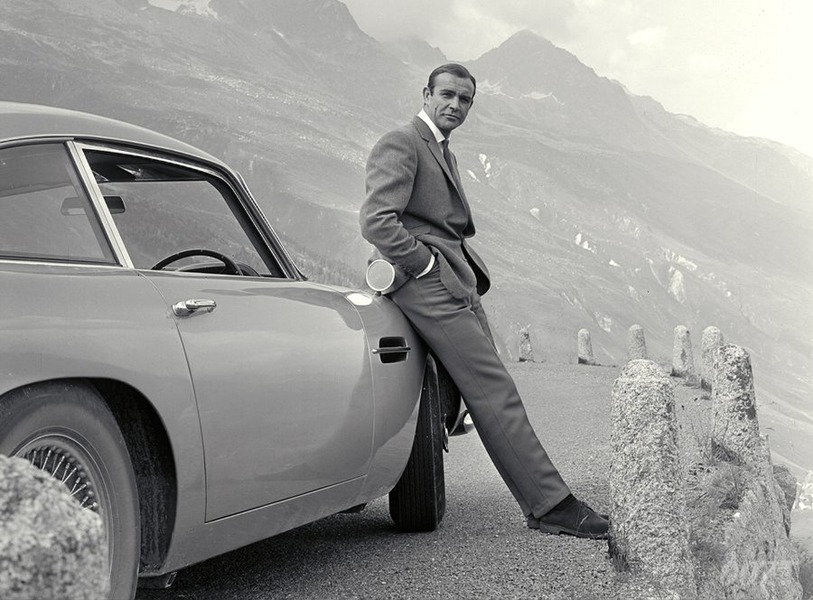
London: Legendary Scottish star Sean Connery, who became a global sensation as the first James Bond and featured in a string of cult hits in his five-decade-long career, has died. He was 90.
According to BBC, the actor passed away overnight in his sleep while in the Bahamas. He had been unwell for quite some time.
In the career spanning half a century, the actor featured in many critically-acclaimed and commercial blockbusters such as "The Hunt for Red October", "Indiana Jones and the Last Crusade", "Murder on the Orient Express" and "The Rock".
Scotland's First Minister Nicola Sturgeon mourned the veteran star's death, saying that the country has lost "one of her best loved sons".
"Sean will be remembered best as James Bond - the classic 007 - but his roles were many & varied. He was a global legend but, first and foremost, a patriotic and proud Scot - his towering presence at the opening of @ScotParl in 1999 showed his love for the country of his birth," she tweeted.
Connery was born on August 25, 1930, to a Catholic factory worker and a Protestant domestic cleaner.
He left school at the age 13 with no qualifications and delivered milk, polished coffins and laid bricks, before joining the Royal Navy. But he was invalided out of the service with stomach ulcers only three years later
He initially made a living by doing odd-jobs like driving trucks, working as a lifeguard and posing as a model at the Edinburgh College of Art. The actor spent his spare time bodybuilding.
It was in 1956 that Connery landed his first acting job for BBC production of "Requiem for a Heavyweight". Soon after, he made his film debut with "No Road Back". The following year, he appeared in films like "Hell Drivers", "Action of the Tiger" and "Time Lock".
A major breakthrough in his career came when Connery, a relatively unknown actor, was cast as James Bond after an interview with producers Albert Broccoli and Harry Saltzman.
It is said that author Ian Fleming was not fully convinced that Connery can pull off the part. However, the actor's charismatic portrayal of the spy won over the critics and for many franchise fans, he is still the best James Bond.
He first played the role of James Bond in 1962's "Dr No", which he followed up with "From Russia with Love" (1963), "Goldfinger" (1964), "Thunderball" (1965), "You Only Live Twice"(1967), "Diamonds Are Forever" (1971) and "Never Say Never Again"(1983).
Connery's portrayal has been a tough act to follow for successors like Roger Moore, Pierce Brosnan and Daniel Craig.
Bond made a global star out of a relatively new Connery but it also pigeonholed him for a long time.
The actor started challenging his image by shifting gears and taking up more dramatic movies such as John Huston's "The Man Who Would Be King", Richard Attenborough's "A Bridge Too Far", "The Name of the Rose", which was a big international hit.
Connery won an Oscar for supporting actor for his turn as a tough Irish cop in Brian De Palma's 1987 "The Untouchables".
In the 90s, Connery starred in a string of hits such as "The Hunt for Red October" (1990), "The Russia House" (1990), "The Rock" (1996), and "Entrapment" (1999).
After the turn of the new century in 2000, Connery's major acting appearance came in the superhero ensemble "The League of Extraordinary Gentlemen".
The actor had officially announced his retirement in 2006, when he received the American Film Institute's Lifetime Achievement Award.
Connery was married to actor Diane Cilento from 1962-73. The couple divorced in 1973 and Cilento died in 2011.
He is survived by his second wife, painter Micheline Roquebrune, whom he married in 1975 and his son Jason Connery.
Let the Truth be known. If you read VB and like VB, please be a VB Supporter and Help us deliver the Truth to one and all.
Belagavi: Owner of Shivam Associates held for running illegal investment scheme
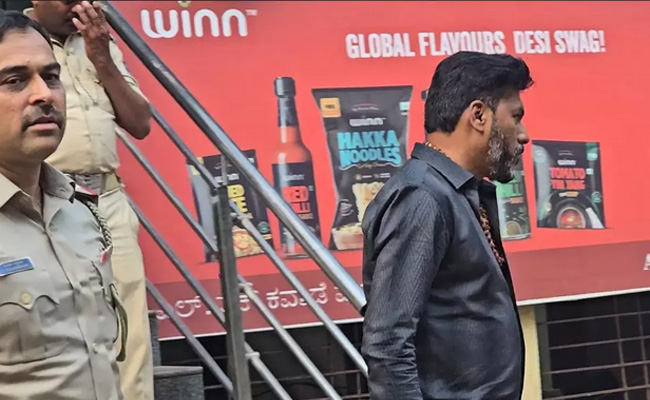
Belagavi: City Police Commissioner Bushan Borase has said that Shivanand Neelannavar, owner of Shivam Associates, has been taken into custody for having violated Reserve Bank of India (RBI) rules by running an unauthorized transaction scheme and getting thousands of people to deposit money.
The police registered an FIR on Friday night and questioned Neelannavar, who is also suspected to be involved in money laundering, in the case.
On Thursday evening, Assistant Commissioner Shravan Nayak, accompanied by officials of the Cooperation Department, conducted a preliminary investigation that followed a search of about 24 hours at the offices of Shivanand Neelannavar, owner of Shivam Associates. The operation is said to have been conducted under directions of Deputy Commissioner Mohammad Roshan.
The officials held the raid over allegations of a money-circulation racket, and reportedly seized important financial documents from the office of Shivam Associates. Preliminary findings suggested that about 5,000 investors were made to invest nearly Rs 4,600 crore through pyramid-style scheme. Documents related to the financial transactions were seized from an apartment and two offices of Shivam Associates for further scrutiny.
AC Nayak is said to have submitted a detailed preliminary report on the probe to the DC on Friday, sources said, and senior officials of the Crime Investigation Department (CID) are expected to take over the case soon.
Statements made by Shivananda Neelannavar, a native of Unkal, Hubballi, at a recent event in Kadur went viral on social media. He was seen declaring that he had built a big empire and, having 15,000 guns, was not afraid of anyone. It is learned that he had said that, if needed, he would also show up as CM in 2028.
The viral video is learned to have drawn the attention of the authorities to Shivam Associates and led them to conduct the raid.