Asymptomatic Indians cleared by UAE health authorities only to fly back home from Thursday: Embassy
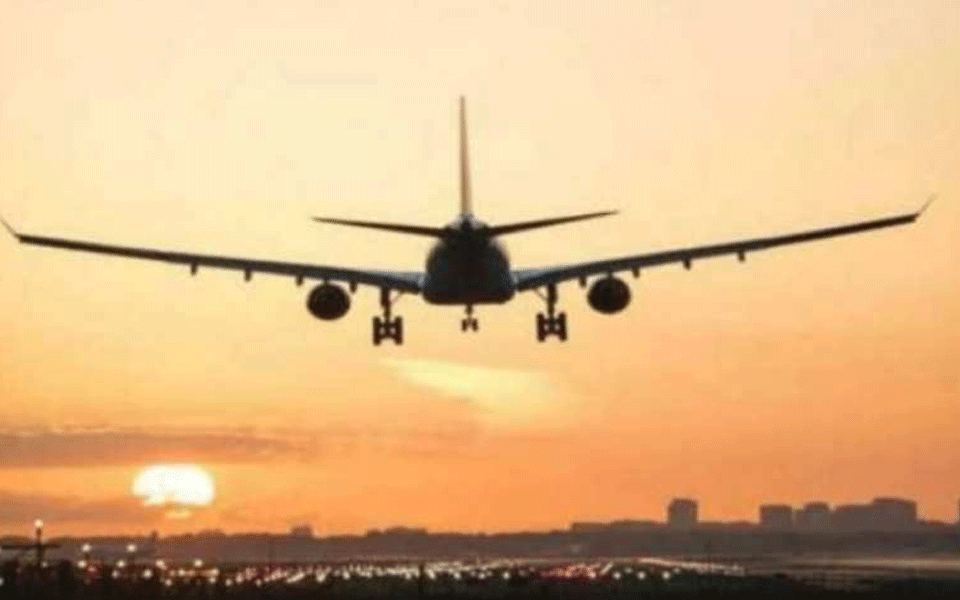
Dubai: The Indian nationals cleared by the UAE health authorities and found to be asymptomatic will only be allowed to fly back home in one of India's biggest ever repatriation exercises, the Indian Embassy in Abu Dhabi has said ahead of the first set of flights on Thursday.
On Monday, the Indian government announced plans to begin a phased repatriation of its citizens stranded abroad from May 7. Air India will operate 64 flights from May 7 to May 13 to bring back around 15,000 Indian nationals stranded abroad amid the COVID-19-induced lockdown, India's Civil Aviation Minister Hardeep Singh Puri said on Tuesday.
The first two special flights that will operate from Thursday to evacuate Indians stranded in the UAE due to the coronavirus pandemic will begin with applicants from Kerala, who formed the majority of the expatriates who have registered to be repatriated from here, Indian Ambassador to the UAE Pavan Kapoor has said.
"All departing passengers will have to undergo medical screening and IGM/IGG test at the departure airport and only those cleared by the UAE health authorities and found to be asymptomatic will be allowed to board the plane, the Indian Embassy in Abu Dhabi said on Tuesday.
According to the embassy, all passengers will be required to sign an undertaking to undergo compulsory quarantine at the destination of arrival and bear the cost of the same.
Each passenger, at the time of boarding would be handed over a safety kit containing 2 three-layered face masks, 2 pairs of gloves and pouches/small bottles of hand sanitizers. While on board the flight, the health protocol of the Ministry of Civil Aviation of India will be strictly followed, said the embassy.
The passenger lists for the two flights on May 7 have been finalised by the Embassy / Consulate and sent to Air India Express for issue of tickets.
The Embassy / Consulate will continue conveying the details of further special flights as and when they are announced by the Government of India, over the next few days.
Less than 2,000 Indians wishing to return home from the UAE will be flown to six Indian states in the first week of India's biggest ever repatriation exercise named Vande Bharat Mission sans social distancing and COVID-19 tests, the Gulf News reported.
Only those cleared by the UAE health authorities and found to be asymptomatic will be allowed to board the plane.
The short-listed applicants, who were contacted by the Indian missions on Tuesday to purchase tickets for the first two flights to Kerala on Thursday, told the Gulf News that the tickets are priced around Dh 725 to Dh 750 (over Rs 15,000).
Sharjah resident Rasheed Thayyil said his 70-year-old mother Nepheeza Thottungal, who came on a visit to the UAE in February, received an email from the Indian Consulate in Dubai which quoted an airfare of around Dh725 (approx Rs 15,000), the report said.
Another applicant from Abu Dhabi Ambily Babu said she purchased a ticket at Dh 750 from Air India Express for her Abu Dhabi-Kochi flight scheduled to fly on Thursday evening, it said.
Air India Express which is set to operate the first two flights to Kerala on Thursday will operate its Boeing 737-800 aircraft, with a seating capacity of 186 economy class seats, the report added.
With nine seats reserved for isolation, only 177 passengers would be flown, it said.
The Indian expatriate community of approximately 3.42 million is reportedly the largest ethnic community in the UAE constituting roughly about 30 per cent of the country's population, according to information available on the Indian Embassy website.
Let the Truth be known. If you read VB and like VB, please be a VB Supporter and Help us deliver the Truth to one and all.
Steel mirrors deployed in Mysuru to discourage public urination
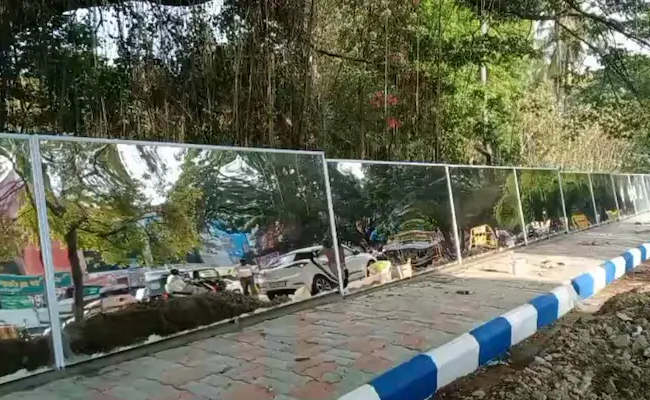
Mysuru (PTI): Fed up with people relieving themselves along roadsides, the Mysuru City Corporation has adopted a unique strategy to curb the practice and promote civic sense by installing reflective steel mirrors along pavements, officials said on Friday.
In what officials described as a first-of-its-kind initiative, the Corporation installed stainless steel sheets with a mirror finish along an 80-metre stretch opposite the Mysuru Suburban Bus Stand.
Officials said the reflective sheets are intended to confront anyone attempting to urinate in public with their own reflection, thereby discouraging the act psychologically.
“The idea is to maintain cleanliness and hygiene, prevent public nuisance, and promote civic sense. It is a simple yet psychological approach that encourages self-awareness through reflection,” officials added.
Soon after the mirrors were installed, videos of the initiative went viral on social media, with many people appreciating the administration’s innovative attempt to address public urination. At the same time, some users pointed out the lack of basic civic sense among people.
Several social media users also suggested that more public toilets, maintained in a hygienic condition, were needed to further discourage open urination.
Explaining how the idea originated, Nitesh Patil, Administrator and Regional Commissioner of the Mysuru City Corporation, told PTI that despite a public toilet being located next to the bus stand, many people continued to urinate in the open.
Even fines and warnings failed to deter them from relieving themselves against vacant compound walls, leaving behind a foul smell.
“One of our engineers came up with this idea, and we decided to implement it. The initiative has received a very positive response from the public, social media, and the press. We are now planning to identify more such locations in the city and install similar reflectors,” he said.
According to him, to ensure that the installation is both effective and visually appealing, LED lighting that switches on along with the streetlights has also been added, causing the stretch to glow at night and enhancing the city’s appearance.
Patil said the initiative had helped create civic awareness while also beautifying the city.
“We want our city to be clean and hygienic. We aspire to become the cleanest city in the country,” he added, recalling that Mysuru secured third place nationally in the Swachh Survekshan Awards 2024–25 last year.