COVID-19: Indian missions in UAE open online registration for its citizens who wish to fly home

Dubai: The Indian missions in the UAE have opened online registration for the expatriates who wish to fly back home after getting stuck in the country amidst the lockdown due to the coronavirus pandemic.
On Wednesday night, the Indian Embassy in Abu Dhabi announced the details of data collection through the website of the Indian Consulate in Dubai, the Gulf News reported.
"It is informed that the Embassy of India, Abu Dhabi and the Consulate General of India, Dubai, have started a database to register Indians wishing to travel back to India under COVID-19 situation. The details can be entered through the website of the Embassy www.indianembassyuae.gov.in or Consulate www.cgidubai.gov.in by following the link 'Register in Database of Indians to Travel Back to India under COVID-19 situation'," India in Dubai tweeted on Thursday.
"These can also be entered by following the link www.cgidubai.gov.in/covid_register," it tweeted.
However, minutes after posting the tweet, the mission deleted it citing technical issues. It seemed some users were having trouble accessing the page, the report said.
On Thursday, the Consulate General of India in Dubai reposted the link, warning it may take "some time for the page to load due to high traffic," the report said.
The Abu Dhabi mission earlier clarified that the purpose of the form is only to collect information to enable the Government of India to plan for the return of Indians from abroad under the present COVID-19 situation, the report added.
This form is to be filled for a single individual at a time. Families need to fill separate forms for each member, it said.
Similarly, for companies, a separate form has to be filled for each employee. It was also clarified that the decision on resumption of passenger flights to India will be taken in due course, the report said.
Tens of thousands of Indian expats are expected to register their details, it said. On April 10, the government said a decision to bring Indians stranded abroad will be taken after reviewing the COVID-19 situation.
Ministry of External Affairs Additional Secretary Dammu Ravi said, "Some questions have come about Indians abroad. It is a situation where we cannot give a definite answer because the lockdown is still there. We need to assess the situation It will be the government's decision on how we manage the return of Indians from other countries."
Indian expatriate community of approximately 3.42 millions is reportedly the largest ethnic community in UAE constituting roughly about 30 per cent of the country's population, as per the International Migrant Stock 2019 released by the Population Division of the UN Department of Economic and Social Affairs (DESA), according to the Indian Embassy.
Let the Truth be known. If you read VB and like VB, please be a VB Supporter and Help us deliver the Truth to one and all.
Karnataka: GBA city corporation polls likely between June 14 and 24
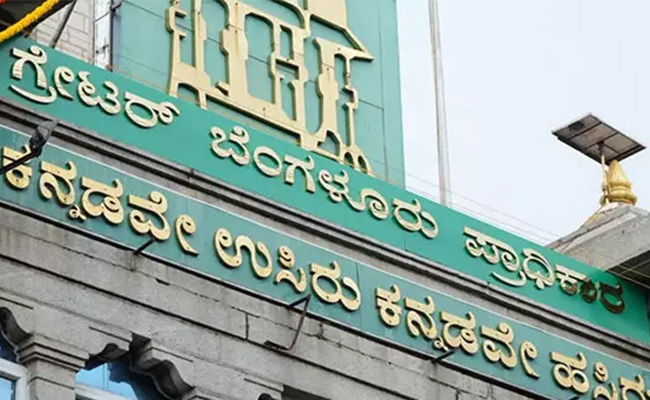
Bengaluru (PTI): Karnataka State Election Commissioner G S Sangreshi on Friday said elections to the five city corporations under the GBA will be held anytime between June 14 and June 24.
He said the exact date for the polls will be announced after a week, asserting that the power to postpone the elections, as requested by GBA authorities, lies with the Supreme Court.
The Supreme Court had directed the Karnataka government and the State Election Commission to conduct Bengaluru local body elections by June 30.
On Friday, the SEC held a consultation meeting with the GBA Chief Commissioner and commissioners of the five city corporations regarding the election schedule, as per the provisions of the GBA Act.
“During the meeting, I informed GBA officials that only the election date has to be fixed, as all other measures and formalities for conducting the polls have already been completed,” Sangreshi said.
“They requested the Commission to consider factors such as rains, exams, census work, SIR, and manpower shortages while fixing the date and sought additional time,” he added.
Speaking to reporters after the meeting, he said, “I told them this meeting was not for seeking time. Elections to the five corporations under the GBA must be held before June 30, as directed by the Supreme Court, and a compliance report must be submitted to the court. I do not have the power to postpone the elections as requested.”
The Supreme Court has already given a “final opportunity,” and both the SEC and the government must comply with its directions, the State Election Commissioner said.
He asked GBA officials to suggest suitable dates between June 14 and June 24.
“While stating that they are ready for elections, the officials highlighted operational challenges, including manpower shortages. However, I have informed them that the elections will have to be held between June 14 and June 24. After a week, I will announce the final date,” he said.
Reiterating that he does not have the power to postpone the elections, Sangreshi said the authority rests with the Supreme Court, and elections must be conducted as scheduled.
“We have consulted the GBA as per the rules. It is up to them to suggest a date within the given window. If they need more time, they must approach the court. Our responsibility is to fix the date and complete the polls before June 30,” he said.
The matter regarding manpower and other concerns raised by GBA officials is already before the Supreme Court, and the State Election Commission has also filed a petition in this regard. The case is yet to be heard.
“Since the matter has not come up for hearing, the earlier order remains binding. Therefore, preparations are underway,” he added.
The tenure of the previous elected body under the erstwhile Bruhat Bengaluru Mahanagara Palike (BBMP) ended on September 10, 2020, and since then, a government-appointed administrator has been managing its day-to-day affairs.
Bengaluru was divided into five municipal corporations—Central, East, West, North, and South—under the Greater Bengaluru Authority in September 2025, replacing the BBMP.
Sangreshi had earlier said that elections to the five corporations would be conducted using ballot papers instead of Electronic Voting Machines.
This follows the Congress government’s decision last September to recommend the use of ballot papers in all future panchayat and urban local body elections, citing concerns over declining public confidence in EVMs.
The state government subsequently enacted the Karnataka Gram Swaraj and Panchayat Raj (Amendment) Act, 2026, paving the way for the use of ballot papers in local body elections.