Drone attacks strike major Saudi Aramco facility, oilfield
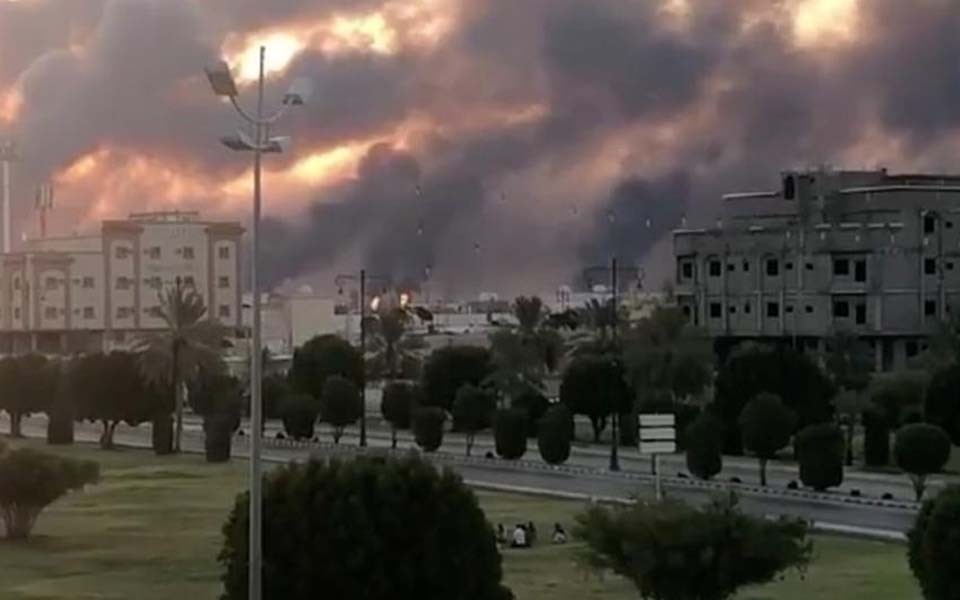
Dubai, Sep 14: Drones attacked the world's largest oil processing facility in Saudi Arabia and an oilfield operated by Saudi Aramco early Saturday, the kingdom's Interior Ministry said, sparking a huge fire at a processor crucial to global energy supplies.
No one immediately claimed responsibility for the attacks in Buqayq and the Khurais oil field, though Yemen's Houthi rebels previously launched drone assaults deep inside of the kingdom.
It wasn't clear if there were any injuries in the attacks, nor what effect it would have on oil production in the kingdom. The attack also likely will heighten tensions further across the wider Persian Gulf amid a confrontation between the US and Iran over its unraveling nuclear deal with world powers.
Online videos apparently shot in Buqayq included the sound of gunfire in the background and flames shooting out of the Abqaiq oil processing facility. Smoke rose over the skyline and glowing flames could be seen a distance away.
The fires began after the sites were "targeted by drones," the Interior Ministry said in a statement carried by the state-run Saudi Press Agency. It said an investigation into the attack was underway.
Saudi Aramco, the state-owned oil giant, did not immediately respond to questions from The Associated Press. The kingdom hopes soon to offer a sliver of the company in an initial public offering.
Saudi Aramco describes its Abqaiq oil processing facility in Buqayq as "the largest crude oil stabilization plant in the world." The facility processes sour crude oil into sweet crude, then later transports onto transshipment points on the Persian Gulf and the Red Sea. Estimates suggest it can process up to 7 million barrels of crude oil a day.
The plant has been targeted in the past by militants. Al-Qaida-claimed suicide bombers tried but failed to attack the oil complex in February 2006.
There was no immediate impact on global oil prices as markets were closed for the weekend across the world. Benchmark Brent crude had been trading at just above USD 60 a barrel.
Buqayq is some 330 kilometers (205 miles) northeast of the Saudi capital, Riyadh.
While no group immediately claimed the attacks, suspicion immediately fell on Yemen's Houthi rebels.
A Saudi-led coalition has been battling the rebels since March 2015. The Iranian-backed Houthis hold Yemen's capital, Sanaa, and other territory in the Arab world's poorest country.
The war has become the world's worst humanitarian crisis. The violence has pushed Yemen to the brink of famine and killed more than 90,000 people since 2015, according to the US-based Armed Conflict Location & Event Data Project, or ACLED, which tracks the conflict.
Since the start of the Saudi-led war, Houthi rebels have been using drones in combat. The first appeared to be off-the-shelf, hobby-kit-style drones. Later, versions nearly identical to Iranian models turned up. Iran denies supplying the Houthis with weapons, although the UN, the West and Gulf Arab nations say Tehran does.
The rebels have flown drones into the radar arrays of Saudi Arabia's Patriot missile batteries, according to Conflict Armament Research, disabling them and allowing the Houthis to fire ballistic missiles into the kingdom unchallenged. The Houthis launched drone attacks targeting Saudi Arabia's crucial East-West Pipeline in May as tensions heightened between Iran and the US.
UN investigators said the Houthis' new UAV-X drone, found in recent months during the Saudi-led coalition's war in Yemen, likely has a range of up to 1,500 kilometers (930 miles).
That puts the far reaches of both Saudi Arabia and the United Arab Emirates in range.
The Houthi's Al-Masirah satellite news channel did not immediately acknowledge the attack Saturday.
Let the Truth be known. If you read VB and like VB, please be a VB Supporter and Help us deliver the Truth to one and all.
AIITA welcomes Karnataka’s ban on obscene songs in school events
Bhatkal: The Karnataka unit of the All India Ideal Teachers Association (AIITA) has welcomed the Karnataka government’s decision to strictly ban school children from dancing to obscene songs during educational and cultural programmes in government, aided, and private schools across the state.
AIITA Karnataka State President M. R. Manvi congratulated the government for taking what he termed an important step to preserve the sanctity of education.
“Such decisions to safeguard the dignity of school children and uphold the values of education are the need of the hour. This rule should not be limited to government schools alone but must be strictly implemented in all private educational institutions as well,” he said.
He further urged the government to address other concerns within school programmes.
“The government should not only prohibit obscene dances in the name of school anniversaries, but also ensure that plays and dialogues that incite religious hatred are avoided. Schools should be centres of harmony, not platforms for spreading hatred,” he added.
According to a recent circular issued by the Department of School Education and Literacy, obscene dances are adversely affecting the mental health and moral values of students.
In this regard, schools have been advised to use songs that promote nationalism, positive thinking, the greatness of Kannada culture, and value-based traditions instead of inappropriate content during programmes.
The circular also emphasises that students should be dressed in decent attire.
AIITA also backed the department’s warning that disciplinary action would be taken against head teachers if such guidelines are violated. The association has further demanded that district Deputy Directors of Public Instruction strictly monitor the implementation of these rules.