First Arab on International Space Station returns to Earth
UAE astronaut Hazzaa al-Mansoori tweets photo of Mecca from space
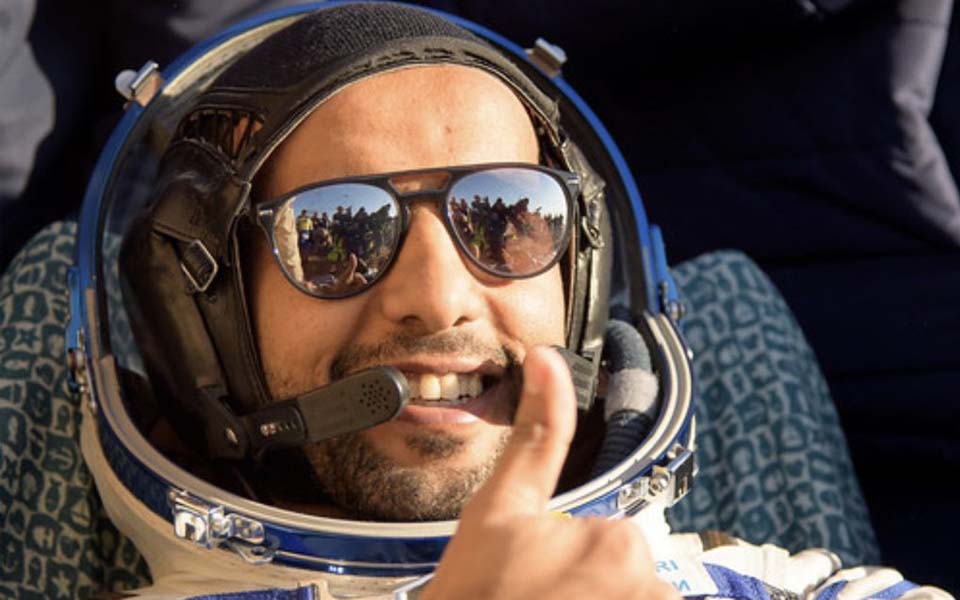
Almaty (Kazakhstan), Oct 4: A three-man crew including an Emirati who became the first Arab to reach the International Space Station returned to Earth safely on Thursday and were in good shape, the Russian space agency Roscosmos said.
Hazzaa al-Mansoori of the United Arab Emirates touched down in the Kazakh steppes at 1059 GMT along with NASA astronaut Nick Hague and Roscosmos cosmonaut Alexey Ovchinin, who both survived a failed launch to the ISS last year.
"The crew that returned to Earth is feeling well," Roscosmos said immediately after the landing.
Roscosmos footage from the landing site in central Kazakhstan showed Mansoori smiling as he sat wrapped in an Emirati flag after leaving the capsule.
Hague and Ovchinin completed a 203-day mission aboard the orbiting laboratory while Mansoori's two crewmates from his September 25 launch -- Russia's Oleg Skripochka and NASA's Jessica Meir -- are staying on as part of a six-member team.
Although Mansoori's mission was short -- eight days in total -- it has been the source of great pride in the UAE, a newcomer to the world of space with ambitions to send an unmanned probe to orbit Mars by 2021.
UAE leaders were quick to hail his safe return.
Abu Dhabi's powerful Crown Prince Sheikh Mohammed bin Zayed al-Nahyan hailed the mission in a Twitter post.
"Congratulations to the people of the UAE for this historic achievement. Zayed's sons will fulfil our ambition to reach Mars," the Crown Prince wrote.
Mansoori has been active on Twitter where he shared photos of the UAE and Mecca Islam's holiest site from the space station.
On Thursday, he posted a view of space taken from the station's Cupola panoramic observatory module and paid tribute to UAE founding father Sheikh Zayed.
"With fear and pride, I am returning with Zayed's ambition achieved. We are not done yet, and we will never be. To bring back the golden era of Arab astronauts," he wrote.
Mansoori's blast-off from the launchpad that sent Soviet cosmonaut Yuri Gagarin into space was roared on by a large crowd at the Mohammed Bin Rashid Space Centre in the UAE, where he has been feted as a hero.
Dubai's Burj Khalifa, the world's tallest skyscraper, was lit up at the moment of the launch.
The 35-year-old former military pilot's whirlwind mission has had wall-to-wall coverage in Arab media.
He is expected to receive an ecstatic welcome when he returns to the UAE following a stopover at the Roscosmos training base in Star City outside Moscow.
Mansoori flew to the ISS after the UAE signed a contract with Roscosmos to allow him to become a "spaceflight participant," a term used for people from outside the main space agencies who take short trips to the station.
Russia currently enjoys a monopoly on manned flights to the ISS.
The first Arab in outer space was Saudi Arabia's Sultan bin Salman Al-Saud, who flew on a US shuttle mission in 1985.
Two years later, Syrian air force pilot Muhammed Faris spent a week aboard the Soviet Union's Mir space station.
As part of its space plans, the UAE has also announced its aim to become the first Arab country to send an unmanned probe to orbit Mars by 2021, naming it "Hope".
While on board, Mansoori donned Emirati dress, treated crew members to local snacks and participated in scientific experiments including a time-perception study that saw him sport a blindfold.
The return from space of Ovchinin and Hague came a year after their rocket failed to launch in the first accident of its kind in Russia's post-Soviet history.
The two men took off in a Soyuz rocket for the ISS in October 2018, but an accident minutes after blast-off sent them plunging back to Earth.
The pair launched again -- this time without hiccups -- to begin Ovchinin's second and Hague's first mission aboard the ISS in February.
The ISS a rare example of cooperation between Russia and the West -- has been orbiting Earth at about 28,000 kilometres (17,000 miles) an hour since 1998.
An incredible image of Mecca from the @Space_Station pic.twitter.com/9EIfpHOjYl
— Hazzaa AlMansoori (@astro_hazzaa) October 2, 2019
Let the Truth be known. If you read VB and like VB, please be a VB Supporter and Help us deliver the Truth to one and all.
Man arrested with Rs 2.54-crore heroin in Mumbai

Mumbai (PTI): Police have arrested a man and seized over 500 grams of heroin worth Rs 2.54 crore in the illicit market from him in Mumbai, officials said on Friday.
The police's Anti-Narcotics Cell (ANC) made the drug seizure in Santacruz in the western suburbs. The operation was conducted by the Kandivali unit of the ANC on Thursday as part of a special crackdown against drug trafficking in the area, they said.
Acting on specific inputs, an ANC team conducted a raid in Santacruz (East) and intercepted a man. During a search, the team recovered 508 grams of high-grade heroin from his possession, an official said.
The seized contraband, a highly addictive, opioid drug derived from morphine, is estimated to be worth Rs 2.54 crore in the international market, he informed.
Following the seizure, a case was registered against the man under relevant sections of the Narcotic Drugs and Psychotropic Substances (NDPS) Act, 1985, and he was formally placed under arrest in the early hours of Friday.
The police are currently investigating the source of the drug and trying to identify the intended recipients of the consignment, he said.