Gulf Medical University to host conference for educators
Focuses on guiding youth to meaningful careers in health professions education

Ajman: Gulf Medical University (GMU) is hosting the prestigious Visionary Leaders Nurture Lifelong Learners conference, bringing together speakers and delegates from esteemed schools across UAE to discuss how educators can help youth in the region choose careers they can thrive in. The conference, which is for educators, is in cooperation with the GMU’s College of Healthcare Management and Economics and will be held in the Ajman campus on Saturday, June 25, 2022.
The one–day seminar will host panel discussions on topics such as: (a) Preparing students for University Education, (b) challenges and opportunities while choosing modern versus old courses and (c) managing socio-economic boundaries and career management.
Renowned practitioners in the field of education, including counsellors and principal of schools such as Habitat School (Ajman), Global Indian International School (Abu Dhabi), Sharjah Indian School, Modern American International School (Sharjah), Ryan International School (Sharjah), Al Zuhour Private School (Sharjah), Delhi Private School (Ajman), Pakistani Islamia Higher Secondary School (Ajman) and Dubai National School Al Barsha (Girls and Boys Wing) will grace the event.
Speaking about the conference, Professor Hossam Hamdy, Chancellor of GMU, said, “We have been honoured to welcome such eminent speakers to exchange ideas across several disciplines and plan the development of a shared strategy that guides the career of youth. With platforms such as these, GMU has constantly strived to support the vision of UAE in attracting prestigious academic, social and cultural opportunities to this region. We look forward to building on these newly formed collaborations to contribute in the expansion of UAE’s higher education hub to further grow, evolve and scale even greater heights.”
About GMU:
Over the last 24 years, GMU has strived relentlessly to scale new heights by fostering brilliance to over 2600 students plus 2000 part time from more than 90 different nationalities and 29 accredited Undergraduate and Graduate programs run by the 6 constituent colleges in the field medicine, dentistry, pharmacy, nursing, biomedical sciences, healthcare management and economics, anesthesia technology, medical laboratory sciences, physiotherapy and healthcare management and economics. In addition, the university also offers short term certificate courses for health workforce development and career enhancement.
The university’s extensive accreditation credentials demonstrate robust quality standards, guaranteeing a qualification that is recognized globally-the university’s Bachelor of Medicine and Bachelor of Surgery (MBBS) Programme outcome is aligned to the World Federation of Medical Education (WFME) standards, the Bachelor of Biomedical Sciences Programme is accredited by the Institute of Biomedical Science (IBMS), UK and PharmD Programme is certified by Accreditation Council for Pharmacy Education (ACPE), USA. Furthermore, the university-affiliated teaching hospital is JCI accredited, and laboratories are CAP accredited. The national, international, and regional engagements exceed 70 collaborations with leading international universities in Europe, US, Japan, Malaysia and Far East.
For more information on various programs students can visit the university website www.gmu.ac.ae
Let the Truth be known. If you read VB and like VB, please be a VB Supporter and Help us deliver the Truth to one and all.
Hidden camera installed on railway signal in Vaishali sends security personnel into a tizzy
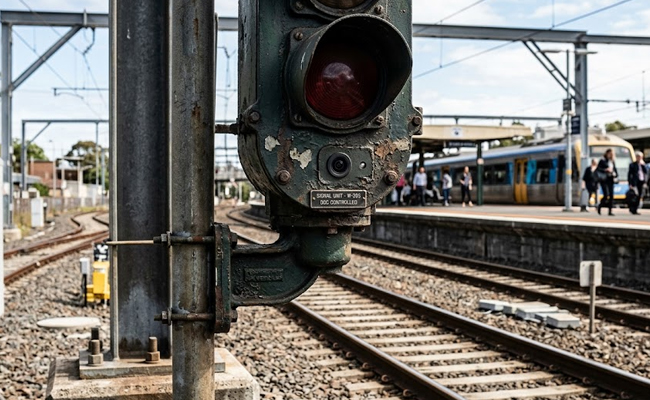
Hajipur (Bihar) (PTI): Security personnel were alarmed when they discovered a suspicious camera installed on a railway signal in Bihar's Vaishali district, officials said on Saturday.
The hidden camera, which had a SIM card, was set up on a railway signal near Sarai railway station.
The Government Railway Police (GRP), Muzaffarpur section, has registered a case and is conducting further investigations into the matter.
"A suspicious camera was found installed on a railway signal near Sarai station on Friday. An investigation is on. Forensic experts have been examining the device. Those who installed the camera will soon be apprehended," Superintendent of Police, GRP Muzaffarpur, Beena Kumari told PTI.
The SP, however, denied reports claiming the recovered camera was being controlled from outside the state.
"Investigators have not found any evidence so far in this regard," she said.