India to begin expatriation flights to bring back citizens from Thursday
No flights for Karnataka citizens
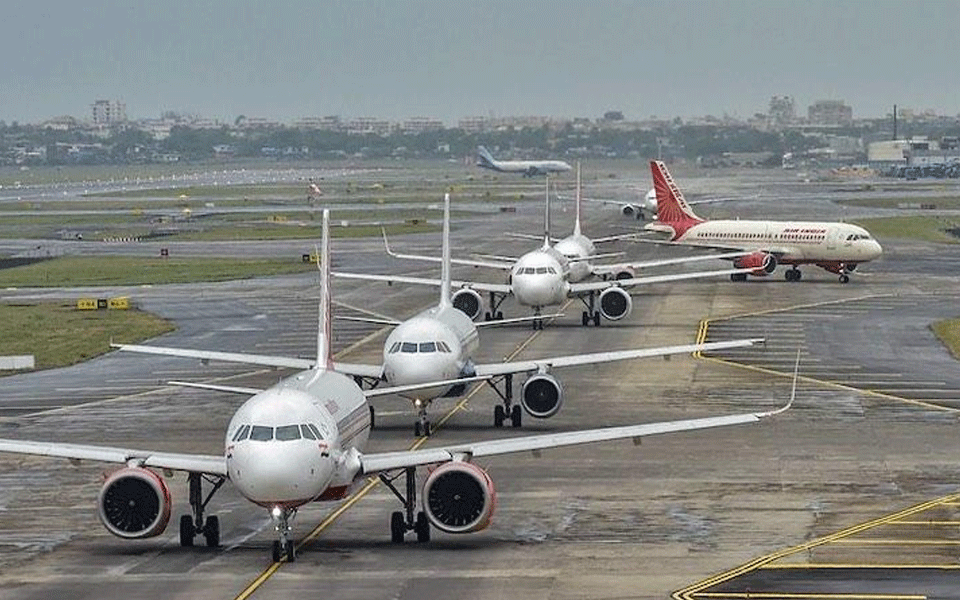
Bengaluru: With more than 190,000 Indian expats in UAE registered to return home on repatriation flight, the Indian government will begin the repatriation operation from Thursday, beginning with two flights that will take of from UAE with Indian expats.
Indian government has decided to deploy fleet of charter flights and naval warships, to bring its citizens back to the country amidst the world-wide corona virus scare. The government sources added that the embassies were preparing priority lists ahead of the operation’s launch on May 7.
According to the reports, between May 7-14 about 60 commercial flights will bring back at least 15,000 citizens from 12 countries with distressed Indian citizens including tourists stranded overseas and expat workers who have lost job being its priority.
Apart from the flights, the government has deployed naval warships including INS Magar and INS Shardul which headed towards Maldives and Dubai respectively.
Interestingly, despite follow-ups, meetings and requests made by several Kannadigas NRI organizations in UAE, the government of Karnataka has not finalized if it will send or receive any flights from the gulf.
The state has no flights scheduled to arrive with its citizens from UAE in the first phase of the operation. In a joint statement released by several organizations of Karnataka in UAE, the organizations claimed that there are several Kannadigas stranded in UAE including plight of severely sick patients and over hundred pregnant women and that at least one flight arriving with the Karnataka’s citizen in the first phase was required.
It also condemned that the approach of the state government and added it was reacting carelessly to the matter. It further demanded that the state government should immediately coordinate with the centre and arrange for flights to ply its citizens back to the state at the earliest.
Praveen Shetty, President of KRNI Forum, Mohammad Naveed- President of Anivasi Kanandigaru Dubai, Sunil Ambalavalil- VP of Anivasi Kannadigaru, Dubai, Hidayath Addoor- Vice President of Bearys Chamber of Commerce, BCCI UAE chapter, Harish Sherigar- Patron Sharjah Karnataka Sanga, Chandrashekar Lingadahalli, President Basava Samithi, Imran Khan- President, Karnataka Media Forum, Ronald Martis- Mangalore Christian community in Dubai, Daya Kirodian- Dubai Karnataka Sanga, Noel Almeida -member of various organization including KNRI, Yashwanth Karkera- Tulu Sanga, Ashfaque sada- President of Bhatkal Muslim Jamaat Dubai, Yusuf Bermaver- General Secretary Bhatkal Muslim Jamaat Dubai, Afzal S M- Bhatkal Muslim Jamaat Dubai, Shashidar Nagarajappa- Kannada Patashale Althaf Hussain- Kodava Samaja, Ashraf KM- Businessman, Johnson Martis- Business professional, Siraj Parladka- Blood Helpline Karnataka and Ansar Barkur endorsed the jointly released press statement on Tuesday.
Let the Truth be known. If you read VB and like VB, please be a VB Supporter and Help us deliver the Truth to one and all.
Massive turnout in assembly polls across states, women voters outnumber men: EC data
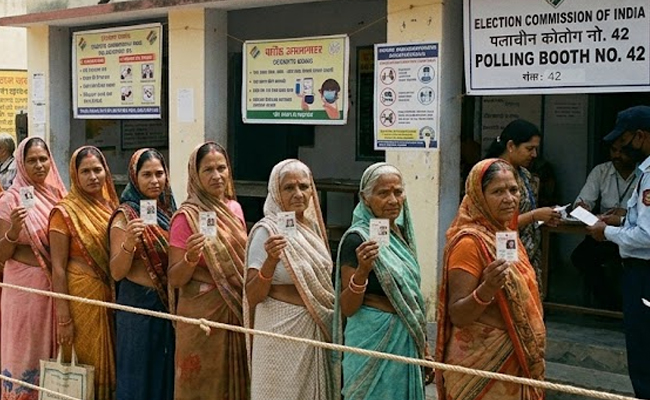
New Delhi (PTI): The recently-concluded assembly elections witnessed exceptionally high voter participation across states, with women voters outnumbering men in turnout percentages, according to Election Commission data.
West Bengal recorded the highest voter turnout among states, with 93.71 per cent polling in 293 constituencies where counting has been completed. The state saw over 6.38 crore votes cast, including postal ballots, against a total of more than 6.81 crore electors.
Women voters recorded a turnout of 93.8 per cent in the West Bengal Assembly polls, slightly higher than the 92.06 per cent participation among men.
The data for West Bengal does not include the figures for the Falta assembly constituency, which is scheduled for repolling.
Tamil Nadu registered an 85.01 per cent turnout, with nearly 4.8 crore votes polled from an electorate of 5.74 crore. Women voters recorded a turnout of 86.2 per cent, higher than the 83.77 per cent among men.
Assam also witnessed robust participation, with the final turnout touching 85.74 per cent. More than 2.15 crore votes were cast in the state, while female turnout at 86.53 per cent marginally exceeded the 84.95 per cent recorded among male voters.
Kerala registered a turnout of 78.11 per cent, with over 2.12 crore votes polled. Female voter participation stood at 81.17 per cent against 74.9 per cent among men.
Puducherry recorded a turnout of 89.82 per cent, with women voters again leading participation at 91.39 per cent. More than 8.5 lakh votes were polled in the Union territory.
Yet, women's representation among elected candidates remained modest.
Tamil Nadu elected 23 women MLAs (9.83 per cent) out of 234 members, West Bengal elected 37 women legislators (12.62 per cent) out of 293, while Kerala returned only 11 women MLAs (7.85 per cent) in the 140-member House.
Only two third-gender candidates contested the elections - one each from Tamil Nadu and Kerala, and both lost, forfeiting their deposits.
The elections also reflected extensive electoral mobilisation infrastructure. West Bengal had the highest number of polling stations at 85,092, followed by Tamil Nadu with 75,064 and Assam with 31,490.
In terms of candidates, Tamil Nadu saw the largest contest with 4,023 candidates in the fray across 234 constituencies, averaging 17 candidates per seat and peaking at 79 contestants in one constituency.
West Bengal pitted 2,920 candidates for 293 constituencies, while Kerala had the fewest contestants among the major states, with 883 candidates for 140 seats.
The data also showed relatively low NOTA votes across states. Tamil Nadu recorded the lowest NOTA share at 0.4 per cent of total votes polled, while Assam recorded the highest at 1.23 per cent. In West Bengal, 0.78 per cent of the total votes polled were NOTA, while it 0.77 per cent and 0.57 per cent of the electorate opted for None of the Above (NOTA) in Puducherry and Kerala, respectively.