India, UAE share values of non-discrimination: Indian Ambassador reminds countrymen in UAE

Abu Dhabi: The Indian Embassy in Abu Dhabi on Monday reminded its countrymen against discriminatory behavior in the wake of Corona Virus spread.
In a tweet from the official twitter handle, Indian ambassador to the UAE, Pavan Kapoor noted that the two countries share the value of non-discrimination. He also added that discrimination was against the moral fabric and rule of law of the two countries.
“India and UAE share the value of non-discrimination on many grounds. Discrimination is against our moral fabric and the rule of law. Indian nationals in the UAE should always remember this.” The tweet stated.
The reminder to Indians by Pavan Kapoor, come a day after Indian Prime Minister, Narendra Modi had voiced similar views and had stated that the COVID-19 doesn’t see race, religion, colour, caste, creed, language or borders before striking.
“COVID-19 does not see race, religion, colour caste, creed, language or borders before striking. Our response and conduct thereafter should attach primacy to unity and brotherhood,” Modi had said in a tweet which was shared by Kapoor.
The coronavirus outbreak has exacerbated Islamophobia in India, resulting in anti-Muslim campaigns across the country. Reports have emerged of Indian hospitals segregating Hindus and Muslims or refusing to admit Muslim patients.
Calls for the economic boycott of Muslims have intensified in recent weeks amid reports vilifying them for spreading the virus.
Alarmed by the developments, several prominent social media handles in the region have expressed outrage over the “ill-treatment” of Muslims in India.
Last week, Princess Hend Al Qassimi, a member of a UAE royal family warned that “anyone that is openly racist and discriminatory in the UAE will be fined and made to leave the country.”
She also slammed Dubai-based Indian expat Saurabh Upadhyay who had put out several tweets targeting Muslims and ridiculing Islam. Sharing screenshots of his tweets, Al Qassimi said: “You make your bread and butter from this land which you scorn and your ridicule will not go unnoticed.”
Let the Truth be known. If you read VB and like VB, please be a VB Supporter and Help us deliver the Truth to one and all.
Trump says EU has until July 4 to approve last year's trade deal or it will face higher tariffs
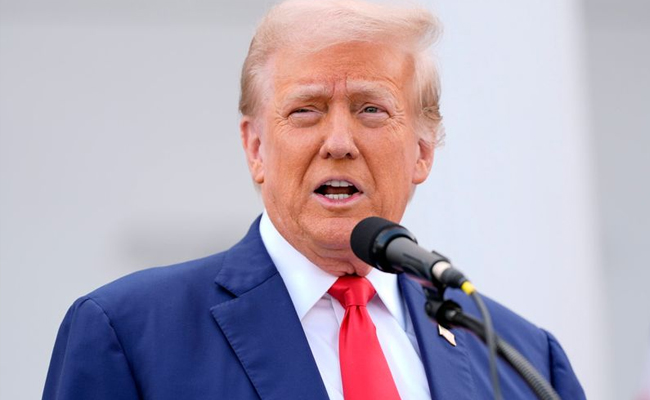
Washington (AP): President Donald Trump has said in a social media post that goods from the European Union would face higher tariff rates if the 27-member bloc fails to approve last year's trade framework by July 4.
The announcement on Thursday appeared to be a deadline extension after the president said last Friday that EU autos would face a higher 25 per cent tariff starting this week. Trump made the updated announcement after what he described as a "great call" with European Commission President Ursula von der Leyen.
Still, the US president was displeased that the European Parliament had yet to finalize the trade arrangement reached last year, which was further complicated in February by the US Supreme Court ruling that Trump lacked the legal authority to declare an economic emergency to impose the initial tariffs used to pressure the EU into talks.
"A promise was made that the EU would deliver their side of the Deal and, as per Agreement, cut their Tariffs to ZERO!" Trump posted. "I agreed to give her until our Country's 250th Birthday or, unfortunately, their Tariffs would immediately jump to much higher levels."
It was unclear from the post whether Trump was implying that the tariff rates would jump on all EU goods or the increase would only apply to autos.
His latest statement indicates he might be backing away from his earlier threat on EU autos by giving the European Parliament several more weeks to approve the agreement.
Under the original terms of the framework, the US would charge a 15 per cent tax on most goods imported from the EU.
But since the Supreme Court ruling, the administration has levied a 10 per cent tariff while investigating trade imbalances and national security issues, aiming to put in new tariffs to make up for lost revenues.