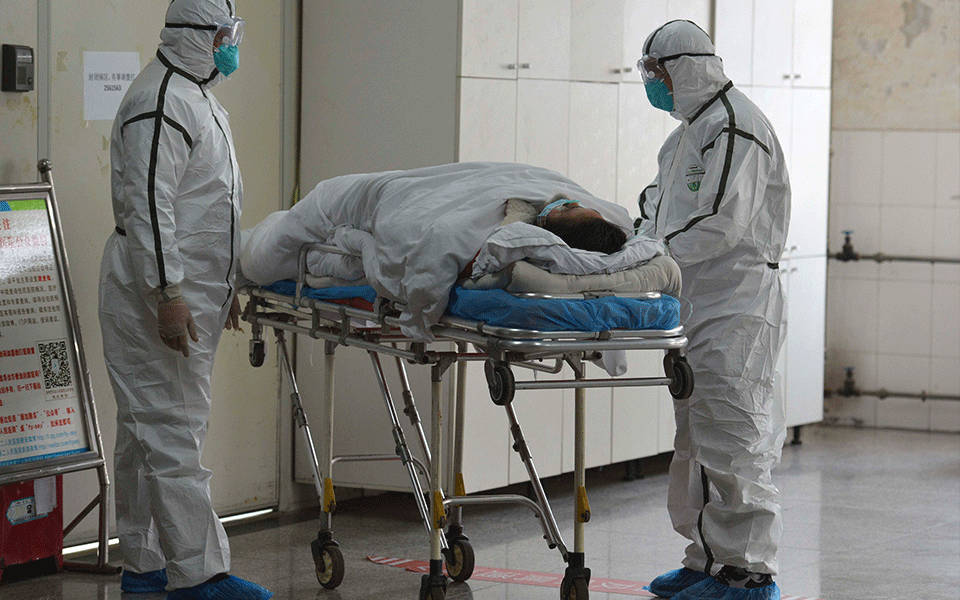
Dubai: An Indian dentist in Kuwait has died from the novel coronavirus, becoming the country's second medical professional to succumb to COVID-19, according to a media report.

Dr Vasudeva Rao, 54, died on Saturday in Jaber hospital where he was undergoing treatment for coronavirus infection, news website timeskuwait.com reported.

A resident of Kuwait for about 15 years, Rao worked as an endodontist at Kuwait Oil Company, a subsidiary of the Kuwait Petroleum Corporation, a government-owned company.

Rao was a member of Indian Dentists' Alliance in Kuwait, an organisation of Indian dental professionals in Kuwait. The organisation mourned his loss.

On Friday, Egyptian ENT specialist Tareq Hussain Mokheimer died of COVID-19, becoming Kuwait's first such medical fatality, the Gulf News reported.

Mokheimer, 62, had worked in Kuwait for more than 20 years.

A total of 171 people arrived in Chennai from Kuwait on Sunday as part of the government's Vande Bharat Mission to bring home Indian nationals stranded in various countries.

Kuwait has reported 58 deaths and 8,688 infections due to the novel coronavirus.

Globally, the death toll due to COVID-19 has gone up to 282,727 with over four million infections reported so far, according to Johns Hopkins University tally. 

Let the Truth be known. If you read VB and like VB, please be a VB Supporter and Help us deliver the Truth to one and all.


New Delhi (PTI): Finance Minister Nirmala Sitharaman on Sunday said the increase in STT in F&O is aimed at curbing high-risk speculative trade and discouraging gullible investors who were losing huge amounts of money in the derivatives market.

The Budget has proposed an increase in the Securities Transaction Tax (STT) on futures contracts to 0.05 per cent from 0.02 per cent.

STT on options premium and exercise of options are proposed to be raised to 0.15 per cent from the present rate of 0.1 per cent and 0.125 per cent, respectively.

Addressing a post-budget conference, Sitharaman said the government is not against derivative trade, but wants small investors, who are facing huge losses, to stay away from the speculative F&O market.

"This nominal increase is purely aimed at speculation, only to deter them, to discourage them. We are not against it (F&O trade), but small investors are facing losses, so how can we be quiet, so it (STT hike on F&O) is to deter such investments," Sitharaman said.

According to studies by Sebi, over 90 per cent of retail investors' trades in the F&O segment lead to losses, and the capital markets regulator has also taken steps to reduce volumes in the past.

Market regulator Sebi has also cautioned small and retail investors against trading in the F&O segment, underscoring the need for responsible investing.

Addressing questions on the intention behind the STT hike, Revenue Secretary Arvind Shrivastava said it has been done to discourage speculative tendencies and handle systemic risk in the derivatives market.

"The government's intention is to discourage speculative tendencies, and the increase in rate is essentially in that direction. So, it is meant to essentially handle the systemic risk in derivative markets," he added.

Shrivastava said even after this increase, the rates of STT will remain modest compared to the volume of the transactions that are happening.

The hike in STT is aimed squarely at high-volume derivative trading, rather than the cash equity market, and is expected to meaningfully increase transaction costs for active and short-term trading strategies.

Sitharaman further said the highest-ever capital expenditure of Rs 12.22 lakh crore announced for 2026-27 works out to be 4.4 per cent of GDP.

The capital expenditure for FY27 is 10 per cent higher than the Rs 11.11 lakh crore budgeted capex announced in FY26.

"We have announced that Rs 12.22 lakh crore is coming through public expenditure. This time it is 4.4 per cent of GDP, which is the highest at least in the last 10 years, it could even be the highest if you were to take data from earlier periods," Sitharaman said.

The capital expenditure was 2.5 per cent of GDP in 2021-22 and around 4 per cent of GDP in 2024-25. The government's capital expenditure was Rs 2.35 lakh crore in 2015-16.

She further said that the 4.3 per cent fiscal deficit target for FY27 is "realistic and responsible". The Budget has proposed to lower the fiscal deficit to 4.3 per cent in FY27, from 4.4 per cent in FY26.

Asked about the budget not making any big announcement for poll-bound states, Sitharaman said there are various announcements, including industrial corridors across the eastern and western parts of India. "So there is enough to cover election states and all other states," she said.