Indian girl beats coronavirus months after surviving cancer in Dubai

Dubai: A four-year-old Indian girl in Dubai, despite her low immune system, has become one of the youngest coronavirus survivors in the UAE after she recovered from the deadly disease last week, according to a media report.
Sivani, who is also a cancer survivor, was admitted on April 1 at the Al Futtaim Health Hub after she got infected with the virus passed on by her mother who is a frontline health worker, the Gulf News reported.
Both Sivani and her dad were also tested despite not having any symptoms and, unlike her father, Sivani was found to be positive, the report said.
Sivani and her mother were kept in the same facility, but extra precautions were made for the girl who had also fought off a rare type of kidney cancer last year called ganglioneuroblastoma.
Sivani was discharged from the hospital on April 20, the report said.
Sivani had undergone chemotherapy sessions only last year and hence her immune system was still weak, said Dr Tholfkar Al Baaj, group medical director at Al Futtaim Health Hub and the consultant in family medicine who treated Sivani.
The doctors were concerned as she was at higher risk of developing a severe form of the disease and therefore, we had put her under close monitoring. Fortunately, she did not develop any complications from the infection, he added.
Sivani remained under treatment for 20 days before two consecutive negative swab tests rendered her all clear. She will now undergo 14-days quarantine at home, the report added.
Sivani's mother has also completed her treatment but remains under observation and is expected to be released soon.
Sivani is believed to be one of the youngest coronavirus recoveries in the UAE. Others were a seven-year-old Syrian girl and a nine-year-old Filipino boy both in Abu Dhabi, the report added.
Let the Truth be known. If you read VB and like VB, please be a VB Supporter and Help us deliver the Truth to one and all.
No need for guv: DMK leader Kanimozhi
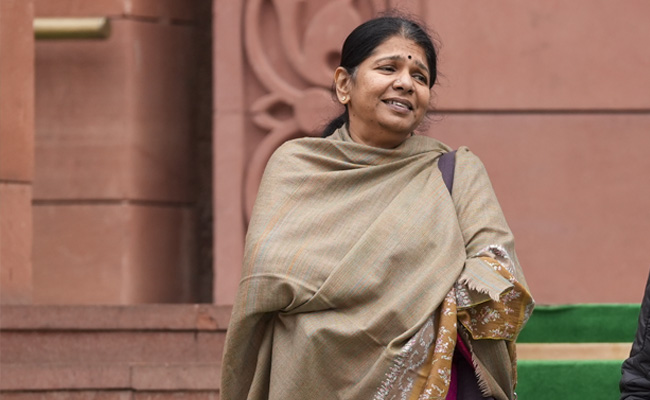
Chennai (PTI): Senior DMK leader Kanimozhi Karunanidhi on Friday reiterated her party’s opposition to the office of the governor amid uncertainty over government formation in Tamil Nadu after a fractured election mandate.
Speaking to PTI Videos, Kanimozhi emphasised that the DMK’s demand for the abolition of the governor’s post remained unchanged, especially as questions arise over constitutional propriety during the current political transition.
"Our position that we do not need a governor at all is something the DMK has never changed at any point in time," she said.
When asked about the governor’s actions following the election results—particularly the delay in inviting the leading party to form the government—Kanimozhi pointed to what she described as the "inherent friction" between the office of the governor and the political interests of the state.
She said the current situation "raises a lot of questions" and requires introspection regarding constitutional procedures.
Kanimozhi described the election results as lacking a "clear mandate", which she identified as the primary reason for the prevailing political uncertainty in the state.
"What the people decide is supreme," she said, adding that while the mandate was not decisive, it must be respected.
The Thoothukudi MP attributed the ongoing delays and "many confusions" to the absence of a decisive majority for any single party.
She firmly dismissed rumours about the DMK potentially supporting the AIADMK from outside to help stabilise the government.
She described such reports as mere "speculation" and "rumours".
"We can’t be responding to every rumour," she said, declining to comment on the AIADMK’s claims regarding its numbers to form the government.
The political situation in Tamil Nadu remains fluid as stakeholders await the governor’s next constitutional step in an Assembly where no party has secured a clear majority.
The DMK and AIADMK—both of which suffered significant losses to the TVK—are reportedly exploring tactical manoeuvres to navigate the hung Assembly.
The TVK, with 108 seats and the support of Congress’s five MLAs, is still short of the majority mark. The DMK and AIADMK secured 59 and 47 seats, respectively.