Israel renews assault on Lebanon after Netanyahu promises 'many surprises' in next phase of war
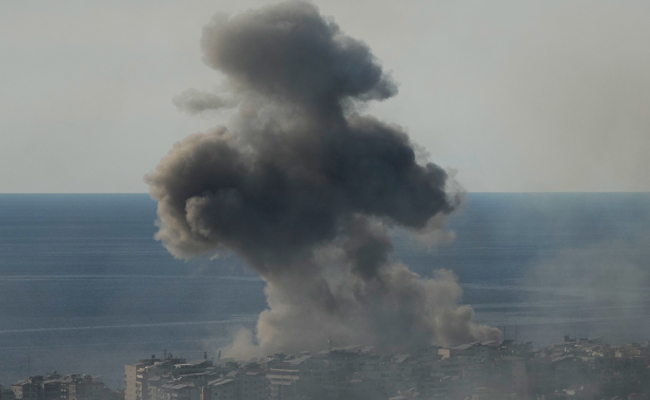
Dubai (AP): Israel renewed its assault on southern Lebanon on early Sunday, including targeting commanders of the Lebanese branch of Iran's Revolutionary Guards' Quds Force, after Israeli Prime Minister Benjamin Netanyahu promised “many surprises” for the next phase of the conflict.
The Israeli military said in a statement that it would “not allow Iranian terrorist elements to establish themselves in Lebanese territory."
The latest strikes in Lebanon followed an Israeli attack Saturday on an oil storage facility in Tehran, which sent up pillars of fire that could be seen in Associated Press video as a glow against the night sky.
It appeared to be the first time a civil industrial facility has been targeted in the war. State media blamed “an attack from the US and the Zionist regime” at the site that supplies the capital and neighbouring provinces in the north.
Elsewhere, Kuwait authorities said two border guards were killed when the Gulf country was hit by a swarm of missiles and drones. The Interior Ministry said only that the guards were killed “while performing their national duty.” No other details were available.
Israeli airstrikes killed eight people in southern Lebanon, the Lebanese Health Ministry said, and local media reported that an Israeli drone hit a hotel in Beirut, killing four and wounding 10 others. The deaths come on top of at least 47 others killed Saturday in Israeli strikes.
The Iranian president apologises for the attacks
--------------------------------------------------------
Iranian President Masoud Pezeshkian apologised Saturday for attacks on “neighbouring countries," even as his country's missiles and drones flew toward Gulf Arab states and hard-liners asserted that Tehran's war strategy would not change.
A rift between politicians looking to de-escalate the war and others committed to battling the United States and Israel could complicate any diplomatic efforts. Conflicting Iranian statements came from two of the three members of the leadership council overseeing Iran since Supreme Leader Ayatollah Ali Khamenei was killed in the war's opening airstrikes.
Pezeshkian, who is a member of the council, also dismissed US President Donald Trump's call for Tehran to surrender unconditionally, saying: “That's a dream that they should take to their grave.”
Trump threatened that Iran would be “hit very hard” and more “areas and groups of people” would become targets, without elaborating. Already, the conflict has rattled global markets and left Iran's leadership weakened by hundreds of Israeli and American airstrikes.
“We're not looking to settle,” Trump told reporters Saturday aboard Air Force One. “They'd like to settle. We're not looking to settle.”
He described the ongoing US operations in Iran as an “excursion” and said issues such as rising gas prices and the safety of Americans would improve once the conflict ends.
Iranian leaders have limited power over the Revolutionary Guard
--------------------------------------------------------------------------
Pezeshkian's message underlined the limited powers exercised by theocracy's leaders over the paramilitary Revolutionary Guard, which controls the hundreds of ballistic missiles targeting Israel and other countries. It answered only to Khamenei and appears to be picking its own targets.
Pezeshkian's statement said Iran's leadership council had been in touch with the armed forces and “from now on, they should not attack neighbouring countries or fire missiles at them, unless we are attacked by those countries. I think we should solve this through diplomacy.”
The US strikes have not come from the Gulf Arab governments under attack, but from US bases and vessels in the region.
Hard-line judiciary chief Gholam Hossein Mohseni-Ejei, another member of the three-man leadership council, suggested that the war strategy will not change.
“The geography of some countries in the region — both overtly and covertly — is in the hands of the enemy, and those points are used against our country in acts of aggression. Intense attacks on these targets will continue,” he posted on X.
Iran's U.N. mission later suggested, without offering evidence, that strikes on nonmilitary sites “may have resulted from interception by US electronic defence systems.”
Late Saturday, top Iranian security official Ali Larijani asserted in an address carried by state media that “our leaders are united on this issue and have no disagreements with one another.”
Trump says the Kurds won't be involved
------------------------------------------------
In other developments, Trump said he has ruled out having Kurds join the war, even though Kurdish fighters in the region are willing to assist in efforts to topple the Iranian government.
“The war is complicated enough without having ... the Kurds involved,” Trump told reporters.
Days ago, Kurdish officials told the AP that Kurdish-Iranian dissident groups based in northern Iraq were preparing for a potential cross-border military operation in Iran and that the US had asked Iraqi Kurds to support them.
The US and Israel have targeted Iran's military capabilities, leadership and nuclear programme. The war's stated goals and timelines have repeatedly shifted as the US has at times suggested it seeks to topple Iran's government or elevate new leadership.
The fighting has killed at least 1,230 people in Iran, more than 290 in Lebanon and 11 in Israel, according to officials in those countries. Six US troops have been killed.
Missile lands at US Embassy compound in Iraq
-------------------------------------------------------
Three Iraqi security officials said a missile landed on the helicopter landing pad in the US Embassy complex in Baghdad. They spoke on condition of anonymity because they were not authorised to comment publicly. An embassy spokesperson declined to comment. There were no reports of casualties.
It was the first reported strike to land in Baghdad's heavily fortified Green Zone since the Iran war began. Iran and allied Iraqi militias have launched dozens of attacks on US military bases and other facilities in Iraq since then.
Iraq's caretaker Prime Minister Mohammed Shia al-Sudani called the embassy attack a “terrorist act” carried out by “rogue groups.”
Strikes target other Gulf countries
-----------------------------------------
Hours after Pezeshkian's apology, the United Arab Emirates said debris from an aerial interception fell onto a vehicle and killed a driver. Four people have now been killed in the UAE since the war began. Authorities have said all were foreign nationals.
Sirens sounded earlier Saturday in Bahrain as Iran targeted the island kingdom. Saudi Arabia said it destroyed drones headed toward its vast Shaybah oil field and shot down a ballistic missile launched toward Prince Sultan Air Base, which hosts US forces.
In Kuwait, authorities said a wave of drones targeted critical infrastructure, including fuel tanks at Kuwait International Airport and a government building in Kuwait City. At least two people were killed by strikes in Iraq's semi-autonomous Kurdish region.
Let the Truth be known. If you read VB and like VB, please be a VB Supporter and Help us deliver the Truth to one and all.
Rupee falls 11 paise to 94.27 against US dollar in early trade

Mumbai (PTI): The rupee depreciated 11 paise to 94.27 against US dollar in early trade on Monday driven by persistent dollar demand and a broader shift toward safe-haven assets.
Forex traders said the Indian rupee has hit a rough patch, falling for five consecutive sessions, weighed down by a combination of factors such as the RBI loosening its grip on currency rules and rising oil prices caused by global tensions.
Moreover, investors are becoming cautious again, with foreign institutions pulling money out of the market after a brief period of buying amid rising geopolitical uncertainty.
At the interbank foreign exchange market the rupee opened at 94.25 against the US dollar, then lost some ground and touched 94.27 against the US dollar in initial trade, registering a fall of 11 paise over its previous close. On Friday, the rupee had settled at 94.16 against the American currency.
ALSO READ: Death toll in Mundathikode fireworks explosion rises to 16
Meanwhile, the dollar index, which gauges the greenback's strength against a basket of six currencies, was down 0.09 per cent at 98.44.
Brent crude, the global oil benchmark, was trading higher by 1.16 per cent at USD 106.55 per barrel in futures trade.
A mix of softer economic signals and renewed, even if fragile, hopes of diplomacy pulled the dollar lower again, CR Forex Advisors MD Amit Pabari said, adding that for Rupee, on one hand, a softer dollar offers relief. On the other, uncertainty remains the dominant force.
Meanwhile, India’s forex reserves have crossed USD 703 billion as of April 17, reflecting a consistent build-up of buffers.
"For now, the rupee continues to lean toward gradual weakness. Uncertainty remains the dominant force, shaping both global flows and local reactions," Pabari said.
He further noted that any dips are likely to be bought into, with the 92.80–93.20 zone acting as a strong support. On the upside, 93.50 to 94.50 is expected to define the near-term range.
On the domestic equity market front, the 30-share benchmark index Sensex was trading 518.96 points or 0.68 per cent higher at 77,183.17, while the broader Nifty was trading up 131.30 points or 0.55 per cent at 24,029.25.
Foreign Institutional Investors offloaded equities worth Rs 8,827.87 crore on Friday, according to exchange data.