Kuwait govt to deport expats who protested over remarks against Prophet at illegal demonstration

Dubai(PTI): The Kuwaiti government has decided to arrest and deport an unspecified number of expats who participated in a protest against the controversial remarks by two former BJP functionaries against Prophet Mohammad, as the Gulf nation's laws do not allow such demonstrations, according to a media report.
Instructions have been issued to arrest expats from the Fahaheel area who organised a demonstration after Friday prayers in support of Prophet Muhammad, Arab News, an English-language daily newspaper published in Saudi Arabia, quoted sources as saying.
Kuwait said that the protestors will be deported to their respective countries as they violated the laws and regulations of the country which stipulates that sit-ins or demonstrations by expats are not to be organised in the Gulf nation, it said.
"The detectives are in the process of arresting them and referring to the deportation center to be deported to their countries and will be banned from entering Kuwait again," reported Al Rai, a Kuwaiti newspaper.
The report did not mention the nationalities of those expatriates who took part in the demonstration. All expats in Kuwait must respect Kuwait laws and not take part in any type of demonstration.
The Kuwait government was one of the few countries who had summoned the Indian envoy over the remarks of the former BJP functionaries.
The Kuwait Foreign Ministry said that the Indian Ambassador to Kuwait Sibi George was summoned and handed over an official protest note by the Assistant Secretary of State for Asia Affairs expressing Kuwait's "categorical rejection and condemnation" of the statements issued by an official of the ruling party against the Prophet.
The ministry welcomed the statement issued by the ruling party in India, in which it announced the suspension of the leader.
The BJP suspended its national spokesperson Nupur Sharma and expelled its Delhi media head Naveen Kumar Jindal after their controversial remarks against the Prophet, as it sought to defuse a row over the issue.
Amid protests by Muslim groups over the remarks, the party also issued a statement aimed at assuaging the concerns of minorities and distancing itself from these members, asserting that it respects all religions and strongly denounces the insult of any religious personality.
Dozen Muslim countries condemned the controversial remarks.
In New Delhi, the Ministry of External Affairs said the government has made it clear that the remarks do not reflect the views of the government.
"We have made it pretty clear that tweets and comments do not reflect views of the government," MEA Spokesperson Arindam Bagchi had said at a recent media briefing.
"This has been conveyed to our interlocutors as also the fact that action has been taken by the concerned quarters against those who made the comments and tweets. I do not think I have anything additional to say on this," he had said.
According to latest statistics, the number of Indian nationals legally residing in Kuwait has crossed the 10-lakh mark in 2019. The Indian community in Kuwait continues to grow at 5-6 per cent per annum. The Indian community remains the largest and the most preferred community in Kuwait, the second largest expatriate community being the Egyptians, according to the Indian Embassy in Kuwait.
Let the Truth be known. If you read VB and like VB, please be a VB Supporter and Help us deliver the Truth to one and all.
Real Madrid fines Valverde and Tchouaméni half a million euros each for altercation
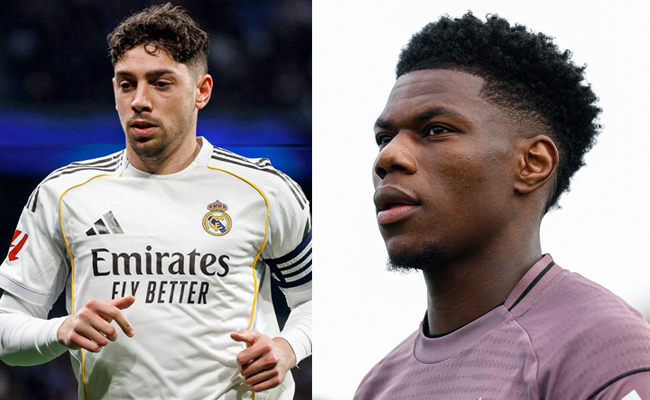
Barcelona (AP): Real Madrid slapped players Federico Valverde and Aurélien Tchouaméni with half-a-million-euro ($588,000) fines on Friday for their altercation during practice.
The massive fines came a day after the midfielders tussled when the team trained. Valverde said in a post on social media on Thursday that no punches were thrown. But Valverde knocked his head on a table and he suffered a small cut that required a brief hospital visit.
On social media, Valverde initially called it a “meaningless fight” with a teammate and said “everything has been blown out of proportion."
His employers, however, considered it a significant enough breach of team discipline to nail both Valverde and Tchouaméni with fines that bite even the bank account of a top soccer player. The half-a-million euro penalties reflect the reputational damage the club was enduring in a chaotic end to a disappointing season.
In a statement, the 15-time European champion said its disciplinary action was concluded after both players expressed to the club “their complete remorse for what happened and apologized to one another.”
Madrid added they also apologized to their teammates, the coaching staff and club supporters, as well as showing their willingness to accept whatever disciplinary action the club deemed “opportune.”
Tchouaméni was back training with Madrid on Friday, two days before they play at Barcelona in a clasico. Madrid has to win otherwise Barcelona will be crowned La Liga champion.
After being notified of the fine, he posted a public apology to the club and its fans on social media.
“What happened this week in training is unacceptable,” Tchouaméni wrote. "I say this while thinking about the example we are expected to set for young people, whether in football or at school.
“Above all, I am sorry for the image we projected of the club.”
Valverde was not at practice due to the head knock.
Both players are set to play in the World Cup next month, with Tchouaméni playing for France and Valverde for Uruguay.
Chaotic end to a poor season
===================
The run-in between the players, who for seasons have played side by side in Madrid's midfield, came after they argued this week in previous training sessions. But tempers boiled over on Thursday. Spanish media was rife with reports that the players previously disagreed over the club's decision to let coach Xabi Alonso go after just months on the job.
It was not the only altercation involving Madrid players during training this week. Álvaro Carreras confirmed he was in a “minor” incident with a teammate. Spanish media said he and fellow defender Antonio Rüdiger got into a scuffle.
Álvaro Arbeloa, the coach who was promoted from Madrid's reserve team when Alonso was fired in January, will face tough questions on what went wrong inside the changing room when he gives a press conference on Saturday ahead of the clasico at Camp Nou.
Madrid is facing a second consecutive campaign without a major trophy amid rumors in the Spanish media that club president Florentino Pérez is considering bringing back Jose Mourinho to straighten out his underperforming team.